Slow Boat to Amsterdam: a Sailing Diary

DSC_0543 - Copy

In the summer of 2012, I worked a passage from Stavanger to Amsterdam on the Dutch tall ship, Wylde Swan. I kept this diary, of sorts, with the idea of writing it up into a feature, which never happened: 

Thursday, 30th August

Arrive in Stavanger in the late afternoon. Blustery day. Call up the number and they come to collect me in the tender and take me out to the ship, which is moored off a small island. Dutch skipper, German mate, Danish engineer, German cook.

The Swan was originally a steamship, built in 1920, on a German flag. It was a herring boat, built for speed. A Dutch outfit bought the hulk in the Noughties and refitted it as a two-mast topsail schooner – biggest in the world, apparently.

More of the crew arrive in the evening, two Dutch, one British (but born in the Netherlands).

DSC_0774

Friday, 31st August

Bright and sunny in the morning. Not sailing until evening so get the tender into Stavanger, look round, take photos, get lunch.

Back to the ship. Three more crew aboard, one German, two Dutch.

Sail around 5pm.

I’m on the 1pm-8pm and 1am-6am watch, so I’m on straight away. Weigh anchor. Slip out of harbour. Stop alongside another ship for the last crew member (Norwegian) to jump aboard. Get a couple of stay sails up. South, south, south…

Can’t sleep. Read until midnight. Shaken awake at 12.30. Back to work.

DSC_0757

Saturday, 1st September

Still heading south. Up on the roof at 4am sweating a sail down, gathering and tying. Trimming and tidying; hauling ropes and cranking winches.

Sailing ships are incredibly noisy things: banging and clanking, creaking and groaning. The wind howls across the deck, slapping hard against the sails. It means I can shout and swear when I repeatedly make a mess of coiling a sheet, and nobody hears me.

The sun is coming up and I want to stay and watch it, but I want to sleep more. It comes easily this time.

Ship pitching heavily when my next watch starts at 1pm. A few of the crew are seasick. But it’s a dull watch. Not much to do. A couple of sails up, a tack, but mostly pootling along on the motor. Cloudy and cold but no rain.

I stare out to sea for hours. It sounds dull but it’s more peaceful than anything I can remember. No rushing, no deadlines, no shouty emails.

DSC_0741

Sunday, 2nd September 

The work always seems to be in the early morning watch. Strong wind across the deck. Ship heeled right over. Deck soaked. Hard to stay upright. A few involuntary sit-downs. Stretch the safety net across the leeward side so no one goes overboard. Stay sails back up. Exhausting first two hours then quiet after that. Quiet and cold.

Only me and the watch leader still standing. Everyone else on the watch is seasick. I can understand it. The ship rolls and pitches and suddenly the horizon rears up at a 30 degree angle. But thankfully I don’t get seasick.

We reach Danish waters around midnight, down the coastline, past the oilfields. Rigs lit up like Harrods at Christmas. The computer shows tankers all around us but none is in sight. The watch leader shows me how to fill in the log and I do it next time.

Still cloudy at lunchtime. The last watch put up the jibs and top sail. It looks more like a tall ship should now. No mainsail though. It takes 10 men to raise it. They call it “the Bastard“.

Two thirds of the way down the Danish coast by 2pm, heading for Germany. I belatedly hoist down the courtesy Norwegian flag. We forgot about it until now. Don’t suppose it matters.

There was talk of being in Amsterdam tonight but the skipper thinks lunchtime tomorrow at best. We take it for granted now that we can be anywhere in Europe in two hours, and anywhere in the world within the day (more or less). Everyone travelled like this until a couple of generations ago. It used to take a couple of months, I think, to get to Australia.

Another quiet afternoon. Ship porpoising gently. Cruising at around 6 knots. A cruise ship going north is about the only thing I see for an hour. Not even any gulls here. The mate has resorted to cleaning the ship. Must be bored.

And then it starts drizzling.

Slight change of course to break the monotony. Re-trim. Swing on the grinder. Make a mess of coiling the sheet again. How hard can it be for fuck’s sake?

DSC_0738

Monday, 3rd September

The 1-6 watch is hard. Just as you start to get properly to sleep, some bastard wakes you up and makes you crawl from your bunk and put waterproofs on.

We are in Dutch waters now, I think. Tracking 190 degrees. Cruising at 7 knots. Busy waters here. Tankers all along the horizon.

A quiet watch. Some trimming of sails, nothing too exciting. Music and tomfoolery on the quarter deck.

Dutch coast in sight at 10 30. Sun out too. The last watch has pulled the sails down. Just motoring all the way now: into Ijmuiden, through the locks and down the canal to Amsterdam. Due in early afternoon

Sunbathing on the half deck until my watch starts; sunbathing a while longer as well. Nothing much to do.

On the outskirts of Amsterdam we monkey out on the nets round the bowsprit and pack the sail. Six of us wrestle with the bloody thing to wrap it into a sausage, get it onto the bowsprit and tie a daisy chain round it. People on the bank whip out phones to photograph us and that feels good.

We arrive around 3pm, throw fenders over the side and moor up. Climb the rigging – like something out of a movie – to lower and tie up the topsails.

 Grab my bag, say goodbyes and wander towards Dam Square.

© Richard Senior 2016

Cycling the Shimanami Kaidō

image1 (9)

I set off too late from Hiroshima, then got the wrong train, and it was going on for lunchtime when I reached Onomichi. But I decided to skip lunch because I wanted to cycle at least some of the Shimanami Kaidō between the eight islands, from Honshu to Shikoku, across the suspension bridges over the Inland Sea.

I have since read about travellers planning and training for the ride for weeks and basing their trips to Japan around it, but I am too spontaneous, too chaotic for anything like that. I had found out about the Shimanami Kaidō by chance a day or two before when looking for something else in the guidebook.

It is a 70km (43 mile) route, end to end, and my guidebook reckoned it would take somewhere around eight hours to ride, which to me seemed too pessimistic. I reckoned four or five.

IMG_2979

The rent-a-bike point was hidden in a car park but I found it eventually and chose a cheap ‘mountain bike’ over a selection of old ladies’ shopping bikes. I revised my estimate to five or six hours when I saw it, dropped my daybag into the basket and rattled along the waterfront to the ferry across the Onomichi-suido Channel. I had picked up a map of the route but it was, in any case, marked with blue and white lines on the road. It would be hard to get lost.

If I wanted my deposit back, I would have to return the bike to Onomichi before 6pm, but the deposit was only ¥1000, or £5.89. (The hire cost was half that, which made it a cheap afternoon’s entertainment.) I saw when I skim-read the back of the map that I could drop off the bike at the end, or at points along the way, and take a bus back; and that was all I needed to know, for the moment.

The bike was too low-geared to go anywhere fast, but the route was flat – or at least so it seemed after the merciless hills of northern England – and the sun was hot and it was a perfect day for cycling. The route took me through a slice of Japan which you rarely see as a tourist, neither the sleepy towns of old wooden houses, nor the bustling cities of neon-lit skyscrapers, just workaday hamlets with a few houses and shops, a filling station, then nothing until a big-hammer factory, and nothing again for the next ten minutes.

IMG_2969 edit

I tracked diagonally across Mukaishima Island and came out at the waterfront and followed its contours round towards the Innoshima suspension bridge. The blue and white lines led under the bridge and round a corner and then twisted back on themselves up a steep hill which spiralled to the cycle lane of the bridge suspended beneath the roadway.

Two hours in, I had worked across Innoshima Island and traversed the Ikushi Bridge, with orchids lining the approach road and big barges trundling underneath and the sun glinting off the water. I was on the fourth island of eight and seemed to be making good time.

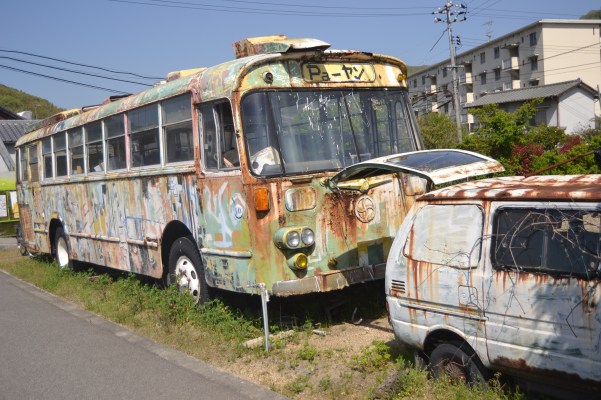
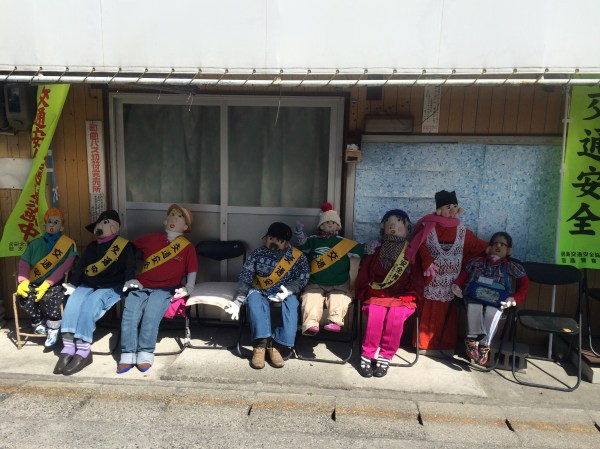
There is apparently a temple worth seeing on Ikuchijima Island but I was too focussed to detour to it, and in any case I had been to Nikkō, Nara and Kyoto already on that trip and would not feel cheated if I never saw another temple. There were, as well, a few curiosities at the side of the road: an old bus in faded psychedelic paint in the style of Ken Kesey’s Furthur and a group of life-size dummies seated in a row as if they were waiting for a bus.

DSC_0837

It took me somewhere around an hour to get to the next bridge, 36 kilometres from Onomichi, a little over half way to Imabari. I had, it seemed, been wildly optimistic to think that I could finish the route in four hours but about right with the more conservative six. I was not sure why the guidebook thought you needed eight, but then the map said eight to ten and I have since read that some travellers spread the ride over a couple of days.

I could still, just about, have turned the bike round and headed back to Honshu before the rent-a-bike terminal closed, but I was enjoying myself too much for that. The other terminals, I saw when I read the back of the map properly, closed at 5pm. There was an outside chance that I could get all the way to Imabari on the edge of Shikoku and find the terminal in time, but it was no more than an outside chance.

There were three other terminals along the way, so there was no need to give up just yet. It was a lovely ride along the waterfront on Omishima Island and across the arched bridge to Hakatajima, where I caught up with a group of serious cyclists with sprayed-on lycra and bikes made from carbon fibre and fresh air and passed a couple of them; but there was too much face to be lost in being overtaken by a tourist in street clothes on a pig-iron mountain bike, so they clunked down a gear and streaked past me.

IMG_2976

I decided as I snaked through the national park to the west of Hakatajima Island to drop off the bike at the next terminal, just before the Hakata-Oshima suspension bridge, the last but one before Imabari. I only had 20km left to ride to the end of the route, and plenty of energy, but by then it was clearly too late to get there before 5pm.

I imagined the bus interchange to be a big building with helpful things like timetables and an information desk, but it was actually just a turning circle with a few wooden shelters. There was no one else around. In a few of the shelters, there were photocopied sheets with bus times on them but the destinations – naturally – were only in Japanese. The last bus going anywhere seemed to be at half-past five.

At somewhere around twenty-past, a bus pulled in but the driver denied that he was going to Onomichi.

IMG_2975

Of course I had no contingency plan and I thought I would be lucky even to find an English-speaker within reasonable walking distance, let alone a hotel or a taxi firm. If it came to it, I supposed I would just have to walk back to Honshu.

But then, at something to six, the bus turned up.

© Richard Senior 2016