Learning to Love Osaka

DSC_0092

Osaka, at first glance, is a hard city to love. It seems to be 140 square miles of concrete, sardine-packed with tower blocks and criss-crossed with flyovers.

But the cherry blossoms along the Ō-kawa River temper the brutality of the concrete. The river parts and flows either side of Nakanoshima island, where the first mile or so has been landscaped and turned into a public park. It is a tranquil spot, lovely to walk through with a gentle breeze blowing off the river, and as you gaze at the lawns and the trees and the rose gardens, you might not even notice that the island is hemmed in by soulless office blocks.

Beyond the park, there is a hint of what Osaka might have looked like before the War in the 1912 Central Public Hall with its red and grey brick, stained glass and cupolas and the 1904 Prefectural Library with its monumental steps and columns.

DSC_1160

The classical castle nearby was rebuilt in the twentieth century, but then so were most of the castles in Japan; if they were not burned down in the tumult of the Meiji Restoration, they were flattened in World War II. It is still impressive to see, and worth paying to go in for the museum with its samurai swords and suits of armour, screens and fans, woodcut prints and ancient scrolls, and the panoramic view from the top.

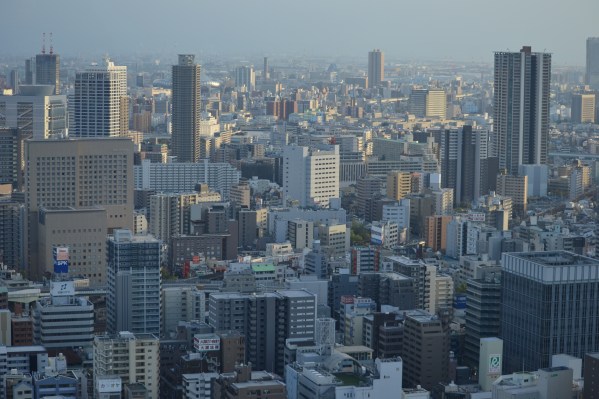
The Umeda Sky Building is the high-tech, modernist equivalent of the castle, designed, like it, to dominate its neighbourhood, to awe and intimidate, to exude power and wealth; and it has the best views in town. The lift scoots you almost to the top, then an elevator takes you through plate glass nothingness to the roof.

To the south and east, Osaka seems everlasting with office and apartment blocks fading to infinity. To the north, they are interrupted only by the broad expanse of the Yodo River, emptying out into the bay to the west.
DSC_0015

At night, a million squares and circles of light glow in the windows, yellow lights swirl at street level, red lights pulsate on the rooftops, neon hoardings shimmer in blues and reds and greens, and the spokes of the giant Ferris wheel out on the harbour glow orange if the next day is set to be sunny, green if cloudy and blue if it is going to rain.

Amerika-mura (American village) got its name from shops selling second-hand Levis and Zippos and trades on it with Uncle Sam and Statue of Liberty models bursting from shop fronts and local interpretations of American fast food.

The vintage shops and street style stores blast J-Pop from the doorways to deter over-25s and to try to encourage the sullen girls in clumpy shoes and over-the-knee socks and giggly boys with spiky yellow hair to look briefly away from their smartphones.

DSC_0124

A little to the east, the Shinsaibashi-Suji shopping arcade extends for a dozen blocks with all the world’s high street chains mixed up with noodle shops and pachinko* parlours, soundtracked one minute by J-Pop, the next by Vivaldi, and always  by the staff in the shops shouting irasshaimase! when customers enter and arigatou gozaimashita! when they leave.

Shoppers jostle down the street with three bags hanging off each arm, mothers propel push-chairs, teenagers snigger in unruly groups, tourists stop and whip out their selfie sticks and the crowd eddies round them. At the end of each block, a road cuts through and the honking cars surprise you.

The mall empties out by the Dōtonbori Canal, where there are monster neon adverts wrapped round the ends of the buildings. The oldest and best-known is the marathon runner, who has been advertising the Glico confectionary company since 1935.
DSC_0098

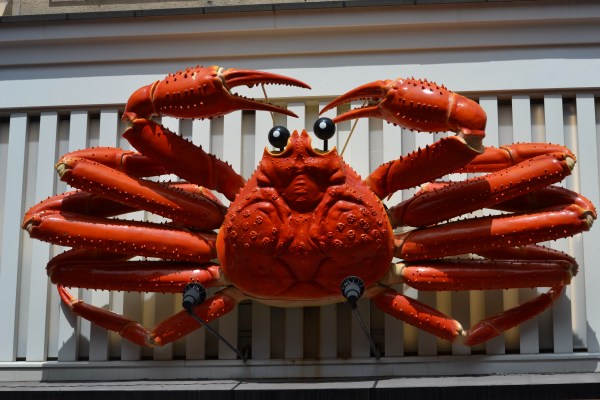
There is a crab restaurant round the corner which states its business with a massive 3D model of a spider crab above the door with claws that wave and eyeballs which extend in turn like pistons. Other restaurants along the street have taken up the theme and there are big puffer fish lanterns, an octopus, model gyoza dumplings, a giant hand holding nigiri-zushi and a life-size model cow.

There are bars and bowling alleys and amusement arcades. In the doorway of one, a salaryman, with his jacket off and sleeves rolled up, danced like your dad to the music from a game.

But just steps from all the sensory overload of Dōtonbori is a quiet corner with a temple dedicated to Fudo Myo-o, the deity of fury, where worshippers stop, pray and throw water over the diety’s statue, which is thick with moss from years of soakings.

DSC_0115

There are cobbled alleys lined by izakayas** with nothing but the traditional red paper lanterns to advertise themselves, no mechanical crabs, no illuminated puffer fish, no model cows. I ate very well in one of them, sitting at the bar watching the chef prepare the food and serve it to me on a long-handled peel like bakers use to take loaves from the oven.

Sake was once served in a small wooden box called a masu, but the practice fell out of fashion. Izakayas, though, sometimes put a glass inside the masu and let the sake overflow into it to show how generous their measures are. Here, the chef, who was also the barman, carried on pouring until first the glass and then the masu overflowed.

I had misjudged Osaka. The ugliness I saw at first was nothing like as all-pervasive as I feared. While it is no Kyoto, it has a sprinkling of traditional sights, and a whole lot more which could not be reduced to items on a list of Top Things to See…, but which is rewarding to see nonetheless. Above all, though, it has an infectious joie de vivre which I never saw matched as I travelled through Japan.

© Richard Senior 2016

*Japanese pinball

**Bars which sell food – loosely like Spanish tapas bars
Camel Train to the Sahara

DSC_0996

How are you, my friend?”

“I’m very good, thank you. And you?”

“Very good. Insh’Allah. First time on camel?”

“Yeah. I’ve ridden elephants, though.

“Camel is different.”

“Of course. No trunk, right?”

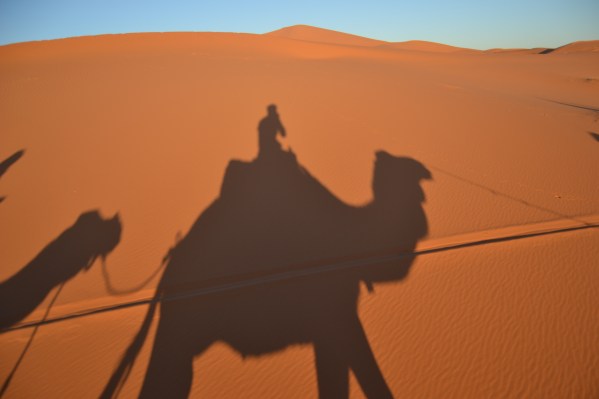
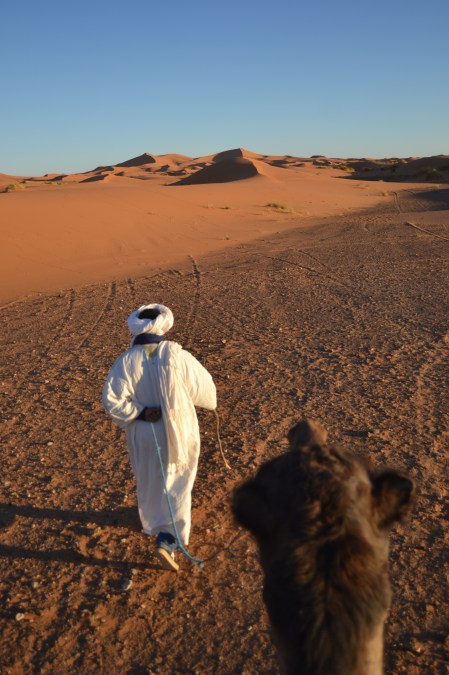
There is an art to getting on a camel. No one told me what it was. I got on like a drunk trying to scale a fence. The Bedouin, then, told the camel to get up and, in three distinct movements, it thrust its head forward, extended its back legs – tipping me forward as if in a roller-coaster going over the top – then brought its front legs up to meet them.

There was a group of us – British, French, Dutch, Austrian, Canadian, Korean and Japanese – gathered from hotels, hostels and riads around Marrakesh and driven 350 miles across country to the edge of the Sahara where the road stopped abruptly and the towns thinned out to villages, then hamlets and finally to nothing but an isolated hostel and sand. The camel train would take us the rest of the way.

DSC_0998

The camels were roped together in two groups of four with a Bedouin leading each group. I had the camel at the front of the train behind a Bedouin in an ankle-length thobe and turban, and jeans and Asics trainers. He hummed to himself as he ambled through the dunes, until his smartphone rang. He was a digital nomad.

The winds had stacked, shaped, sculpted, smoothed and polished the sand into hills and valleys, peaks and troughs, soaring anything up to five hundred feet, then plunging back to the desert floor, gently undulating, and soaring up again; the ridges were sharply creased, the slopes pristine.

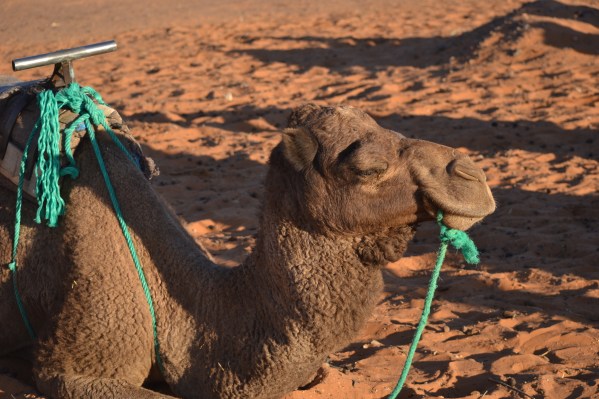
It was all the same to the camels, who plodded along with deliberate steps, never slowing, never slipping, up sinuous inclines, along knife-edge trails across the dunes, and down slopes steep enough to worry me about going over the handlebars. They have a reputation for being foul-tempered things which spit and burp and growl, but then so do some of us. These camels had a relaxed air and beatific smiles. They seemed barely to notice, let alone to care about, the strangers on their backs.

DSC_0977

The sand glowed orange in the dying sun of the late afternoon; the shadows were long and dark. We stopped at the top of a dune and looked west and watched the sun slip below the horizon, then set off again in the twilight.

It was a lot more comfortable on the camel than I imagined it would be, but my thighs eventually began to protest at constantly stretching around the saddle bags and I was glad when we got to the camp.

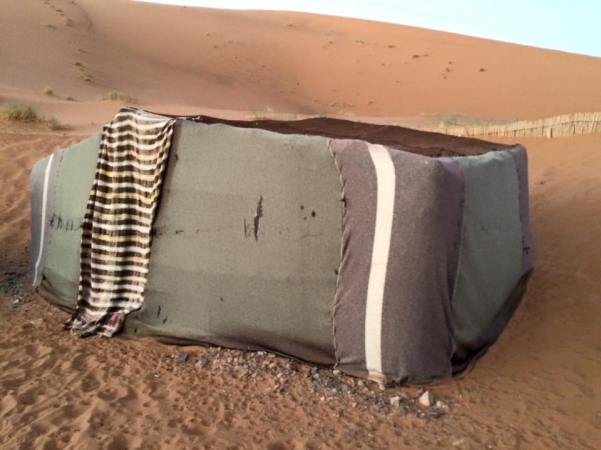
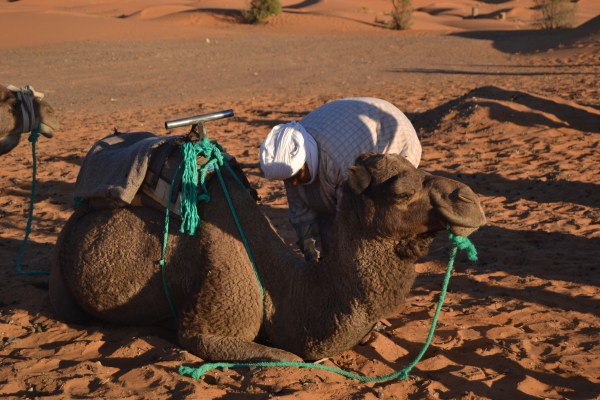
The camels sank to their knees and I got off as clumsily as I had got on. The Bedouins unloaded the saddle bags and we dumped our stuff in the tents. They were a roughly rectangular shape, flat-roofed, waist-high, with a wooden frame covered with stitched woollen blankets.

12310452_988618587864854_545520496778157623_n

There was a big communal tent, too, with flickering lanterns, low tables, Berber rugs and a family of tabby cats. The Bedouins poured out mint tea, lit a crackling camp fire and cooked a simple but perfectly good tagine. The cats noisily begged us to share it and, as always, it worked with me: they got the chicken and I had the bread and potatoes.

I had packed an overnight bag and shorts and a t-shirt to sleep in, but I am not sure where I thought I was going to find water, nor whether I really envisaged stripping off and getting ready for bed in the dark and the cold of the desert. As it was, I just laid down fully-clothed and pulled a couple of Berber rugs over me.

The cats crept into the tent in the middle of the night, or at least I assume it was them: something around that size bolted out when I got up to go to the toilet, and I didn’t want to think about what else it might be.

DSC_0986

A wind had picked up by then and howled with a quiet determination. The sky was crammed with stars. The camels were sleeping with their necks stretched out across the sand in front of them. The last embers of the fire glowed weakly.

I was perhaps an hour, as the camel plods, from the nearest hamlet but it was easy to imagine that I was hundreds of miles in any direction from human habitation, further from the modern world and all its annoyances: far from endless TV shows about forgotten celebrities and amateur property developers, interspersed with excitable adverts for products which nobody needs, from constant finger-wagging and pettifogging rules, from unsmiling one-upmanship where fun ought to be, from lives too busy for living. It was just an illusion, though.

We were back on the camels in the bitter cold dawn, hooded and gloved, to welcome the sun back up.

© Richard Senior 2016

The Uros and the Uru-Sceptics

DSC_0718

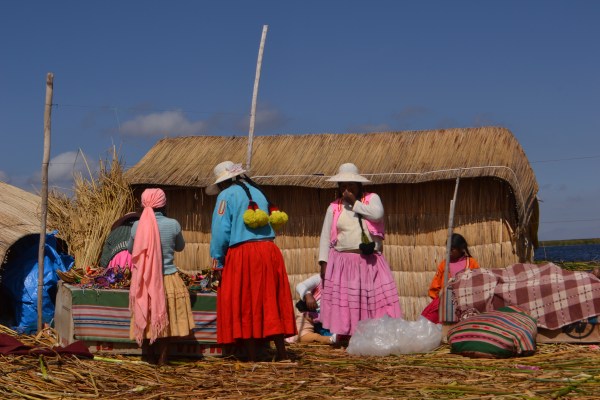
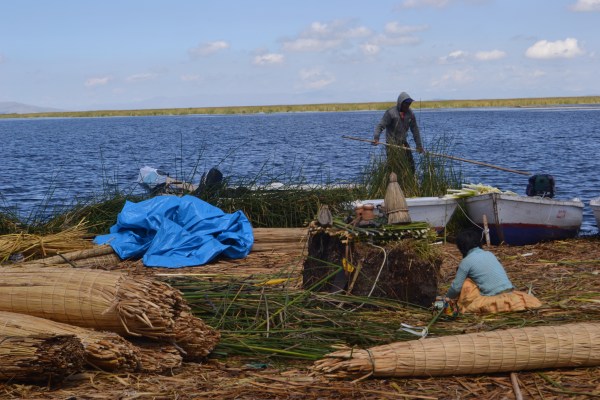
The island was made from layers of totora reeds and looked like a giant hay bale. It was one of forty-four floating islands between the reed beds on Lake Titicaca. As I stepped ashore, it sank underfoot, forcing up a puddle of water. It flexed and wobbled like a plywood sheet laid over uneven ground. Yet a few families called it home.

The Uru people have lived life their own way for hundreds of years. They fled to the lake and built the floating islands when the Aymara arrived in Southern Peru; they anchored the islands to the bed of the lake and stood ready, if attacked, to weigh anchor and row them to safety.

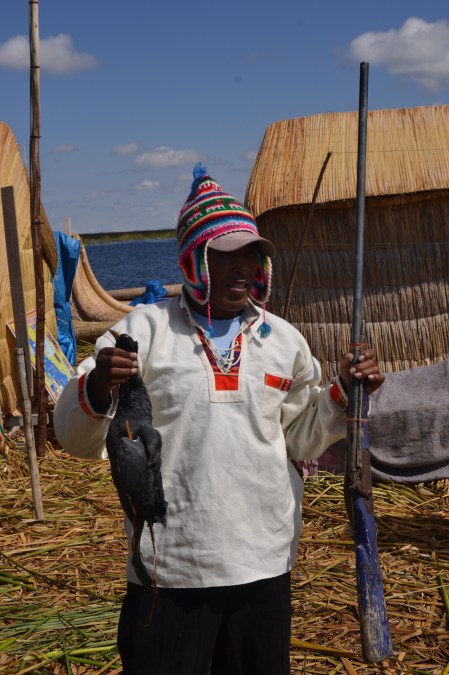
The islands rotted from the bottom up but the Uros maintained them by adding more layers of reeds. They used the same reeds to build huts and watchtowers and the white lower part as a foodstuff: they say that it works as a painkiller and hangover cure and inures them to the cold. They fished with tethered cormorants, kept ibis for eggs and hunted birds with flintlock rifles.

DSC_0738

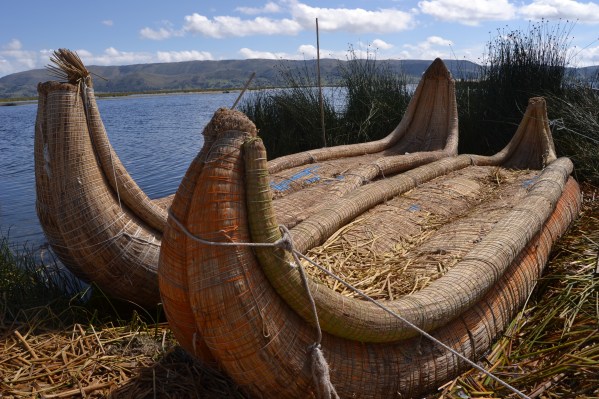
They took bundles of totora reeds to the mainland to barter and sell and, by now, you will have guessed what they made their boats from.

There are solar panels, nowadays, on some of the huts; the Uros have TVs and smartphones, and their own radio station. They have motorboats to get to the mainland, although they still build rowing boats from totora reeds – I was rowed round the islands in one. They earn money, now, by selling textiles and handicrafts to the tourists who visit the islands.

Otherwise, though, their lives seem largely unchanged in the half a millennium or so within which the Aymara where subjugated by the Incas, the Incas crushed by the Spanish, the Spanish driven out by Bolivarian rebels and independent Peru fought wars, in turn, with Colombia, Spain, Chile, Colombia again and Ecuador and went through military juntas, Maoist insurgencies and strong-armed economic reforms.

DSC_0715

Sceptics maintain that it is all a façade. They accuse the Uros of embellishing their history – if not making it up – to entertain the tourists. But wherever there are people living an alternative lifestyle, there are mainstream figures doing their best to discredit them.

With no written records until the Spanish arrived, neither the Uros nor the Uru-sceptics can prove their case; but researchers have at least established that the Uros are genetically different from other indigenous groups.

Their lifestyle, though, has been under threat since the 1980s, when the government restricted hunting and fishing on Lake Titicaca and started confiscating their eggs and birds. Then climate change caused the surface of the lake to rise dramatically and inundate the islands, and brought droughts which ravaged the tortora reeds.

DSC_0733

The Uros rebuilt their islands closer to the shore of the lake and many drifted off to live a regular life on the mainland; others have followed since. The sceptics – who obviously have too little going on in their own lives – claim that no one really lives on the floating islands anymore and that the Uros return to homes in Puno after the last tourist boat leaves.

It seems unlikely to me that they pack up their children, their birds and their cats every night and leave their televisions, solar panels and radio equipment unattended. But, whether fixed or transitory, the population of the islands has undoubtedly fallen and each generation seems a little less interested than the last in maintaining the traditional lifestyle. Tourism is now a major part of the lives of the Uros who remain on the islands, and may soon be their only reason for staying.

© Richard Senior 2016

Paterai Prison: the Best Bars in Tallinn

DSC_1420 e1

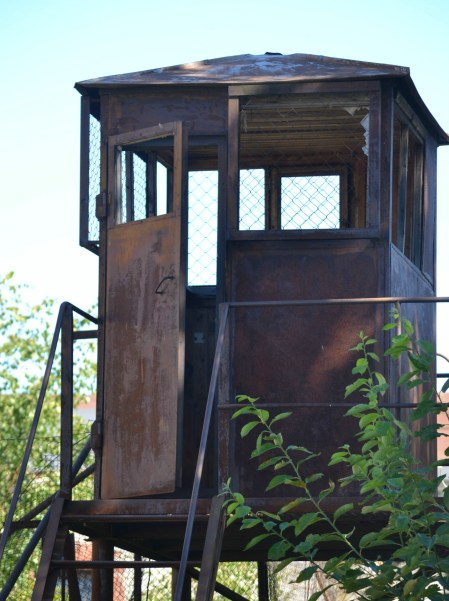
The weeds were waist-high at the foot of the watchtower; the windows were smashed, the door rusted open.

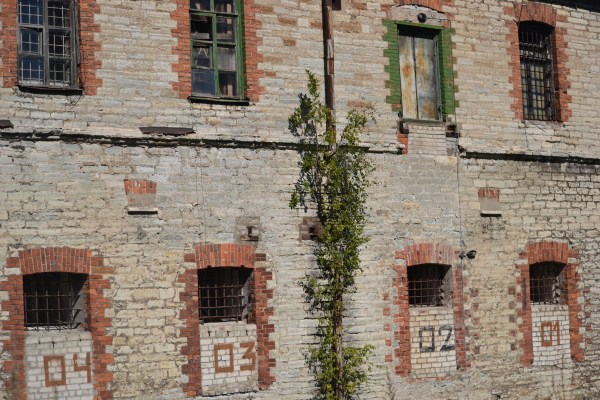
The whitewash on the main building had weathered to beige and flaked away and exposed the crumbling brick beneath. Razor wire coiled haphazardly round the edge of the roof. Windows were missing panes of glass behind the bars; some had been bricked up and a few, in what must have been administrative rooms, seemed stuck open.

Paterai Sea Fortress is a sprawling sextant-shaped building arranged – as an estate agent would say – over four floors, including the basement. It was built as a cannon battery in 1840 on the orders of the Tsar to protect the shipping lanes to St Petersburg; later it was converted into barracks, and later still to a prison. But it was long ago abandoned and left to decay.

DSC_1413

The main wing curves around the waterfront and looks out across Tallinn Bay. Two smaller wings extend from the rear and meet at a point and enclose a courtyard with standard Soviet exercise blocks, three metre squared, surrounded by walls too high to see over, open at the top, but covered with mesh. A gangway for the guards runs between them.

I had read that it was possible to arrange guided tours but instead just turned up and walked in. I doubt that I was supposed to, but the gate was open and the security guard never looked up.

There was an eerie silence in corridors which once must have echoed with the slamming of doors, the jangle of keys, the clunk of locks; sobs and screams, jeers and shouts, the thumps and squeaks of scuffles, running feet and the sickening thuds of batons swung with abandon.

IMG_3970e

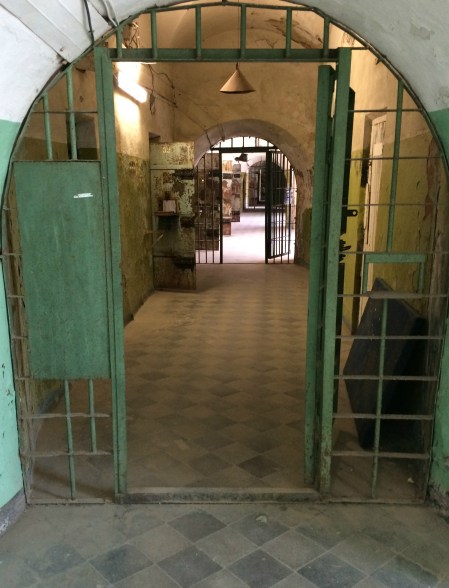
The paint was bubbling from the walls, and each accretion from each regime was visible; the chequerboard floor tiles were half-hidden under dust. A ventilation duct had burst open and its panels hung limply from the ceiling.

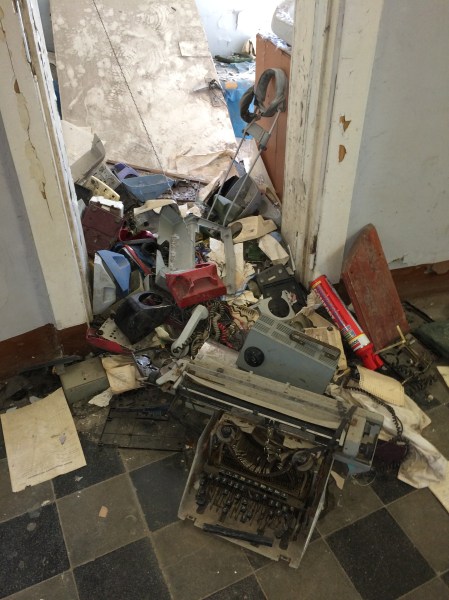
The administrative rooms had the look of being ransacked, or cleared out in a hurry by ham-fisted soldiers.  Drawers left open, doors hanging off cupboards; chairs knocked over and never picked up, the contents of files strewn across desks and over the floor. Smashed typewriters, telephones and office bric-a-brac spilling out into the corridor.

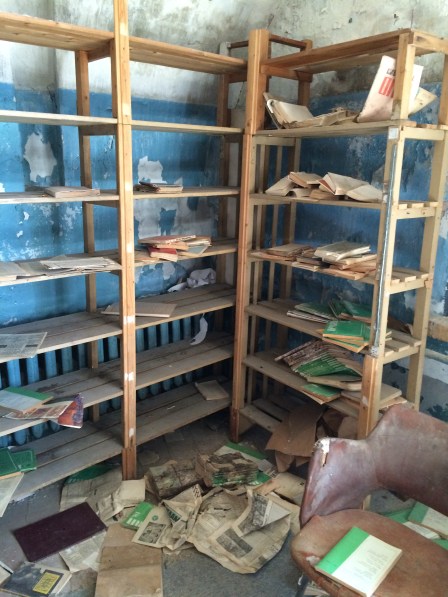
The dusty shelves in what used to be the library were bare, except for a few rows of toppled booklets, stray pages from books and screwed up newspapers with the headlines of twenty-five years ago.

IMG_3945

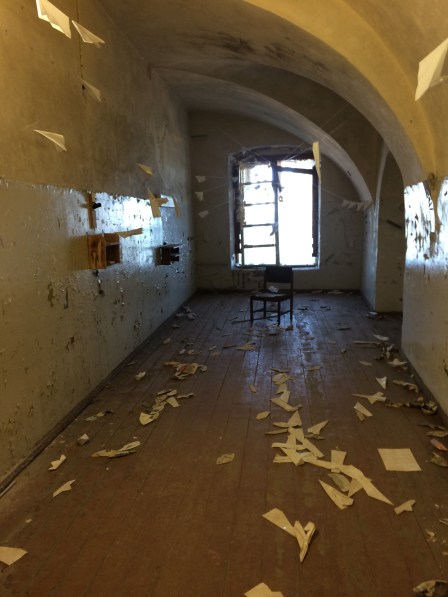
A few of the cells still had skeletal bunks squeezed in rows under vaulted ceilings – it was thirty to a cell in Soviet times. The rest were hauntingly empty, expect, perhaps, for a solitary chair and paint which had peeled from the walls in strips and covered the floor like autumn leaves.

There was nothing to stop me nosing about wherever I liked and I wandered, as if at a gallery, down each of the long, empty corridors, stepping through gates which used to seal off each section, peering into rooms never knowing what I would find inside, with only natural light spilling through windows and into the corridor through open doors, and occasionally being plunged into total darkness and having to use the torch on my phone.

One room was filled with old chairs, spewing out stuffing, upside down bunks, collapsing cupboards, more Soviet newspapers, leg braces, and the remains of a notice with a heading in Russian which my phone translated, nonsensically, as “what to do if grab”.

IMG_3968

Another room had a sink in one corner, missing its taps and stained dark brown, and a squat toilet whose walls were papered with fading pictures torn from magazines of young women who might well be grandmothers now.

The tiles in one room of the old prison hospital were still gleaming white, but the grouting around them was filthy with age and neglect and the paint, as elsewhere, was peeling away in sheets and the damp was blackening the plaster beneath.

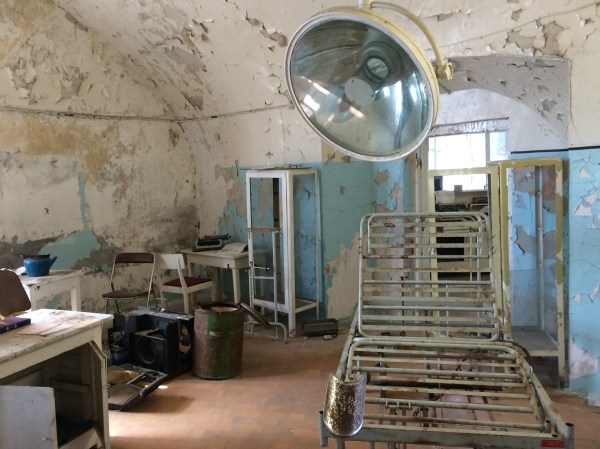
Operatory lights were still attached to the ceiling, angled at the frame of an operating table and a mottled dentist’s chair. There were big broken bottles, scattered syringes and a box marked ‘ТАБЛЕТКИ’ (pills), and cabinets and machines and tables and chairs which looked as if they belonged in a hospital bay; but there were, as well, discordant notes like a flat iron, a house brick and the rusting head of a pitchfork. It looked like conceptual art.

IMG_3950 e

It occurred to me, when I was at the far end of the corridor on the top floor, that the security guard would be likely at some point – I had no idea when – to lock the front door, shut the gate and go home for the day. It occurred to me, too, that no one knew I was inside.

Perhaps I might hear the door shut; and perhaps I might be able to run to an open window, or wrestle one open, and shout down to the security guard; but, then, this was the security guard who never noticed me going in.

I hurried a little after that, down to the claustrophobic basement where one room was filled with old bicycle wheels – surreal, but I was conditioned to the surreal by then – and out into the courtyard, where I waded through weeds to the exercise blocks, then quickly up, down and along the other wings.

IMG_3947

In a melancholy room lined with heating pipes, spotted with damp, and lit through a small, high window, there was a trapdoor in the floor and a rusted hole in the ceiling above it where a hook used to be. This, apparently, was where prisoners were hanged.

There was no way that I was going to risk spending the night among the ghosts of this bleak and silent monolith. I made for the exit and slipped out again. The security guard never looked up.

© Richard Senior 2016

Not Such a Big Night

DSC_0231

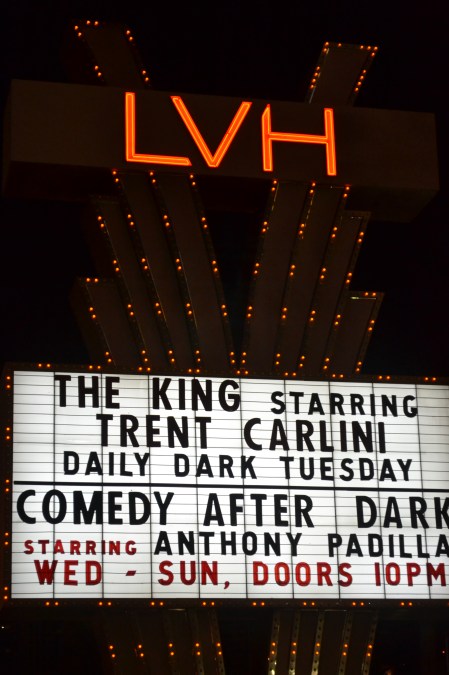
Sean Connery’s Bond scaled up the façade in Diamonds are Forever; he met Plenty O’ Toole at the craps table.

The hotel, called The Whyte House in the movie but in real life the Las Vegas Hilton, was in its prime then, in 1971. It was the biggest hotel in the world with its 30 floors and 3,000 rooms; to this day, it has the biggest sports book in Vegas.

Elvis performed at the Hilton year after year, eking out the last of his credibility. It was at the Hilton, too, that Muhammad Ali lost his heavyweight title in 1978, and Mike Tyson won his seven years later.

But nothing stays fresh for long in Las Vegas.

The LVH, as it was known when I stayed there, had long been overshadowed by the theme hotels. It is a block from the Strip, which in Vegas might be a hundred miles. But it had its own stop on the monorail and still looked impressive, if dated.

I was only there because I had got a mid-week deal with a double room for the price of a bed in a hostel. But as I stood in line in the cavernous lobby, with its marble floor and abundant staff, behind guests with designer luggage and look-how-rich-I-am watches, I felt out of place with my scruffy old backpack and started to worry that I had made a mistake and was going to be hit with a bill I could not afford.

There was no mistake, though: I had not overlooked a nought when I booked the room. More or less everything was extra and the extras were ambitiously priced, but they gave me a free credit line to try to entice me to the tables.

DSC_0044

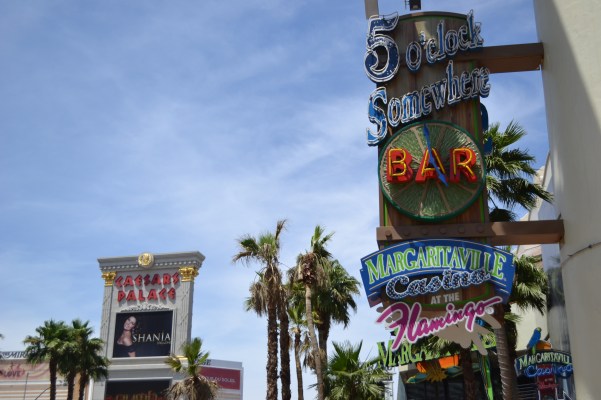
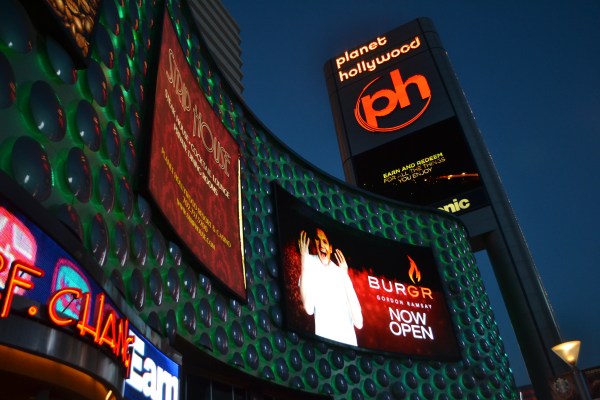
Sin City. An agglomeration of modern-day temples of Bacchus. What goes on in Vegas stays in Vegas. You can – you are strongly encouraged to – leave all restraints at the city limits, do everything to unashamed excess, indulge your favourite vices, do what you like, so long as it looks somewhere near legal.

You can get luminous cocktails in four-foot long glasses, a family-sized bottle of Jim Bean or jeroboams and upwards of Champagne. The bars stay open all night and you can drink round the clock, if you want. I saw a woman in her fifties whom I imagined to be something like a partner in a big firm of accountants walking down the Strip with a glass of red wine in the middle of the day, and a girl in her twenties so hammered she could do nothing but slump in a doorway and sway.

You can lose your shirt, in circumstances forgotten halfway down a four-foot long cocktail or at any of the 197,000 slot machines, the 231 blackjack tables and goodness-knows-how-many roulette wheels.

You can splurge at celebrity chef restaurants – three Ramsays, two Robuchons, a Guy Savoy, a Pierre Gagnaire and half a dozen Wolfgang Pucks – or go to a buffet and pile your plate as high as the Stratosphere Tower.

DSC_0076

But none of that appealed half as much as a big hotel room with a bath and a sumptuous bed. For the best part of six months, I had slept in a succession of Asian guesthouses, overnight trains, Australasian hostels, sailing boats, and a notorious budget hotel in LA. The LVH might as well have been the seven star Burj Al Arab, for me. I had not seen a bath since I left London, and looked forward to seeing one again.

I was in bed by nine, without so much as a beer or a symbolic $1 bet, and very happy about it.

© Richard Senior 2015

Being on the Market in Busan

DSC_0192

It is an imposing modern building on the waterfront in Busan in the south-eastern corner of Korea. The sides are green plate glass; the roof is swooping steel and evokes a flock of gulls in flight. The ground floor is the main hall of the Jagalchi Fish Market, the biggest in South Korea. Above it are six floors of restaurants, below it a two-storey car park.

Casual visitors browse the stalls alongside the trade buyers; they choose their fish and take it upstairs to one of the restaurants, where the chef will gut it, skin it, slice it and send it back to them raw with half a dozen side dishes. This is hoe, South Korea’s answer to sashimi.

The market spills out into the surrounding streets and extends for several blocks. The first world slickness of the main building disappears outside, where the stalls have all the picturesque chaos of a traditional Asian street market.

DSC_0212

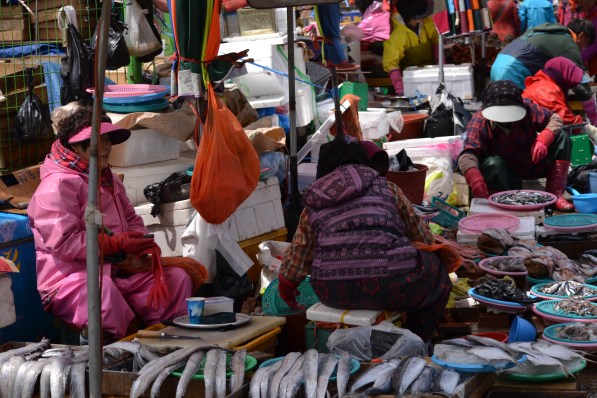
A man sits on an upturned crate, his face hidden behind a wide-brimmed hat, gutting and salting mackerel. Formidable ladies in visors and wellingtons squat at stalls under colourful umbrellas either side of the lanes. Behind them are haphazard piles of Styrofoam boxes, plastic bowls, carrier bags and filleting knives.

There are fish laid out on plastic sheets draped over planks balanced on buckets: grey mullet, red snapper, flounder, porgy, halibut, shark. There are octopus kept alive in bowls of percolating water; and baskets of fish heads; and every sort of seafood: shrimps, prawns, mussels, clams, sea cucumbers, abalones, sea snails, occasionally squirting jets of water at passers-by like kids with water pistols. There are stacks of jars with baby crabs fermented in chilli paste; and racks of dried squid; and bowls of seaweed, and bottles of chilli sauce.

Shoppers amble up and down the lanes, stopping to look a fish in the eye, peel back its gills, open its cavity, question the woman on the stall. Sometimes a scooter bullies its way noisily through the crowd.

DSC_0208

There are seafood restaurants, where the stalls peter out, with little rooms inside and big tanks outside, piled high with spider crabs and lobster, or a writhing mass of eels. It is rare to find English spoken or written and you are reduced to pointing and guessing, but whatever you get is bound to be fresh and will probably be cheap.

Jagalchi is not – yet – a tourist attraction on the scale of Tsukiji across the Sea of Japan in Tokyo, much as the tourist board tries to talk it up. It is just as rewarding; but no one important, as of yet, has endorsed it as a Must See sight, so it never appears on bucket lists and the tourists come in twos and threes instead of by the coachload. There is no need to restrict entry to certain times or hand out English language maps at the gates or post lists of things which the visitor should refrain from doing.

I was the only Westerner there and the only visitor with a camera. The rest were just trying to buy dinner, and I was trying not to be annoying.

© Richard Senior 2015

On the Road to Chefchaouen

rsz_dsc_0403

Several companies ran buses to Chefchaouen and I assumed that I could just turn up and get a ticket. I was wrong.

I left the bus station in a bit of a daze. There was no Plan B. I am doing well if I have a Plan A. I supposed that I would have to walk back to the Medina and spend another night in Tangier.

But there was a small crowd around the grands taxis and a driver was calling out for passengers for Tetouan. It was on the way to Chefchaouen.

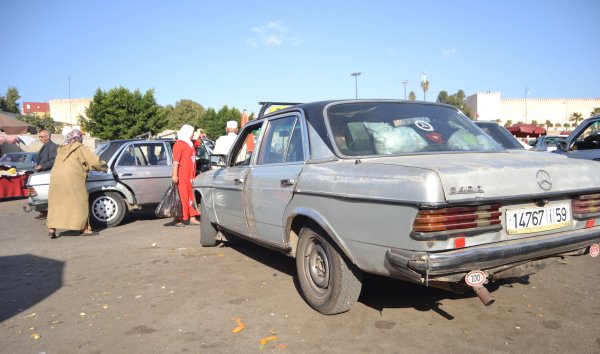
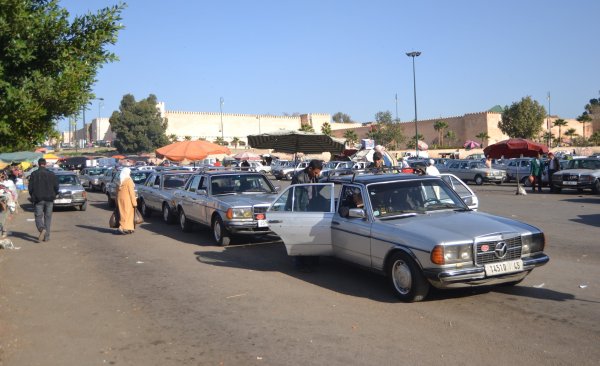
Grands taxis are everywhere in Morocco, cream in Tangier, white in Fès, silver in Meknès. They shuttle between towns the length of the country, these rumbly old Mercs from the seventies and eighties. Their suspensions sag, their bumpers droop, and there are great gobs of filler in the side; their interiors are a blend of fake leather, fake wood and real duct tape. But old Mercs never die.

You pay for a place, which is not the same thing as a seat. Two people share the front passenger seat, four squeeze into the back. Mercedes only fitted seatbelts for five, including the driver, but they never work anyway, and it is said that the drivers take it as an insult if you try to put one on.

You will wish you were wearing a seatbelt, though. The drivers push their grands taxis as hard as you can push a 2.4 diesel which has been to the moon and back twice. They use whichever side of the road is convenient, overtake where they want, and ignore the flashing lights and honking horns.

When other motorists see a grand taxi in the mirror, they take it as given that it wants to overtake. If they see that the road ahead is clear, they signal it to the taxi driver with their right-hand indicators, and if they spot something coming after he has started to pull out, they warn him with their left-hand indicators. Not that it always deters him.

I got out at the bus station in Tetouan, walked around the corner and found another line of grands taxis, this time painted in a washed-out seventies blue.

“Chaouen?” a driver asked.

“Oui.”

“Un place?”

“Oui. Et un grand sac.”

“De rien.”

That was about the limit of my French conversation.

rsz_dsc_0405

The grand taxi charged up into the Rif Mountains, through villages where people went about on donkey carts and storks nested at the top of each pylon. The slopes were thick with cannabis plants. Around half of the world’s hashish comes from Morocco, most of it from these mountains. Growing it, processing it, selling it, buying it and smoking it remain highly illegal; but it has, for centuries, been a major part of the local economy – it was legal until independence – in an otherwise poor region of a country with huge unemployment.

The sun was hot, the grand taxi was decades too old to have air-con and the winder handles (remember those?) for the back windows were missing. But the journey to Chefchaouen was short. We stopped at the Medina gate and I asked the driver where I could get a petit taxi to my hotel.

“Oui. Petits taxis, ici.”

He flagged one down, a Peugeot 205 from the early eighties with a rattly gearbox and turquoise paintjob.

Gare routière,” I tried to say to the driver. The hotel was across from the bus station.

Carre rue tiers?”

I showed him a print-off from the booking site and he puzzled over as if it were in code.

 “It’s on…. Erm…C’est…sur Avenue Al Maghreb?”

“Seize heures avez nous Alma Greb?”

A small crowd came over to laugh at the stupid foreigner.

“Parlez-vous français?” one asked.

Non. Désolé .

Well how do you know what I said then? He probably thought, and rattled something off to the driver in spirited Arabic. By his tone and gestures, it seemed to be along the lines of, “Oh, just drive him out of town and dump him there. Bloody foreigners”.

I was apprehensive, then, when the driver hurtled past a sign for the gare routière, and barrelled round a roundabout and up a boulevard, seemingly heading out of town. But it was just a taxi driver’s shortcut.

C’est combien?” I asked when he stopped outside the bus station.

Vous parlez français?” he said, with an implicit why the bloody hell didn’t you say so before?

Un petit peu,” I said, greatly overstating it.

© Richard Senior 2015

One Morning in Nuremberg

DSC_1234

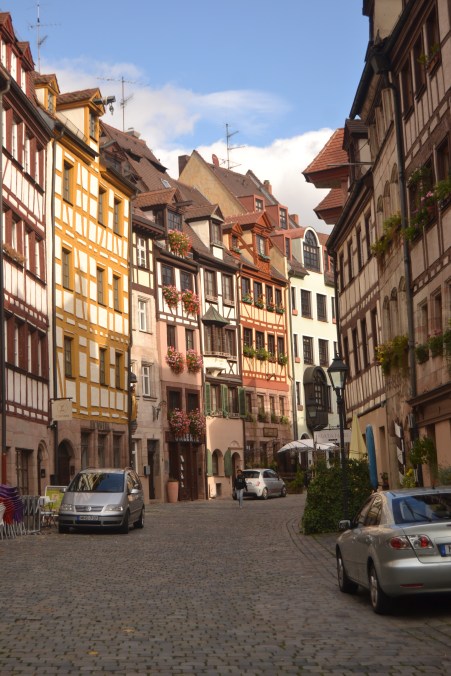
The Altstadt was quiet on that late autumn morning. It was a few weeks too early for the Christkindelmarkt, but there was a regular market with stalls, under red and white awnings, selling gingerbread, wild mushrooms and flowers.

It was a cold morning and the customers’ breath fogged in front of their faces at the bratwurst stand as the vendor grilled sausages, stuffed them in buns and slathered them in German mustard. The wind lifted the edge of the awning.

The Pegnitz River slices the old town neatly in half, St Lorenz to the south, St Sebald to the north. Each has a venerable church with twin towers imposing themselves on the skyline of spires and turrets and terracotta roofs.

There is a choice of bridges to cross the river. Several are centuries-old. Museumsbrücke leads directly into the Hauptmarkt – the main market square – and has the best view of them all. To the left, as you walk over it, is the Fleischbrücke, standing since 1598, notwithstanding the Second World War; to the right is the Heilig-Geist-Spital – Holy Spirit Hospital – built in 1339 and beautifully reflected in the river. The low arches beneath it blend into their reflection and form the shape of spectacles.

The cafes around the square across the river had optimistally put out their tables and chairs, but no one was sitting outside that day. A tour group, wrapped up in winter coats, trooped into the square and stopped in front of the Schöner Brunnen, the gilded 14th century fountain. The guide twisted the brass ring in the fence around it with a clank and a squeak and told – I assume – the story I had read in my guidebook about it bringing good luck.

Mention Nuremberg, even now, and many will immediately think of the Nazis; but its history did not begin with Hitler’s bombastic rallies, nor end with the war crimes tribunal.

In its half-timbered heyday, it was the unofficial capital of the Holy Roman Empire, the centre of the German Renaissance. Albrecht Dürer, was born and died there; his house survives as a museum. It is one of a cluster of timber-framed fachwerkhäuser in the steep cobbled streets in the lee of the castle at the top of the Aldstadt. The shops around it sell antiques, antiquarian books and, one, garden gnomes in bondage gear, as if gnomes were not creepy enough already.

There is evidently more to Nuremberg, behind the lace curtains, than gingerbread and wooden toys.

I found that again when I started walking round the old city walls and came to a sign which purported to bar the way to under-eighteens. I was puzzled, at first; but beyond it, the windows were framed with red tube lights and the street was busy with furtive middle-aged men.

More tourists appeared in the Hauptmarkt in the quarter of an hour leading up to twelve and assembled on the cobbles in front of the Frauenkirche to watch the mechanical clock. On the hour, a bell tinged, drummers mimed drumming, trumpeters jerked up their arms, and miniature electors rotated around a miniature Holy Roman Emperor.

“Oh!”said the crowd in half a dozen languages,“… Is that it?”

© Richard Senior 2015

Eating Up Vietnam #3: Hội An

DSC_0981

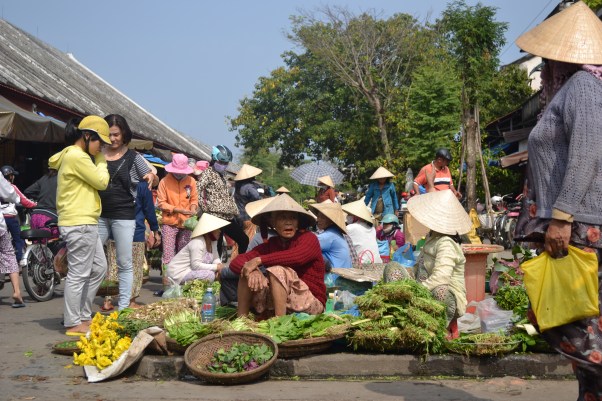
We went first to the market to pick up ingredients. Women in silk trousers and conical hats sat surrounded by baskets piled high with limes, spring onions, garlic bulbs, leafy herbs and turmeric roots. Shoppers weaved between stalls on their scooters.

Back at the cooking school, Hanh gave us each a booklet of recipes and a job to do. I started shredding the unripe papaya, Scott did the same with the carrots and Melissa assembled a dressing sauce with the familiar blend of lime juice, sugar, fish sauce, garlic and chilli.

Every country in Indochina has a take on green papaya salad. The Thai version, som tam, is well-known in the West: the others, not. Vietnam’s món gòi đu đu, is similar but simpler and lacks the conflagration of chillies. Just coat shrimps with paprika and pan-fry fleetingly, then toss with shredded papaya and carrot, mint and sesame seeds in the dressing and garnish with peanuts and onion flakes.

Once the salad was prepped, we started on gỏi cuốn, or ‘fresh’ spring rolls. It was just an assembly job after we had shredded a cucumber and carrot and squeezed the liquid from each. Soften the rice papers briefly in water, dry them off, and roll them up with the shredded vegetables, shrimps, chopped mint and onion flakes, then serve with a dipping sauce.

DSC_0968

Richard, did you say goodbye water,” said Hanh, “because the rice paper still look wet”. I stopped, patted it dry some more, and continued.

We cooked aubergines, then, with a technique more commonly used for fish. Peel, quarter and briefly deep-fry the aubergines, then roast them in a clay pot with spring onions, paprika, sugar and soy sauce until it caramelises. Garnish it with chopped coriander and serve with rice on the side.

The phở was just about ready by the time the aubergines were on the heat. We made a simplified version of this well-known noodle soup with the stock extracted from beef bones furiously boiled for twenty minutes – it is better simmered for an hour or more – with sugar, ginger, coriander, star anise and shallots. We coated a beef fillet with chilli paste and sugar and left it to marinate while the stock was cooking, then sliced it and served it with beansprouts, mint and peanuts and the stock poured over the top.

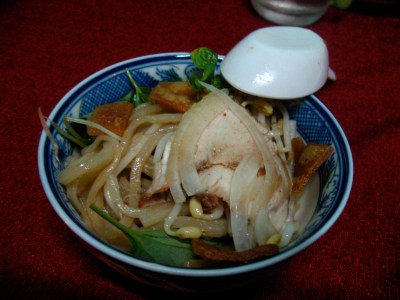
Hội An has a noodle dish of its own which I like even better than phở. Cao lầu is made with pork shoulder marinated and roasted in the Cantonese way, flat noodles, a generous handful of leafy herbs and pillows of deep fried pork rind. They will tell you in Hội An that it can only be made with water from an ancient well in the town, which is obviously not true, but I never saw it on menus elsewhere.

Cao_Lau_Hoi_An

There is a story, too, about bánh bao vac, or white rose as it is called on English menus. They say that the recipe is a secret, known only to one family which has handed it down the generations and supplies every restaurant in Hội An. It sounds to me like something they have made up for tourists. Surely any good chef could work out what was in it and try different quantities until it was right. But, again, I never saw it anywhere else but Hội An.

White rose is half a dozen rice flour dumplings, stuffed with shrimps, onions and seasoning, topped with deep-fried shallots and served with a sweet dipping sauce. They are much lighter than the Chinese-style dumplings you find all over Asia, and made me think more of tortellini. They are not exactly white and they look nothing like roses.

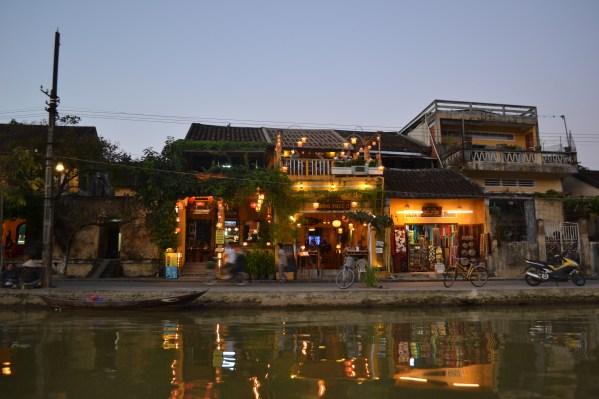
Cá kho tộ (fish in clay pot) is not a local dish. It is on menus throughout Vietnam. There are any number of variations but the basic idea is to roast snakehead fish, or similar, in a clay pot with a counter-intuitive caramel sauce. I ate it throughout Vietnam, but it was never quite as good as it was in the courtyard of a lovely restaurant overlooking the river in Hội An.

© Richard Senior 2015                     

Cao lầu image: By Dragfyre (Own work) [CC BY-SA 3.0 (http://creativecommons.org/licenses/by-sa/3.0)], via Wikimedia Commons

Why ‘Everywhere’ is Not on My List

I haven’t been everywhere, but it’s on my list” – Susan Sontag

No one has been everywhere. A lifetime is nowhere near long enough to see every city, every town, every village, every cattle station, every desert camp in the world.

For all their international summits, official visits, personal planes and unlimited funds, world leaders only ever see a fraction of the whole. President Obama has visited 53 of the 195 countries which the US State Department recognises. David Cameron has been to 47, François Hollande to 69. The Queen has managed 117 countries in 63 years; Pope John Paul II kissed the tarmac in 129.

Michael Palin has apparently been to 96 countries; ‘Nomadic’ Matt Kepnes has been to 80-odd. I know travellers who have been to upwards of 70.

But somewhere around 300 people in the world are known to have visited every sovereign state. Mike Spencer Bown is probably the most famous. He set off travelling at the traditional age of 21 and went home at the markedly un-traditional age of 44. In 23 years of hitch-hiking across war zones, living with bushmen, being frequently arrested, and funding himself by buying and selling everything from furniture to gemstones, he spent time – seemingly months and years at a stretch – in each of the 195 countries.

Spencer Bown is like a real-life version of the fictional character which so many travellers become in their stories. Few, in truth, have the balls, the single-mindedness, or the entrepreneurial nous to travel the way he did. I would not even daydream about spending the best part of a quarter of a century on the road.

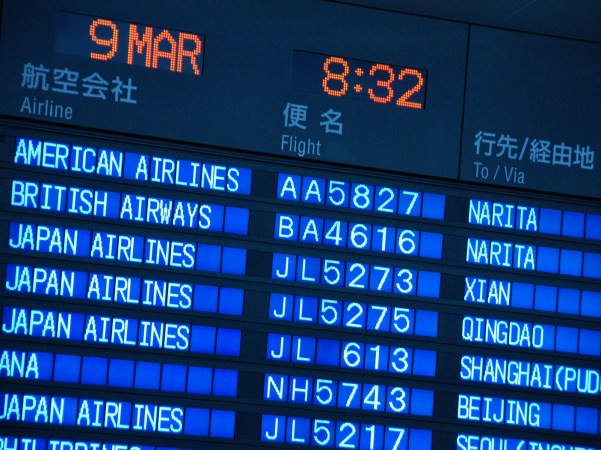
DepartureBoard_Centrair

It need not take that long, but it is far from a gap year project. A 24 year-old British guy named James Asquith travelled to 196 countries (the State Department’s list + Taiwan) over the course of five years, at the eye-watering cost of £125,000 (US$190,000) – more than, say, a school teacher would earn in the same timeframe, and far more than most 24 year-olds have seen in their lifetime.

Even if I had it, I would find it hard to justify spending that sort of money and that sort of time. But then, everywhere is not on my list.

Unless you have decades to spare, like Spencer Bown, the more places you choose to go, the less you can see of each. There is always a risk of spreading yourself too thinly.

Professor Yili Liu of Michigan University holds the record for visiting every sovereign state in the fastest time, 3 years, 6 months and 6 days. That might sound a long time, but it averages out at around six days for each nation. It would be punishing to keep up that sort of pace and – I imagine – extremely frustrating to get a tantalising glimpse of each country then hurry off to the next one.

I was in Australia for six weeks, but by the time I had worked my way up the East Coast to Cairns, I only had time to squeeze in a visit to Melbourne by taking internal flights. I had a month in each of Japan and New Zealand but it was not long enough to get right from top to bottom.  You need at least a couple of months to do justice to countries as big and diverse as China and the United States.

IMG_5264

But if you spend a month at a time in a dozen countries, a year will have gone already with 184 states still to see. Budget just a week for each of the others and you will have another three and a half years of constant travel ahead of you, and yet miss out on a lot of the day-long bus journeys through ramshackle villages, the share-taxis between towns, and the trains through epic landscapes which, for me, are half the fun of long-term travel.

When I looked at the list of nation states, I counted over eighty which hold no interest for me. The only persuasive reason to go to around half of those, it seems to me, is to be able to say that you have. I do not care about bragging rights and lack the gene which impels some people to collect. Some of the others are just too far away, too much of a hassle to get into, or too similar to places I have been already to make it seem worthwhile going. A few are too dangerous. Travellers like Spencer Bown prove that it is possible to travel through even the most lawless of failed states; but I would not get much out of it if I were constantly terrified of being murdered, caught in crossfire, or kidnapped and beheaded for a propaganda film.

There are perhaps another thirty countries which I have heard nothing but good about and which often appear on lists of places to see before you die, but just do not inspire me enough to get on a plane and go.

My travel list constantly evolves. It is an abstract list, not written down anywhere on a piece of paper, still less entered into a spreadsheet. The shortlist of countries I feel I must visit changes often but always numbers somewhere between 50 and 60. I have been to a lot of them now. There are another 10 or 20 which I hope to get to one day, but will not feel cheated if I never do.

It is a diverse list, which takes in just about every region, and includes the biggest and most populous nations and some of the smallest and least populated, island nations and city states, the very progressive and the very conservative, some of the richest and some of the poorest, countries with rainforests and countries with deserts, the peaceable and the belligerent, countries with well-preserved heritage and countries which are aggressively modern, secular countries, religious countries, most of the remaining Communist countries, flat countries and mountainous countries, hot countries and cold, the liberal and the authoritarian, agrarian countries and industrial countries.

But everywhere is not on my list.

© Richard Senior 2015

Departure board image: User: (WT-shared) 木更津乃風 at wts wikivoyage [CC BY-SA 4.0-3.0-2.5-2.0-1.0 (http://creativecommons.org/licenses/by-sa/4.0-3.0-2.5-2.0-1.0)%5D, via Wikimedia Commons