Vang Vieng: The Town Travellers Conquered

DSC_0319

I got the last seat in the minibus going to Vang Vieng. A bossy woman of somewhere around sixty sat in the front with the driver. She scolded him for using his phone at the wheel and told him to put it away, which he did, but drove the rest of the way with his foot to the floor in revenge. We barrelled through villages at motorway speeds, leaped bumps in the road and felt the g-force on the corners as the tyres screamed in panic.

When we stopped for a welcome toilet break, a young backpacker told the woman she should have kept quiet, but she said that it was the height of arrogance to tell people how to behave. Hang on a minute…everyone else thought, but kept quiet.

Sixty years after France lost its Indochinese empire, forty years after the US pulled out of Southeast Asia, travellers have recolonised this sleepy town armed with nothing more warlike than elephant print trousers and back-to-front baseball caps. They have turned it into an adventure playground.

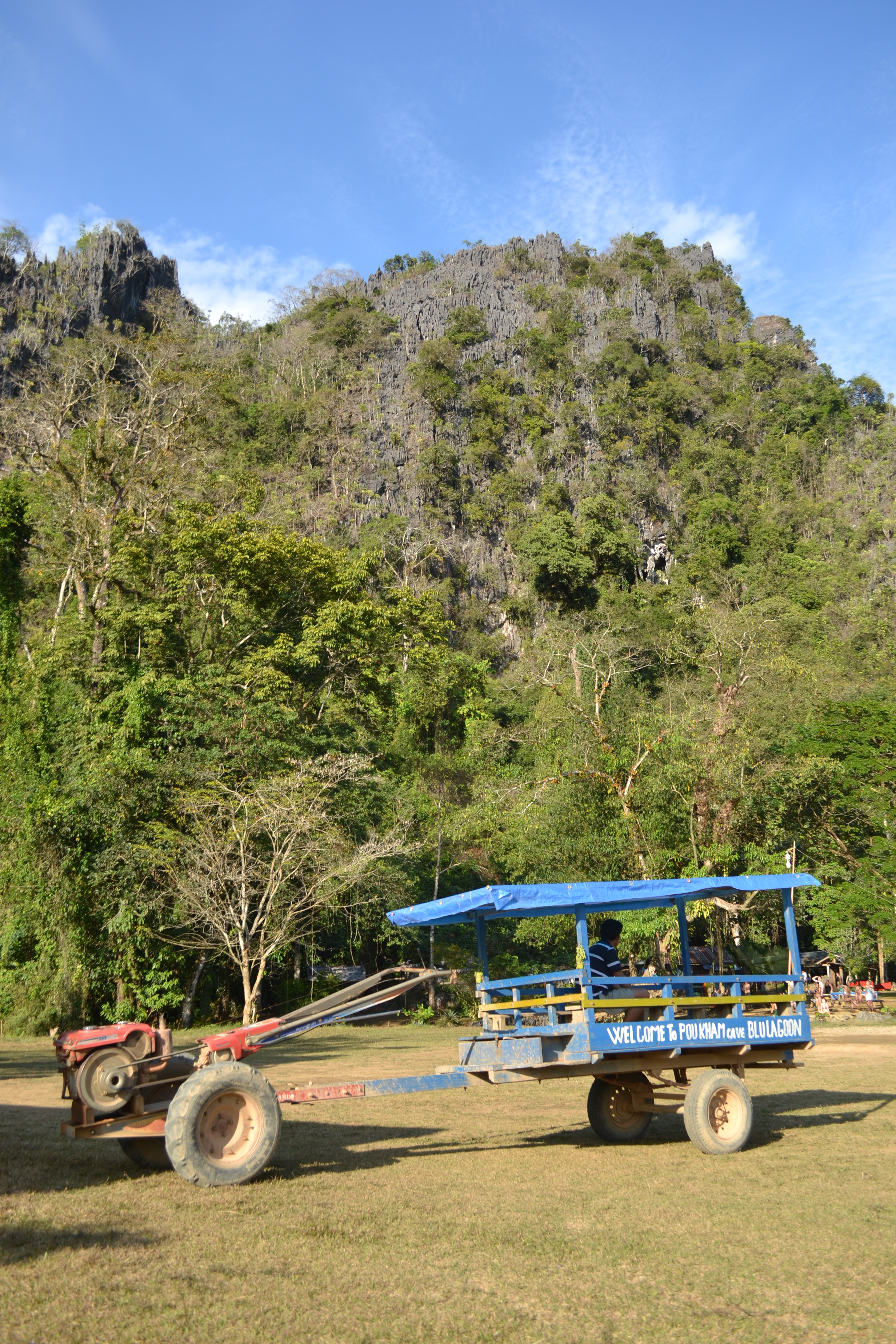
There are karsts to climb, and cave systems to explore, and the rapidly flowing Nam Song River to float along on an inner tube with a Beerlao in one hand and a joint in the other, as if relaxing on a beanbag at home. There are ‘happy shakes’ and ‘happy pizzas,’ garnished with ganja, ya ba or magic mushrooms, and bars where eating is cheating and water is for washing in and drinks are to be downed in one. And this in a nation so conservative that pop music and jeans were once illegal and sex outside marriage still is.

Every fourth building downtown is a guest house; every tenth is an internet café. The stores in between are bureaux de change, souvenir shops and places to make an “over seacall” or buy a “busticker” to the next destination. The locals shop at stores in villages way out of town or at stalls set up on the old Air America runway, unused by planes since the covert war was abandoned in the middle seventies.
DSC_0256

There is an Australian steakhouse, a French bistro, a kosher restaurant and an Irish pub, which does stews and roasts in the tropical heat, and there are dozens of places to go for a burger, or an English breakfast, and to watch an episode of Friends as you eat.

Wherever you go, there is a hubbub of British, American and Australian English, and English spoken with the accents of other rich countries. Sometimes you hear Spanish, sometimes Russian, sometimes Korean, but rarely Lao.

I am no better than the other travellers: I climbed rock faces, crawled through caves and got hammered; I would have gone tubing, as well, if I were more of a swimmer and less of a coward. But it was hard not to feel ashamed to be part of it all.

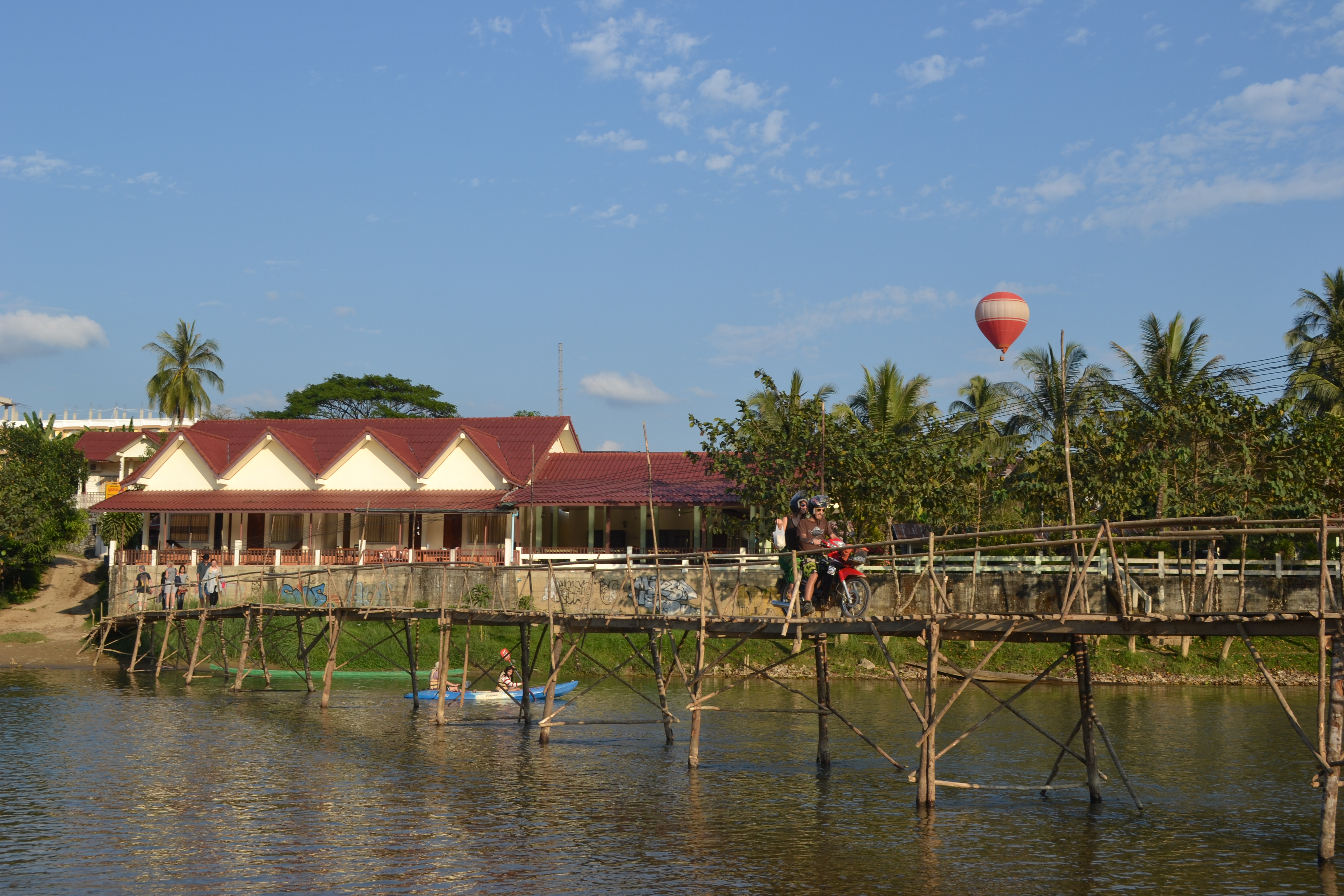
Yet, if not tourism, what? A third of Laos’ population lives on less than a dollar a day. Just the other side of the river, across the bridges of bamboo and twine which creak and wobble as you walk on them but which, nonetheless, you share with scooters and cars, it is a world away from the imported culture of Europe and North America which dominates downtown: a world of subsistence farming, of thatched huts, children running naked, women kneeling at the river beating clothes on the rocks, and bent old men pushing older carts, which past generations pushed before them.

It is a scene unchanged since long before Vang Vieng was somewhere you Must Go Before You Die, before it appeared in a profusion of odd-numbered lists, before the first travellers discovered it; before the Pathet Lao came to power, before the CIA sought to influence local wars; before the French folded Laos into their Indochinese empire; before the Burmese and Siamese invaded.

This is the real Laos. Travellers see it briefly from their rented scooters as they hurtle out to the further-flung caves.

© Richard Senior 2015
24 Hours in Paris

I arrived in Paris in the afternoon off the TGV from Bern.

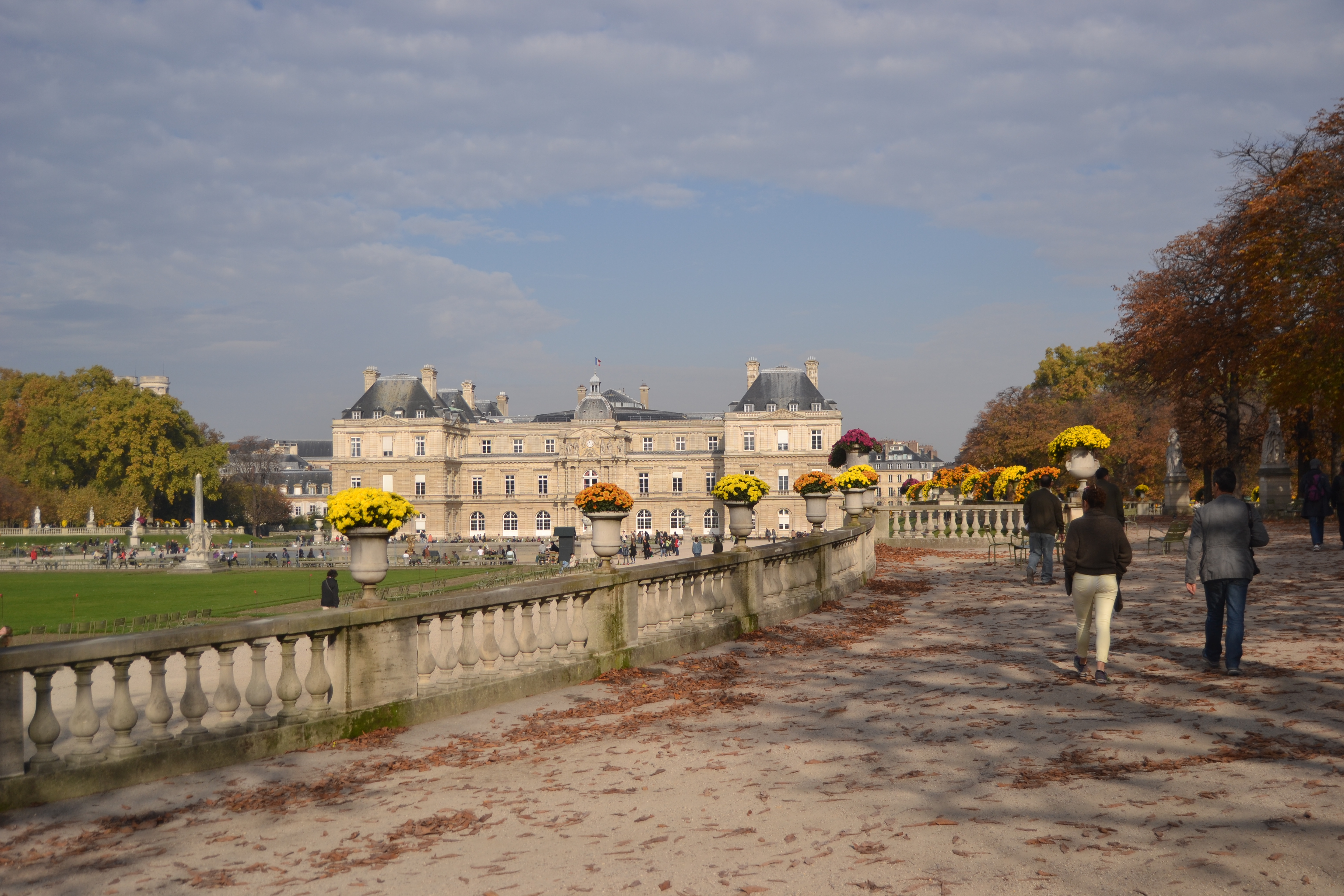
I had seen the sights on previous trips and wandered, now, as I might in London with no itinerary and no real aim, just enjoying the amble through the daily life of one of the world’s great cities. I walked down Rue Volney, hung a left into Rue des Capucines, then a right and down through Place Vendome to the Jardin des Tuileries and along the right bank to the Tower.

I crossed there and backtracked along the left bank and went to the Musée d’Orsay, where I stayed until they turned people out. I love the old Beaux-Arts station building, and the Manets, the Monets, the Van Goghs, the Cézannes, and Renoir’s Bal du Moulin de la Galette and Caillebotte’s Raboteurs de Parquet, which I had prints of on my wall as a student.

DSC_0093

I stopped for dinner at a bistro busy with a garrulous after-work crowd. There were old cycle racing posters and desilvered mirrors on the walls, and hams and saucisson hanging over the counter, and a short menu of bistro staples. I ordered one of those salads the French do so well, with a nice mix of leaves and walnuts tossed in a vinaigrette, topped with slivers of hard, sharp cheese and greedy slices of Bayonne ham, and followed that with crispy, gelatinous pieds de cochon swilled down with a carafe of red.

I had arranged to have lunch the next day with a local girl whom I knew when she lived in London, but she cried off and I had the day to myself. I was out early and walked by a different route down to the river and crossed Pont Neuf over the prow of Ile de la Cité into the old bohemian quarter to look for the places which Hemingway wrote about in A Moveable Feast and The Sun Also Rises.

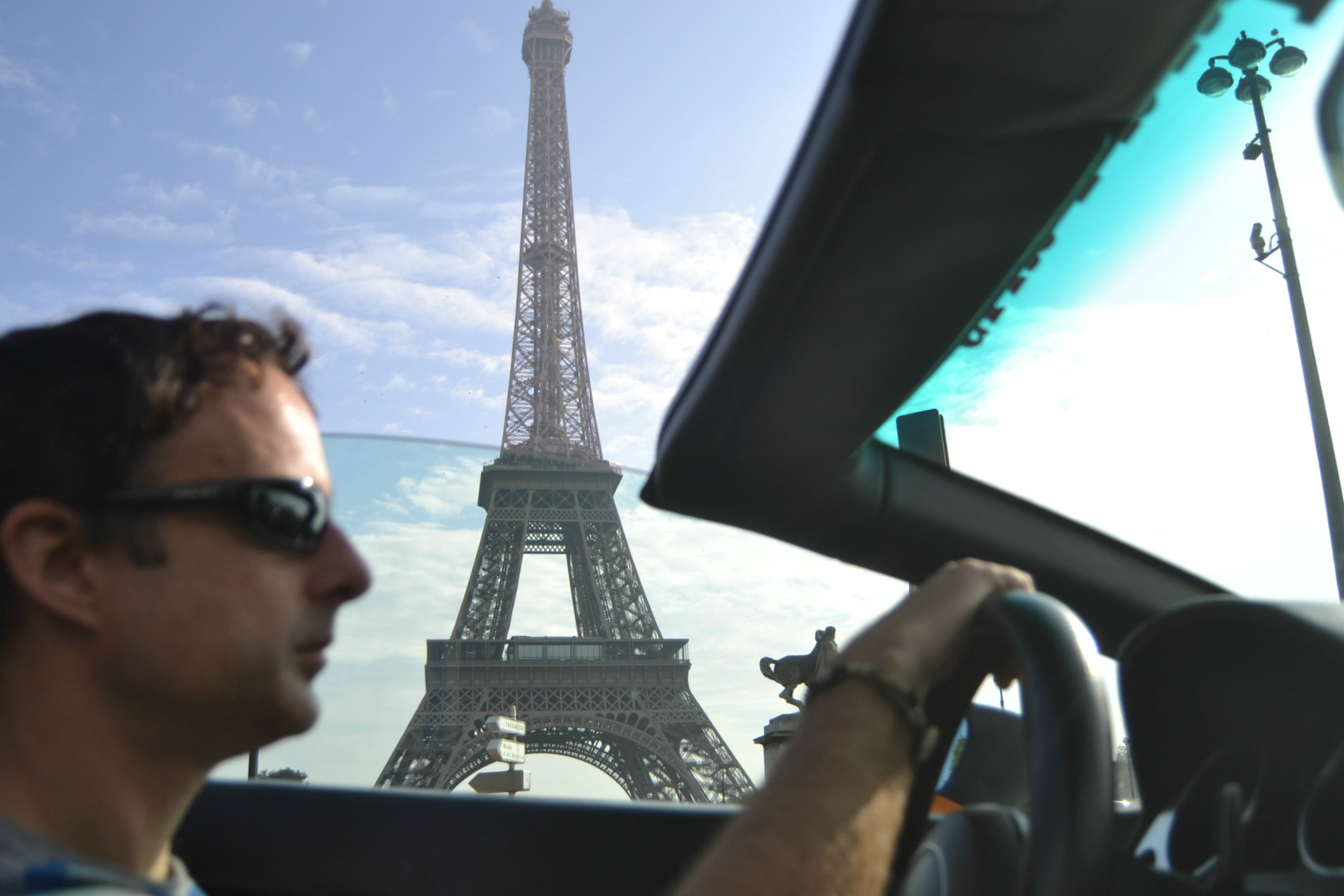
When I had done with Hemingway, I walked back up to Place de la Concorde where I had seen the Gallardo Spyder the day before with “Drive it for 89€” on the side. I guessed there would be more to it than that, but no. Show them your licence, pay them the money and sign to confirm that you have not been drinking or smoking, and it is yours for the next twenty minutes.

DSC_0121 e

I prodded the starter button and blipped the throttle and the V10 roared, and the guy directed me on a route through town which took in the big sights but avoided the worst of the traffic. Alongside the river, top down, the engine snarling behind me, then – as invited – into a tunnel and burying the accelerator in the carpet. The Gallardo streaked forward, the howling V10 reverberated off the walls of the tunnel and a motorbike in the right-hand lane was sucked back instantly into the distant past. Out into daylight, then through another tunnel, foot down again, then up to the Place de l’Étoile and down the Champs-Élysées, back to where I started.

I had just enough time, then, for a quick lunch at a bistro on the way to my hotel. It was an old, wood-panelled place with black and white photos of a bygone Paris on the walls. The husband and wife team who ran it seemed to know most of the customers well. She stayed at their tables to chat after taking their orders; he interposed now and then from the bar across the room.

Rillettes, a bavette of beef with shallot sauce and fries, a glass of red, a bottle of water and an espresso for the price of a pizza and Coke in London. I love the democratic food culture in France. Focussed women in designer suits sat a table away from bantering men in paint-spattered overalls – unthinkable in the class-bound, proudly unequal UK.

I grabbed my bags and took a bus to the Gare du Nord for the Eurostar home. The neighbourhood was no smarter than it had been when I was last there, ten years before, and I had arrived late at night and had to walk round drunks sprawled across the pavements, but it felt marginally safer in daylight.

© Richard Senior 2015

Across the Altiplano to Chile


DSC_0106

An Aymara lady muttered to herself as she laid out a blanket on the island in the middle of the road and set out the fruit which she hoped to sell to the drivers who passed by. Down the street, a door banged, a moped started and a man wobbled off to work. The rest of the town slept on.

Uyuni was 100 miles to the north; Chile was 50 miles west, or 150 south. To the east there was little but mountains for 80 or so miles until you got to another small town named San Vincente, which became unexpectedly famous a century ago when  two North Americans were shot there. Their names were Robert LeRoy Parker and Harry Longabaugh, but they are better remembered as Butch Cassidy and the Sundance Kid.

Juanito strapped the backpacks on top of the jeep, warmed the engine, kicked the tyres and bundled us in. We tracked south again, to Chile the long way round. Out of the town and onto the plain, following a river, watched by vicuñas, the patrician cousins of the plebeian llamas. In the near distance behind them, a row of adobe huts, abandoned so long ago the roofs had rotted away. In the far distance, purple mountains speckled with grass, dusted with snow.

DSC_0158

We crossed the river and drove into the hills. Herds of llamas with coloured ribbons tied into their wool as badges of ownership were the only sign that anyone lived for miles around. But further along, a dejected group of Aymara sheltered behind a rock from the sun. “They wait for the bus,” the guide said. “It comes once a week, but not always”. I am not sure whether he was joking.

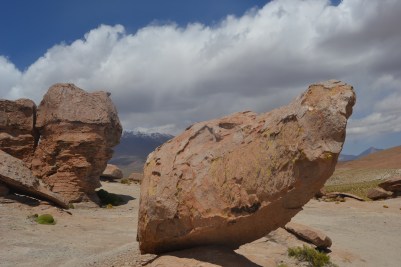
We stopped for a break near the lip of a canyon and I scrambled along to the edge of an outcrop and peered into the depths at the deep green river slithering along the base. Then on from there to a valley littered with rock formations, rising anything up to a hundred feet, pitted in places, smooth in others, patiently whittled by centuries of wind into arresting shapes. I free-climbed a few to amuse myself; but whatever I climbed a guy from another jeep climbed something higher, and put his camera on timer and photographed himself doing star jumps at the top.

We explored lakes and rock formations, spotted flamingos, vicuñas and an occasional retiring viscacha, a big rodent which looks like a rabbit with a long bushy tail. Then, with something like a hundred miles left to run, we stopped at an eco-hotel with concrete beds, visible wires, and a toilet which the wind whistled up and rattled the seat all night.

DSC_0196

The setting, though, was stunning. It was on the banks of Laguna Hedionda (which sounds better in Spanish than it does in translation as the Stinky Lake), the only building in sight. The lake was framed by mountains with folds of purple, brown and blue, and a sprinkle of snow on the highest peaks. On islets of mud and around the edges, mineral deposits left bold swathes of yellow and green over a white undercoat.

Vicuñas glanced from the banks at flamingos as they strode through mud, searching for food. There were dozens on the lake, noisily treading water as they built up the airspeed to fly, or gliding into land, cutting the power and braking hard with outstretched legs, then backtracking down the runway, or taxying along an islet awaiting clearance from the tower. I got closer to them than I imagined I would, but whenever I made a noise, the whole squadron scrambled, flew a circuit of the lake then cautiously landed back.

I had always wanted to see flamingos in the wild but, until then, had only caught a glimpse through the filthy window of a Sardinian public bus. I was very happy, until later in the evening when I had to attempt the hotel food. It was the worst I have had anywhere, ever. Even in Britain. The steak was perfectly cooked, if you wanted to use it for knocking in nails. The mash it was served with might have been okay, but I think that the top must have come off the salt when they seasoned it. I pushed my plate to the side and filled up on the hard bread which came with it.

DSC_0204

We started early again the next morning, heading south through a canyon, bumping along boulders, then racing across the Siloli Desert with a great plume of sand behind us. The sky was the same unbelievable blue as a dedicated rambler’s anorak, the sand so red it might have been the road to Uluru.

Until then, we had listened to Juanito’s CD of Andean folk songs, which were about as cheerful as Country and Western but at least added local colour. Then the guide plugged in his iPod and played Eighties pop. No one else seemed to mind, but there is little that gets me down more reliably and his playlist included all of the most cynical, saccharine tracks from that horrible decade of white BMW’s and big mobile phones; but I had my own iPod on quicker than a fireman can strap on his breathing apparatus and listened to Martin Garrix while the others had Tears for Fears, or some shit.

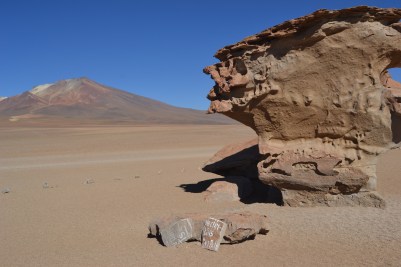
There were more rock formations in the middle of the desert, including the famous Stone Tree. With a runaway imagination, many beers and some acid you might think it looked vaguely like a tree, from a distance. If anything, it looks like a massive oyster mushroom.

DSC_0281

Minerals in the water have turned Laguna Colorado the colour of tinned tomato soup. A flurry of flamingos came to feast on the algae, pink against rusty red. They and the mountains reflected in the surface. There were volcanic rocks scattered along the banks, poking through clumps of spiky grass. The sky was still faultlessly blue. I could have stayed and gazed across the lake all morning, and I thought that I might when the guide realised that he had left his fancy altitude-sensing watch on the bonnet at the gate to the park and went off to pace the road. Incredibly enough, he found it. Then the jeep had a flat and Juanito seemingly learned on the job how to change a wheel. I was worried that the hand-tightened nuts would work loose, the wheel would come off and the jeep would end up on its roof; but I forgot about that as we pushed on across the Altiplano.

The altimeter briefly went over 5,000 metres above sea, higher than the peak of Mont Blanc, higher than the halfway point of an Everest ascent. Desert handed over to geyser field. Smoke issued from tears in the ground, mud sputtered in pools, sulphurous skid marks stained the rocks.

Juanito pointed at the distant volcano which had been growing in the centre of the windscreen for an hour. “Chile está allá,” he said, to general incomprehension. “Other side it is Chile,” the guide clarified, and raised a collective cheer.

DSC_0306

They dropped us beside a dead bus on a square of rough ground behind a hut with the national flag hanging from a rusty pole. It was the border post. A bored civil servant collected departure cards and put stamps in passports, which might have been hand-drawn on folded card for all the notice he took.

There was nothing much for half an hour, except roads that were as good as any in Europe – a novelty after Peru and Bolivia. If this were back home, the tabloids would get themselves apoplectic about the scope for immigrants to disappear across country. Even when we reached the official checkpoint, there was no barrier, no guard and little beyond your conscience to stop you driving straight through.

My preconceptions about Chile, grounded in the Pinochet era and fuelled by reading Isabel Allende, were plainly all wrong.

© Richard Senior 2015

Cappuccino with the Cats in Korea

IMG_3141

The girls at the cat café spoke no English but by pointing and miming got me to understand that I had to take my shoes off at the door and sanitise my hands.

A haughty Persian lay on the counter resting its eyes; a silver tabby stood behind it, inspecting the accounts. In the middle of the room there was an activity centre lined with soft carpet for the cats to climb on, sharpen their claws against or curl up asleep in. Next to it there was a rug for them to roll about on and cardboard boxes to play in and toy mice and things on strings for customers to dangle in front of them.

IMG_3138

Modern life is too often too busy, too cramped for pets, and cat cafes are a compromise. There are rabbit cafes as well. Maybe you would love a cat of your own but your apartment is too small, or your lease stipulates against animals, or you spend all day and half the night at the office and all your free time out of town; so you can go to the cat café, buy a drink and stroke their cats instead. They started in Taiwan, became hugely popular in Japan – where there are now owl cafes and goat cafes – and spread across Asia to the West. This one was in Busan, in the south-eastern corner of Korea.

I first heard about them sometime last year when one opened in Shoreditch and thought they were a lovely idea but worried that the cats might be exploited, or at least not get enough quiet time to themselves. But, at this café, there were places for them to go where the customers couldn’t, and the customers left them alone when they wanted to sleep or were not in the mood to be stroked. They looked healthy and happy and properly fed, neither scrawny like feral cats nor fat from over-indulgence.

rsz_img_3143

I am good with cats; they like me. I can usually persuade the toughest of toms to come and say hello. I have had them climb on my shoulders all over the world, and purr and poddle and roll on their backs to have their tummies tickled. But these Korean cats were indifferent to me, until the girl handed me a packet of fish-flavoured treats and I instantly became the most popular guy there. The little white kitten which had, until then, just wanted to curl up and sleep on the activity centre now tried to badger me into letting it eat the whole packet. But while I was feeding the kitten – far less than it wanted – a tabby climbed up my leg and meowed and gave me its best wide-eyed, heart-melting look, so I fed it as well, and then a black and white cat strolled over and muscled out the tabby.

IMG_3144

Once I had fed them all, and they grudgingly accepted that I was telling the truth when I said there were no more treats, they sat on my table or on the sofa beside me and were happy to have their paws and noses stroked. It seemed as if we were friends for life. But, being cats, they would of course have abandoned me without thought if another customer had opened a packet of fish-flavoured treats.

© Richard Senior 2015

Sunny Weather: Proceed with Extreme Caution!

iphone jan 2014 014

The sun came out in Britain this week. It was treated as a national emergency.

There were notices posted in train stations warning passengers to drink plenty of water and tell a member of staff if they started to feel unwell. The newspapers doubted whether trains would run at all, because – they predicted – the tracks would be likely to buckle in the 32⁰ heat. There was no point going by car, either, because the road surface would probably melt.

Old people were told not to go out and – in case it had not occurred to them – to try to stay cool. Ice lollies were suggested, and cold drinks. Spectators at Wimbledon were strongly advised to wear hats and use sunscreen. People everywhere slathered on factor 50, which is virtually whitening cream.

Academics were called on for learned advice as to how to survive the terrible ordeal of a sunny day. Wear wet clothes, said someone from Cambridge University, and open the windows upstairs and down. Fan your face, suggested a professor from Portsmouth University, stick your hands in cold water, take a lukewarm shower and eat curry.

Nightmare…misery…unbearable,” said the Daily Mail, although it said the same about the idea of Labour winning the election. Even the Daily Express took a break from hysterical rants about immigrants and ‘Europe’ to shout KILLER HEAT BLASTS BRITAIN. The editorial probably blamed the European Court of Human Rights.

As always in times of grave emergency – it was the same in the Second World War – ideological differences were put aside and the left-leaning BBC took the same line as the right-wing Express. “Heatwaves can have a profound effect on the body,” it declared on its website, “… it can be deadly”. It warned of the danger of heat cramps, heat rash, heat oedema, heat exhaustion and heatstroke. Symptoms, it said, include confusion and disorientation. It perhaps should have added that they are also consistent with sitting in the park all day drinking beer.

By Thursday, the crisis was over. The weather map was covered in reassuring grey clouds and double spots of rain. It was bouncing off the roof by the evening, and the relieved population went back to planning its holidays to countries where the temperature stays around 40⁰ all summer and no one thinks anything about it.

© Richard Senior 2015

Osaka’s Brave New World

DSC_0064

It was early morning. A drunk old woman puffed on a cigar and shouted at nobody. Men with straggly beards and beaten up clothes were curled up asleep on the pavement. One cuddled an empty bottle of shōchū.

The adult cinema, the blowfish restaurants and the cheap clothes stores were yet to open. They might have closed for good. But the lanterns were already – or still – illuminated at the casual kushikatsu places, selling deep-fried things on skewers. Forlorn-faced maneki neko cats waved limply to customers who did not come. Lights pulsated on the facades of the pachinko parlours; the music inside was amped-up to festival volume.

Shinsekai, it says on the signs: New World. Half was modelled on Paris, half on Coney island. What could go wrong? It was meant to show the world how forward-looking Osaka was when it was laid out in the early twentieth century and everything Western was fashionable. There was even a version of the Eiffel Tower. They called it Tsūtenkaku: the tower reaching to heaven. An ‘aerial tramway’ connected it to a Luna Park. There were Billiken statues copied from the United States. They are supposed to bring good luck.

IMG_2700 fs

But the amusement park closed in 1925. Tsūtenkaku was torn down in the War, although another was built in the Fifties. The New World grew old. There was no longer anything fashionable about it. If it suggested Paris, it was the Paris of the shabby streets around the Gare du Nord.

The entire area is squashed with small, cheap eating houses,” says the Japan National Tourist Organisation with what is presumably meant as positive spin. Shinsekai became the seediest quarter of Osaka. It was – by reputation – the most dangerous place in Japan. That is all relative, though. If Shinsekai were in London or New York, wealthy professionals would happily live there, and walk home late at night.

Everyone has heard the stories about salarymen who were made redundant in the slump of the 1990’s but kept on dressing up in their suits every morning and taking an early train to jobs they no longer had. To admit to their families and friends that they were out of work would have been too great a loss of face. Some, instead, moved to Shinsekai, where they could live in penurious anonymity. The rough sleepers with the straggly beards might well be the ambitious middle managers of twenty years ago.

It is, indeed, a New World.

© Richard Senior

Thank You for Flying with the Bangkok Helicopter

rsz_dsc_0008

It was evening rush hour in Bangkok. The offices emptied of workers and they swarmed on the transport hubs. Motorcycle taxi drivers sat in a line on their bikes at the ends of the sois. Meter cabs worked the main streets. The queues for the buses at the Victory Monument were as long and unruly as they are in London when the Tube drivers strike and there are dozens of applicants for every place on each bus.

I didn’t know which bus to catch to get back to Banglamphu, so I shuttled between stops, and forced my way to the front of each queue in the hope of finding a route map or someone who could tell me where to go; but there was never a route map and no one told me where to go, or at least not in a good way.

I waited to see if the crowds would thin out, but they swelled instead and I gave up on the idea of catching a bus and walked to the main road and flagged down a taxi. “Khao San Road?” I said, and he abruptly drove off by way of reply. The next two ignored me and drove past, and several after that already had fares, so I gave up on the idea of taking a taxi, as well.

That left what is known locally as the Bangkok helicopter: the fastest, most dangerous way to get across town. I approached a knot of drivers and interrupted their sniggering conversation and asked the one who had a spare helmet clipped to his bike if he could take me to Khao San Road. He quoted an inflated price and I tried to haggle but it was a waste of time so I agreed and got on the bike.

I asked for the helmet but he waved a dismissive arm and roared off while I tried to insist. It is illegal in Bangkok to ride without a helmet and I would have been the one to be fined if we were stopped; farangs are easy targets and assumed to be good for the money. I had more immediate anxieties, though, than the risk of being handed a fixed penalty.

I held onto my hat and bag with one hand and gripped the handle with the other. I have no idea what speed we were doing on the expressway, and nor had the driver because the speedo was broken; but it was comfortably above the speed limit. Everyone busts the speed limit in Bangkok if their cars or bikes or trucks will go fast enough. It is so widely ignored the police barely try to enforce it.

The driver kept up the speed as the streets became narrower and busier, ducking through traffic, overtaking a bus, undertaking a truck, carving up a taxi, mounting pavements, weaving to the front of queues at the lights and setting off shortly before they changed, ignoring the horn concerto which the other drivers performed. It seemed to me to be more of an adrenalin sport than a mode of transport. All it would take is a car to swap lanes without warning, a passenger to fling open a door at the lights, a pedestrian to step out between buses.

But locals, as ever, seem relaxed. It is, for them, just a convenient way to get to the office, or school. You see kids of ten or eleven on the back of motorbike taxis, and office girls side-saddle, using the time to finish their make-up. Only the cost would deter them from using the Bangkok helicopter: not the danger.

© Richard Senior 2015
If You Meet a Lion, Just Pretend Nothing Happened

rsz_dsc_0364 (1)

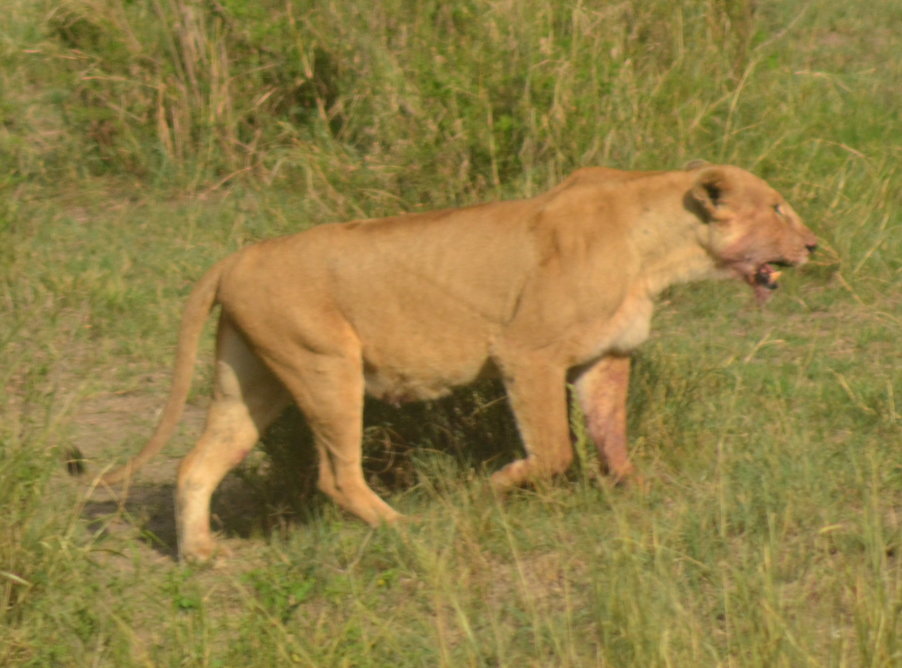
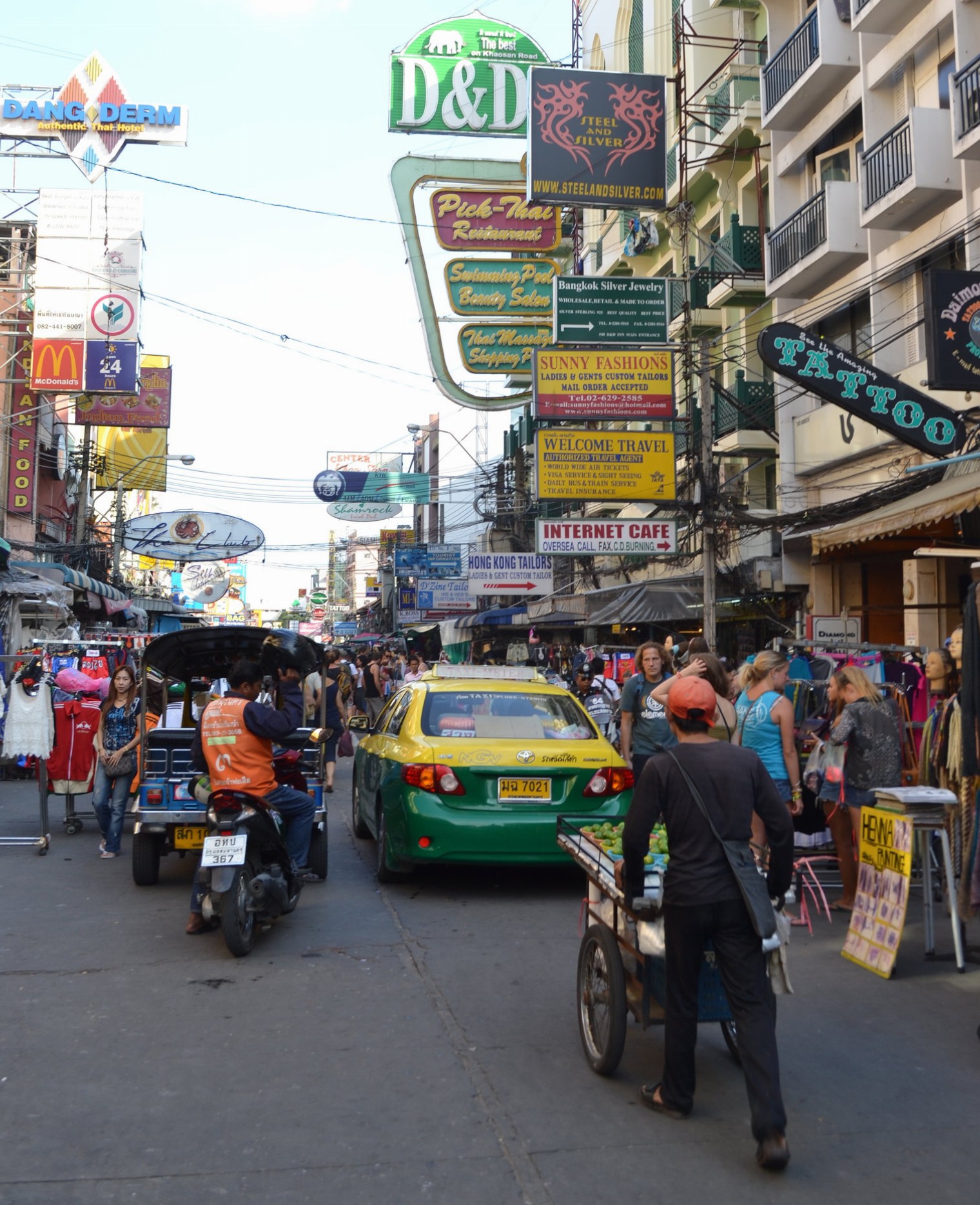
If you meet a lion on your way to the toilet block,” I was told, “whatever you do, don’t run. Only food runs. And don’t turn your back on it either. Walk slowly, back to your tent, zip it up and pretend nothing happened. Just remember that you’re not their main source of food. And make sure you have your torch with you at all times.”

“Yeah, I wouldn’t want to face a lion without it,” I said.

The Serengeti is just south of the Equator and the nearest town is hours away, and when the sun sets it just drops from the sky and the darkness is suddenly total. The piercing whistle of ten thousand cicadas stole the silence, and birds sporadically cackled and whooped as I zipped up the tent and turned in for the night.

There was nothing to stop the animals coming into the campsite, no fence, no hedge, no one ready with a tranquiliser gun, just in case. Two separate herds of elephants had wandered through that afternoon and trumpeted, stamped and flapped their ears if anyone went too close with a camera. Buffalo and wildebeest grazed around the edges. Baboons were all over the place.

Something woke me up in the middle of the night and I made the long, lonely walk to the toilet block, surrounded by the buzzing cicadas. A glow worm would have been disappointed with the light my wind-up torch gave out. The oinking grunts of the wildebeest were close at hand but they were out of sight. They sounded to be inches away. If they were nearby then, surely, so were their predators. There might have been a lion a foot from me. Remember that you’re not their main source of food. Not their main source!

Don’t run…don’t turn your back on it…walk slowly back to your tent. It is easy enough to say; but if the yellow eyes of a 400lb lion had blazed at me through the night, I would undoubtedly have turned and run, in any direction but the right one.

rsz_2dsc_0607

Baboons began barking. It is a horrible, heart-rending sound: a sound of terror, a sound of unbearable pain. Or so it seems, at least, when you hear it when out, alone, in the sinister East African night. “If the baboons are barking,” I recalled someone saying, “it means that leopards are close”. So leopards were out there somewhere, as well. The cicadas hissed, the wildebeest grunted, the baboons barked, a bird trilled, but still I saw nothing. I would not have seen anything, even if something was there. With my useless torch, I would have fallen over a leopard before I saw it.

The cicadas hissed, the wildebeest grunted, the baboons barked and something howled. Hyena? Jackal? I didn’t know what it was but quickened my step until I was all but jogging and reached the toilet block and shut the door and flicked on the light and met an enormous spider.

I got back to the tent and fell into an uneasy sleep, until I was jerked awake again by the gurgling roar of a territorial lion. I would, I supposed, get used to all this in time.

© Richard Senior 2015
Winning Entry: Wanderlust Magazine Travel Writing Competition

Wanderlust

“A Flight I’ll Never Forget (no more than 700 words)”

Down Under (and Back Over Again)

I had been thrown round the sky by an aerobatic pilot before. But it was in an aggressively capable modern aircraft, built for that sort of thing. I had been strapped down firmly with a seven-point harness and had a canopy slammed and locked into place above me. And I was twenty, then, and had no fear.

This time, I was in a Tiger Moth: a flimsy-looking, open-cockpit biplane built of fabric and wood in the Second World War to a design from the early thirties. I had nothing but a pair of straps, much like the ones on my backpack, to stop me from falling to my death. “If you fall out they can blame me,” said the pilot as he strapped me in. I was not too reassured.

The septuagenarian engine coughed hard, spat out a gobful of smoke and settled into a throbbing rhythm. We chugged across the field, then turned and accelerated along the runway. The Tiger Moth limbered into the air, like an elderly man mounting a stile, and climbed at a leisurely pace as we pottered out towards the bay. There was a wonderful view from 3,000ft over the marina at the boats at anchor and out towards the Barrier Reef.

DSC_0591

In straight and level flight, it is easy to imagine yourself back in the days of boaters and blazers and croquet on the country house lawn. But we were not there for civilised flying.

“Okay here we go
,” said the pilot over the radio, chopped the throttle and pulled the stick right back. The Tiger Moth reared up to the vertical, stood on its tail and stalled. It fell sideways with a bang, as if a wing had come off, and spun. All my senses screamed that I was going to die. I gripped the edge of the cockpit, as if that would somehow save me.

The sky, the ocean, the marina, the reef whirled round me in the confusion of a tumble down stairs as the pilot dived to build up airspeed and unstall the wings and then pulled straight up into a perfect loop. Over the top, upside down; my headphone lead flapping about in the air; the wind howling through the rigging, the sun flashing off the glass in the windshield. I looked up at the ocean and down at the sky; and we tipped right over, back round to where we had started. Then, straightaway, sideways into a barrel roll – boats sailing upside down in the sky – under and over, and the world righted once again.

Terror to elation and back again. Rolling, looping, spinning. East to west inverted, west to east right side up. The engine snarling, then abruptly cut. Just the whistling of the wind in the wires. Sky and ocean switching places again and again, until I was no longer sure which was right.

But no one can hear you scream from up there.

(c) Richard Senior

In Saigon with Graham Greene

“FOR THE THIRD time, and after two years, one was back. There seemed at first so little that had changed: in Saigon there were new traffic lights in the Rue Catinat and rather more beer bottle tops trodden into the asphalt outside the Continental Hotel and the Imperial Bar.” – Graham Greene,New Republic, 5 April 1954

Western journalists with bellies full of beer no longer crowd, shouting and giggling, into cyclos and hurry to the House of Five Hundred Girls. Grenades are not routinely flung into cafes. There are no fat Burgundians sautéing capons in butter. No jaded English reporters playing quatre cent vingt-et-un with cerebral French policemen. The casinos, the Corsicans, the cargo boats from France are all long gone. The sickly sweet smell of opium does not hang in the air. Girls in silk trousers no longer cycle to milk bars. The red flag flies, now, in place of the Tricolore.

DSC_0666

Yet there is a surprising amount left of the Saigon which Graham Greene knew when he reported from there in the dwindling days of French Indochina and distilled it into his classic novella, The Quiet American. The official name has been Ho Chi Minh City since 1975 but locals still call it Sài Gòn.

Greene’s narrator, Thomas Fowler, lived with his Vietnamese girlfriend, Phuong, in an apartment near the river on what was then rue Catinat. When the French left and Saigon became the capital of South Vietnam and rue Catinat became Đường Tự Do (Freedom Street), it filled up with brothels and drunken GI’s and fell into sleazy decline. Since reunification it has been Đường Đồng Khởi, or Total Revolution Street; but despite the name, it has gone back upmarket and has much the same character now as it had when Greene stayed there.

Fowler’s apartment is based on one in which friends of Greene’s lived in the old Saigon Palace Hotel, down-at-heel in the early Fifties but restored now to its belle époque splendour and once again a hotel, the 4-star Grand.

DSC_0768

If you take the walk which Greene often took, up and down Đồng Khởi, you will still see much of what he saw, amongst the high-rise modern blocks. Start down by the river, where Fowler watched the stevedores unloading American planes by arc light and the sailors on the pavement drinking beer, pass the Majestic Hotel, a block from the Grand.

Call in for cocktails if you like, as Greene and his character did; or go back in the early evening to watch the sun set from the rooftop bar and feel the breeze from the Sài Gòn River. Carry on up the street, past the flamboyant fin de siècle opera, which the communists renamed Municipal Theatre to make it sound more democratic, to the Continental Hotel where Greene sometimes stayed and where Fowler met Alden Pyle, the Quiet American of the title.

Pyle lived in rue Duranton (now Bùi Thị Xuân) at the other side of what is now the Culture Park with its propaganda posters and hilariously slanted accounts of the war, and worked at the American Legation at 39 Hàm Nghi, a surprisingly modest corner block, which is still there now. He was officially part of an economic aid mission, but his real job was to supply insurgents with plastic explosives to stage atrocities which could be blamed on the communists.

DSC_0763 a

Further up Đồng Khởi, beyond the Continental, is “the hideous pink cathedral” of Notre Dame and the neoclassical Central Post Office, with steelwork designed by Gustave Eiffel and maps on the walls of Saigon et ses Environs 1822 and Lignes Telagraphiques du Viet Nam et des Cambodge 1930. The mosaic of Ho Chi Minh on the far wall would be new to Greene, but he would not be surprised to see it, nor disapprove

There are surreal juxtapositions in the streets of what is now Ho Chi Minh City, District 1. The plate glass phallic symbols of the top dollar corporate world stand next to crumbling low-rise shops. Little old ladies in conical hats with yokes on their shoulders totter across the road as young men and women in this season’s fashions swarm around them on hurtling scooters. Just round the corner from Gucci and Louis Vuitton and restaurants priced for deep corporate pockets, there are street markets where everything is laid out on mats on the ground, with the meat buzzed by flies, and the fish kept alive in puddles of water, and a rat poking about nearby, which no one seems to mind. There is a timelessness amid the hectic modernity. As Fowler remarked to Pyle:

“‘If I believed in your God and another life, I’d bet my future harp against your golden crown that in five hundred years there may be no New York or London, but they’ll be growing paddy in these fields, they’ll be carrying their produce to market on long poles wearing their pointed hats. The small boys will be sitting on the buffaloes.’”

But the old Đa Kao bridge, where Pyle was murdered, was replaced in the 1980’s. The colonial block across from the Continental which appears in the 2002 movie in which Michael Caine played Fowler had gone by 2009. The Art Deco model for the rubber planter’s “so-called modern building (Paris Exhibition 1934?)” which Fowler thought about renting disappeared just last year.

The notorious Vietnamese Sûreté, whose “dreary wall….seemed to smell of urine and injustice” survives for now as offices of the Department of Culture, Sport and Tourism, with the old cells in the basement, but it is about to be pulled down to make room for a luxury hotel. Colonial buildings all over town have been left to rot since independence, with old French shop signs still faintly visible, and missing render, and tin sheets nailed onto roofs where the tiles have dropped off, and shutters hanging by one hinge. They are gradually vanishing as Vietnam develops.

DSC_0740

There are still the cyclos – Greene called them trishaws – which pedal slowly through the pages of The Quiet American, but they might not be there for long, either, because the authorities apparently want shut of them.

“There seemed at first so little that had changed”.

© Richard Senior 2015