Are You a Tourist or a Traveller… And Who Cares?

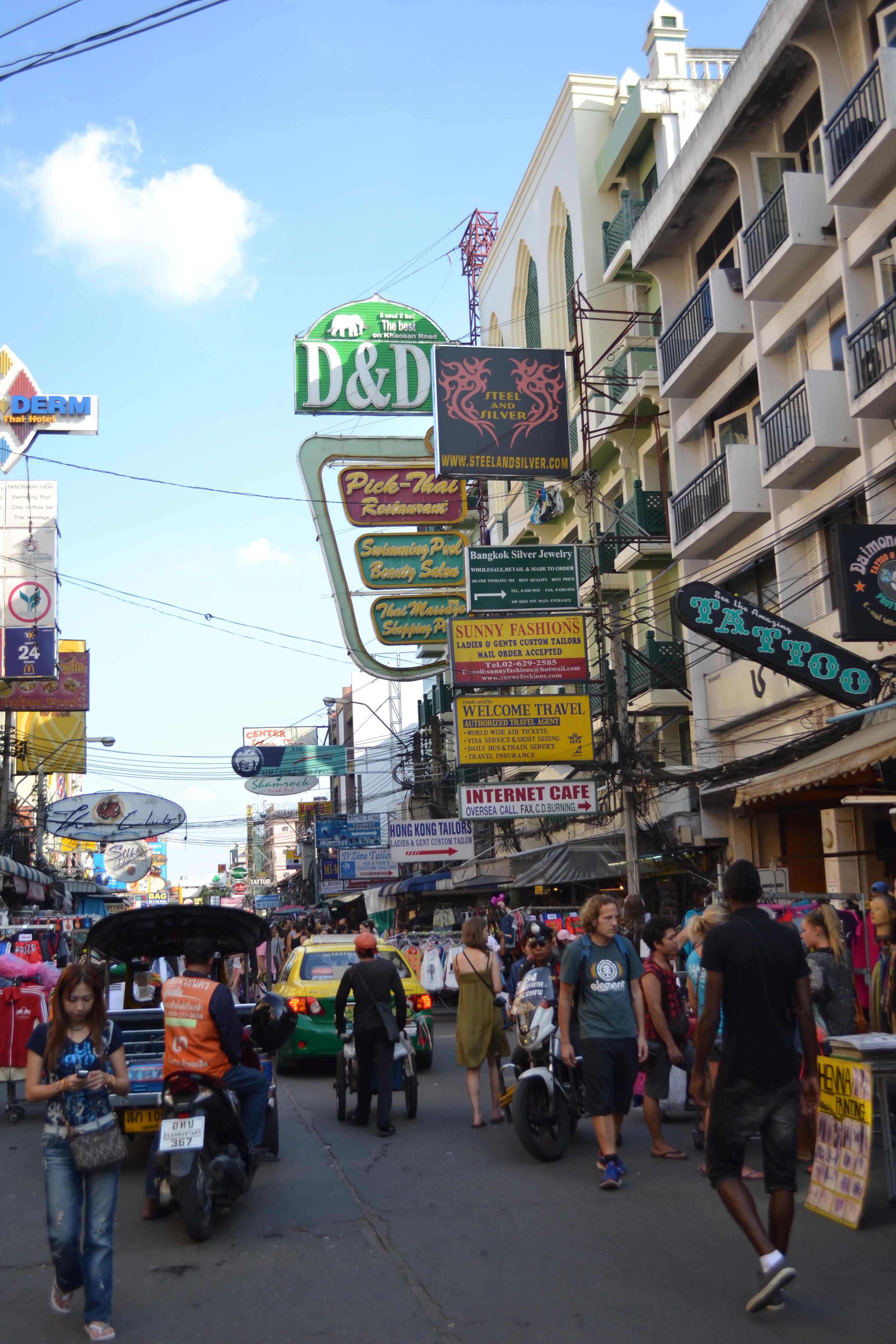
The narrator of Alex Garland’s The Beach fancies himself as a serious traveller. He is a voyeur of riots and extreme poverty and sneers at the ‘touristy’ Lower Gulf Islands. It is satire, of course, and readers will notice that he sees nothing of Thailand beyond the backpacker ghetto of Khao San Road and what amounts to a private island for young middle class Westerners.

Garland said, of the sort of travellers his book was lampooning, “These people say they aren’t tourists but travellers and think they are special, more sensitive. It’s stupid. They’re not”. The Beach set out to explode their pretensions. But, as with Wall Street and La Dolce Vita, the point is often spectacularly missed.

DSC_0077 (2)

There are numberless features exploring the supposed difference between tourists and travellers. It clearly matters a lot to some. There are graphs, there are charts, there are tables and pictograms to help you understand. There are lofty quotations from people like Chesterton: “The traveller sees what he sees, the tourist sees what he has come to see”. But almost everyone agrees with Evelyn Waugh that “the tourist is the other fellow”.

If you like being patronised, there are quizzes you can take to see which side of the line you fall; and if –heaven forbid – it turns out that you are only a tourist, WikiHow has a 9-step guide, complete with pictures, to teach you how to become a traveller.

As far as the dictionary is concerned, all of us are travellers (people who travel) and most of us are tourists (people who travel for pleasure) and I generally use the words interchangeably. But I did the quizzes out of curiosity and found that I am 80% traveller according to one, but only narrowly so according to another, and merely a tourist according to a third. None of them was interested in how much I had actually travelled or what I had learned on the way. This is a sample question:

Which do you prefer?

[   ] Having a map

[   ] Having no map

If you prefer to have a map, it suggests you are a tourist.

If you prefer not to have a map, it suggests you are bonkers.

Travellers, says one source, like WiFi connections, while tourists dislike bugs. They cancel each other out in my case. In everyone else’s too, I should think.

Travellers apparently blend in to their surroundings. They do this by wearing Chang Beer singlets in Thailand, chullo hats in South America, Masaai wraps in East Africa and hiking boots with zip-off trousers everywhere else.

DSC_0009

Travellers, we are told, immerse themselves in the local culture, so if you approach a backpacker on Khao San Road with the routine Thai greeting gin khao reu yung (have you eaten yet), he or she will respond with gin khao leauw (I have eaten already), then tell you how to make yum woon sen and start a debate about Thaksin Shinawatra.

It seems to be widely agreed that travellers are not interested in sights, and that this makes them better people. One source scoffs at “buildings of note,” while another has a go at art galleries. It must follow that the tourists who head straight for Macy’s are closer to being travellers than those who go look at Brooklyn Bridge and the Met.

DSC_0722


But there are sights and there are sights. The sort of traveller who would laugh in your face if you told him you had spent a morning at St Peter’s Basilica would insist that you need at least a week for the temples of Angkor, if not a month, a year, or several lifetimes.

Some good points are buried within all the snobbery. There is more to the world than the twenty dollar sights, and a ragtag market can be more rewarding than a world-famous cathedral. But to refuse on principle to see the big sights is surely as myopic as refusing to see anything else. If you want to learn something of the local culture – and it is not work, so no one should say that you have to – you need, for sure, to see how ordinary people live; but you need to know something of the history, the politics and religion as well, and that will take you back to the sights which appear in the guidebooks. Better just to go and see the things which interest you and skip the ones which don’t. Never mind whether the guidebooks gush or someone in a bandana scoffs.

Respecting local customs is just good manners, and recognising that things which are different from home may not be worse is about being open-minded. There is no need for an artificial distinction between tourists and travellers.

(c) Richard Senior 2014

The Kindness of Strangers

DSC_0683

I jumped out of the back of the songthaew (shared taxi) and wandered off to find a guest house. By the time I was a hundred yards down the road, and the songthaew was the other side of the island, it hit me that my daybag was still under the seat. In it were my camera, laptop, emergency funds, spare credit card and enough documents to clone me.

I flagged down another songthaew and got him to take me to the depot, where they asked me a few questions and I was out at the end of the first round:

“What was the number of the songthaew?”

“Pass.”

“Was it an Izuzu or a Hyundai?”

“Pass.”

 “What was the driver’s name?”

“Pass.”

I looked in the back of the parked songthaews, the controller phoned round the drivers, and I wrote out my contact details, but none of us expected my bag to turn up.

I felt numb as I headed back to Chaweng, checked into a guest house and dropped off what was left of my stuff. But my spirits rose a bit when I went to the beach and felt the powdery white sand underfoot, and a bit more when I sat with a Singha beer and watched the jetskiers carving up the sea and listened to the waves collapsing on the shore. Gradually, as the sun slipped down, everything twisted into focus. It’s only stuff isn’t it? I told myself.

I had an email in the morning from a girl in Moscow, who told me that her mother was on holiday on Samui and had found my bag and in it a print-out with my email address at the top. The lady spoke no English so had asked her daughter back home, who did, to get in touch with me.  I went in a taxi to a smart hotel up in the hills and retrieved my bag with everything still in it.

I had got back what I had given up as lost for good; but – more than that – I had seen human nature at its best. People might get themselves wrapped up with greed and envy, prejudice and spite; but they are capable, too, of spontaneous acts of kindness towards a perfect stranger.

(c) Richard Senior 2014

Riding History in San Francisco

DSC_0738

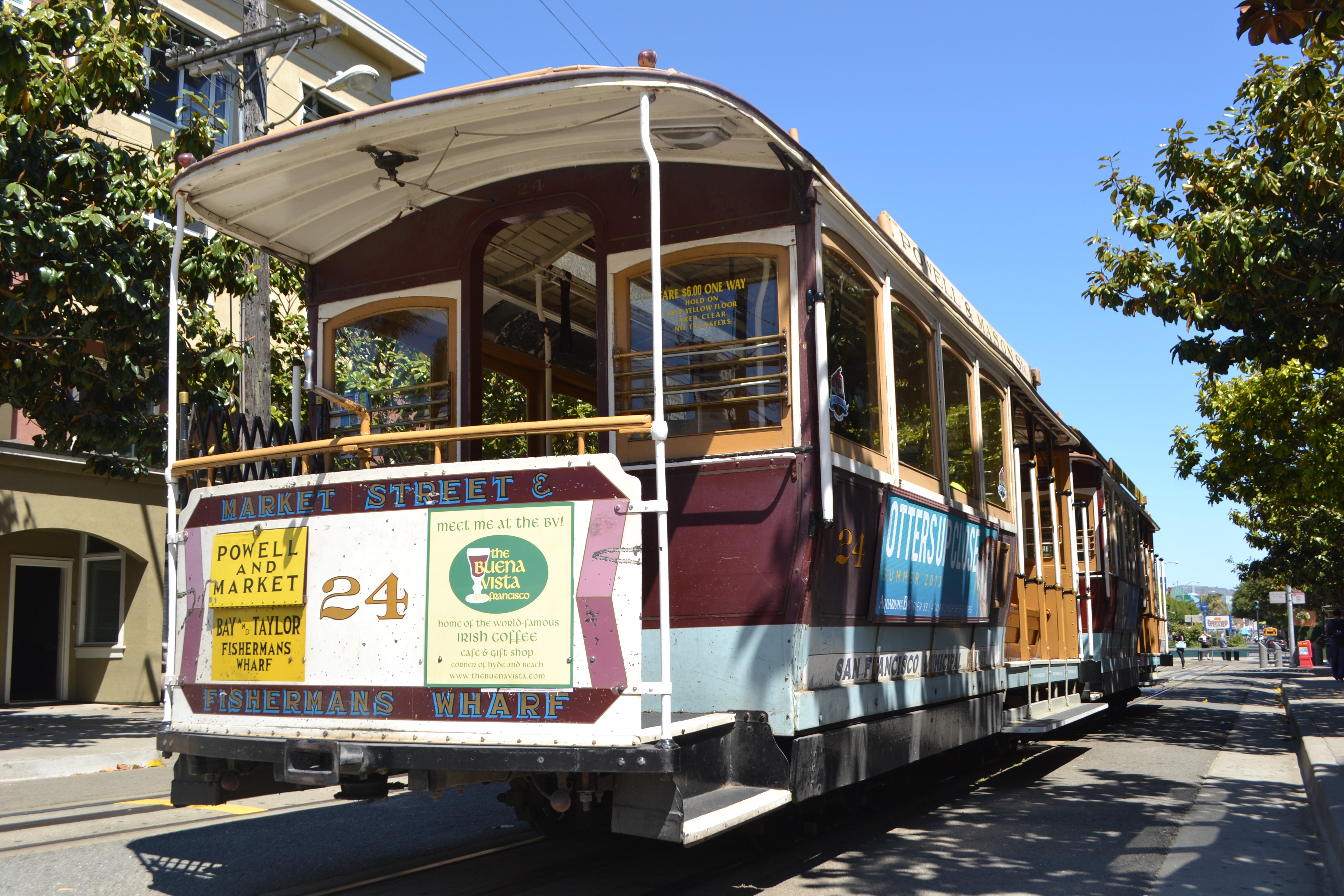
The cable cars would never have survived in Britain. The unsmiling grey people who make the important decisions would have killed them off long ago. Inefficient, an accountant would have sniffed: they need two people to operate them instead of one. Dangerous too, a health and safety officer would have added: someone could jump or fall off the platform and go under the wheels and get squashed and sue us. They would have gone to the scrappers with London’s Routemaster buses.

It almost happened in San Francisco in the late 1940’s, when the cable cars were coming up to 75 years old; but a citizen’s committee forced a referendum and won it. The cars are a National Historic Landmark now and, much as it might be a tourist cliché, few visitors leave without riding one.

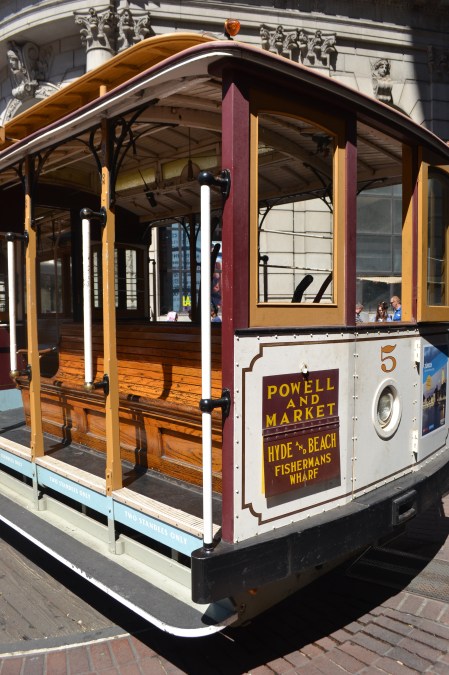
You have to wait in line for an age at the terminus up near Fisherman’s Wharf, but a car will eventually trundle down the hill and onto the wooden turntable set into the road. The stocky gripman and skinny conductor will jump out, lean against it and shove it round to face the other way. It is delightfully archaic.

DSC_0937

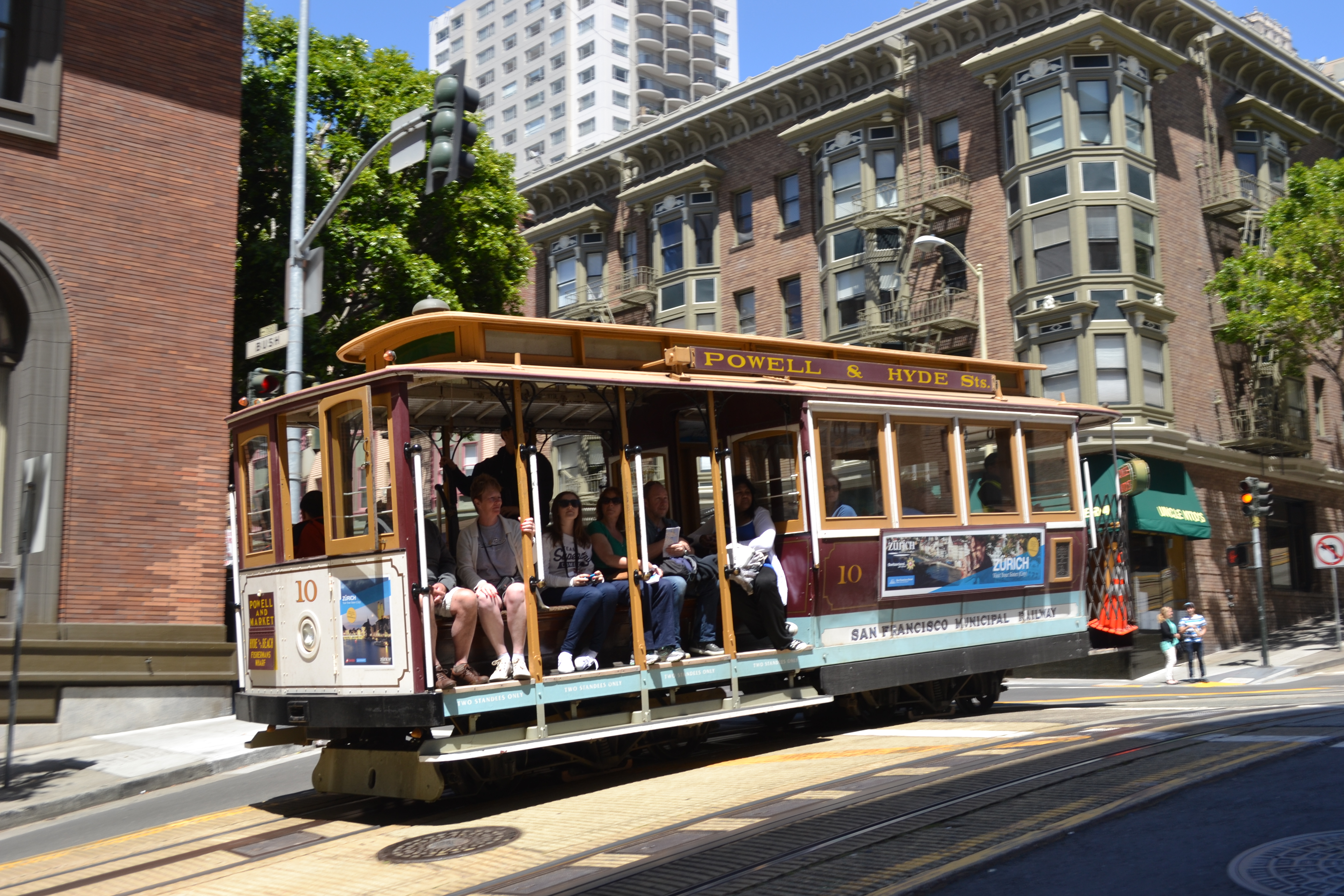
You stand on the platform and hang on to the pole in the open doorway. The conductor dings the bell and the gripman tugs on hefty levers and the car jerks forward and climbs through North Beach to the summit of Columbus Avenue and begins its descent downtown. Tourists whoop and scream as the car tips into the dizzying hills, as if they really believe you could fall off the edge of the world in the heart of an American city. But the gripman has the lever hard back so the car never gathers much speed, except on one or two corners when he lets it go so it can build up the momentum to get round.

Then down, down, down, stopping at each block, as the gripman calls out the street name and some passengers jump off and some climb on; then clanking past Chinatown, glimpsing the other suspension bridge, the one no one cares about because it is not funky orange; tourists genuflect in the street to get action shots as the car rolls towards them, the gripman rings the bell to get them to move; and then on and down to the turnaround at Market Street in a quiet corner of the Tenderloin.

It would, in truth, have been quicker to walk, much quicker to take the bus. But it would not have been half as much fun.

DSC_0745

(c) Richard Senior 2014

Zanzibar Night Market

DSC_0041

When the sun goes down, trestle tables go up in Forodhani Gardens in the middle of Stone Town in Zanzibar.

The tables are filled with lobsters, gleaming white squid, fat octopus tentacles, kingfish, marlin and tuna. Dozens of vendors light charcoal grills and wheel in juice presses like old-fashioned mangles. The crowds swarm in and jostle each other and the vendors shout and orders are placed and fish is thrown onto the grill. The juice man works at pit stop speed, forcing sugar cane through the press, folding it, forcing it through again, then again, and again, until it has given up all of its juice. Then he mixes in lime and ginger.

Squid is deceptively hard to get right. So many restaurants cook it too long, or not long enough. But the grill man knew better than that. He sliced it up with a few quick strokes and tipped it onto a paper plate with a handful of salad and a good squirt of chilli and tomalley sauce. He owed me some change but talked me into settling for a coconut bread. I ate the squid and the bread as I looked round the rest of the stalls, then replaced them with kingfish and green pepper skewers.

(c) Richard Senior 2014

Going for a Spin in Rotorua

DSC_0652

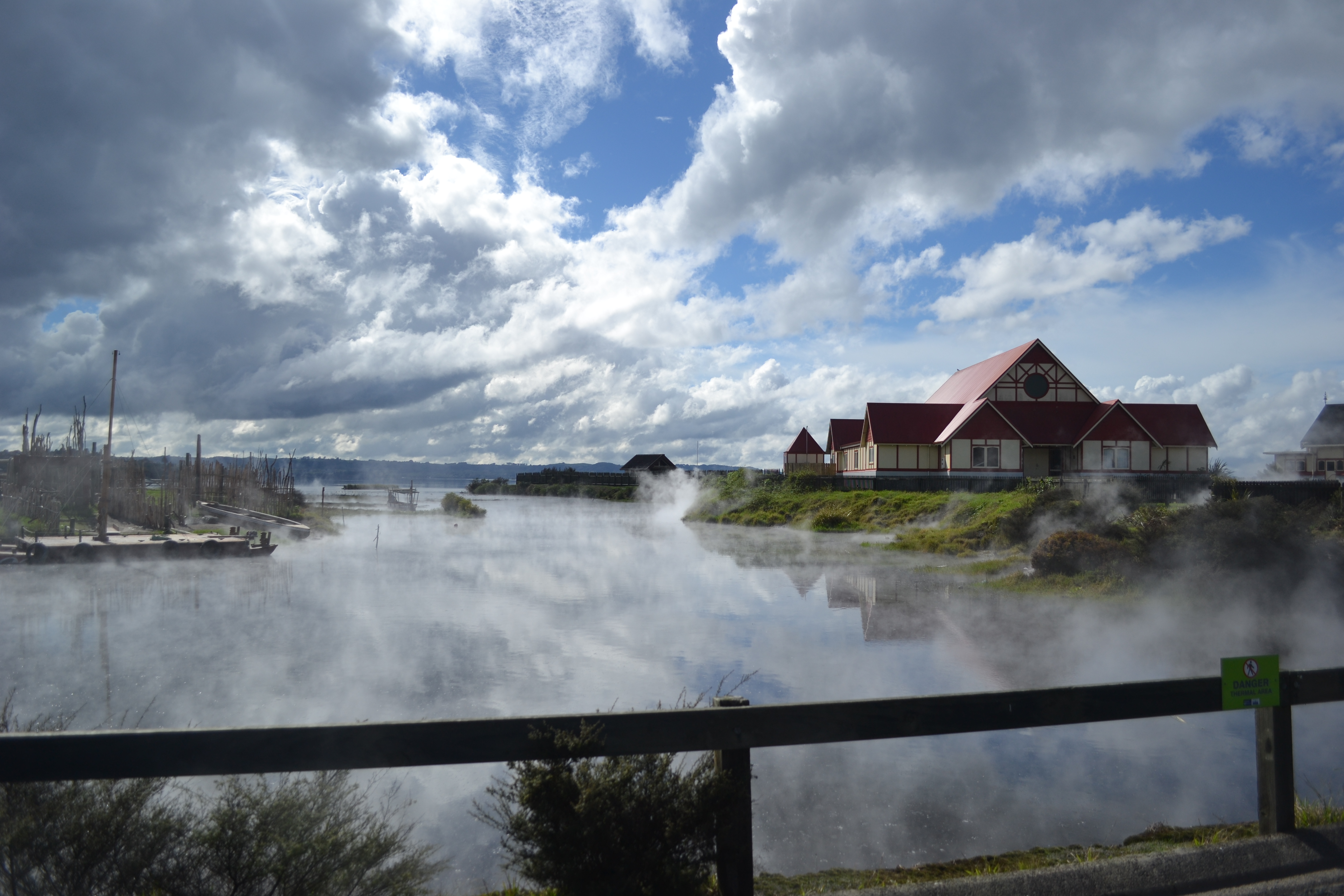
The landscape was Jurassic, all ferns and sulphurous pools. Smoke issued from every pore in the ground. Mud pots belched and cauldrons bubbled, as if hard-boiling the eggs whose smell hung over the town.

The trees were wearing their autumn clothes in reds and greens, yellows and browns, and the leaves were beginning to carpet the ground. The air was fresh and the silence was perfect, except for the squawk of the gulls and the honk of black swans; and the lake was still and reflected the mountains and trees and strips of blue sky in its surface. Seaplanes stood idle while geese moved out in convoy, and spindly-legged, red-beaked, blue-chested pukekos tottered on the grass and immaculate gulls glided expertly in to land.

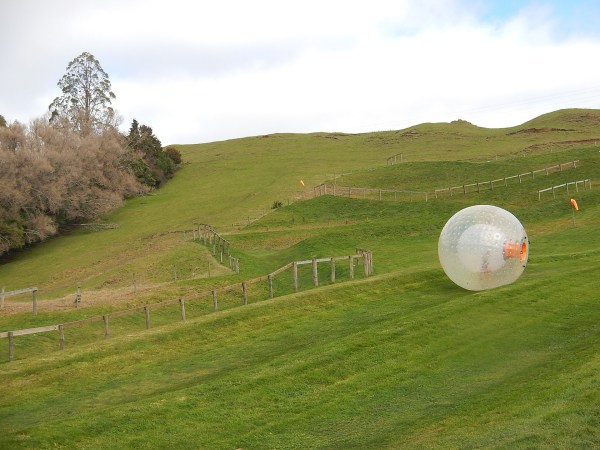
Such a sleepy town. Yet it was here, in Rotorua, that New Zealand’s second craziest adrenaline activity began. The first, of course, is bungee jumping. The original Zorb company is still doing business on the outskirts of town; but I booked with Ogo, the rival outfit, run by the ball’s inventor*. The name is different but the idea is the same: a big rubber ball suspended inside a bigger rubber ball, with an aperture in the side.

zorb-1532366_1920

They drove me up to the top of a long, steep hill with a track carved into it, and tipped a bucketful of warm water into the Ogo ball; I dived through the aperture, Superman style, and they zipped me in and shoved me down the hill. I tried to stay upright but fell down straight away and slithered about in the water as the ball picked up speed as it careered down the hill. I was laughing hard all the way down and carried on laughing when I got to the bottom and stopped with a bump, rolled back and landed upside down in a jumble of arms and legs.

Then I moved onto the Fishpipe, which is an Ogo ball fitted with a seat and a six-point harness and attached to a frame which allows it to spin like the rig on which astronauts train. The operator dialled up the speed, by turns, until I was tumbling like washing in the machine and laughing again, until the coins worked themselves out of my pockets and pelted me as I spun.

(c) Richard Senior 2014**

*Update: Ogo has since taken over Zorb but operates under its name from from what was the Ogo site

**Except Zorb image via Pixabay

In San Francisco with Kerouac

[S]tretched out ahead of us the fabulous white city of San Francisco on her eleven mystic hills with the blue Pacific and its advancing wall of potato-patch fog beyond, and smoke and goldenness in the late afternoon of time. – Jack Kerouac, On the Road

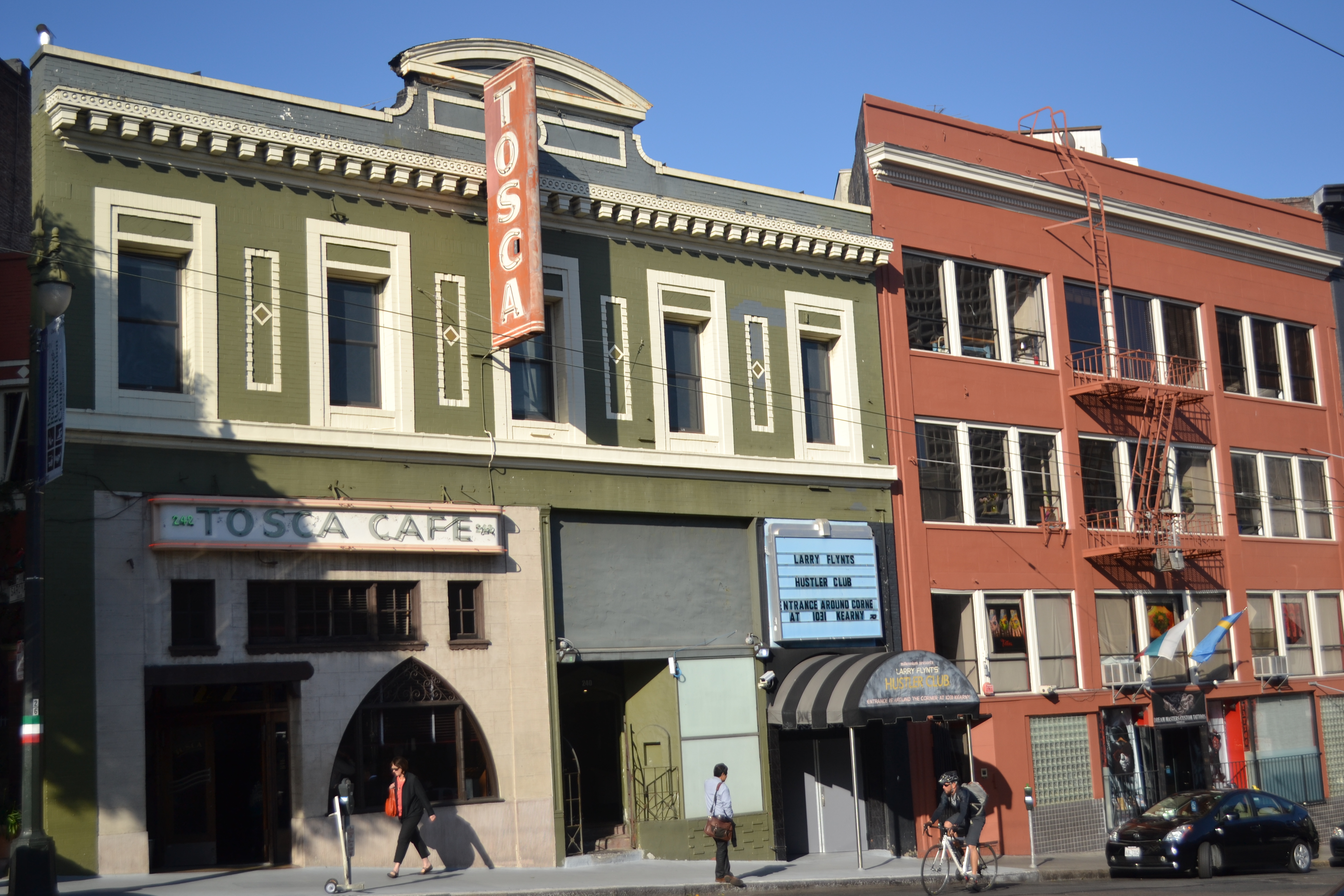
North Beach is an old Italian neighbourhood. There are tricoleri painted around the lamp posts and cafes named for operas, and delis filled with salami and prosciutto legs. Everywhere the smell of good coffee and soffritto gently frying, the clunk-shush of espresso machines, bouna seras and ci vediamos.

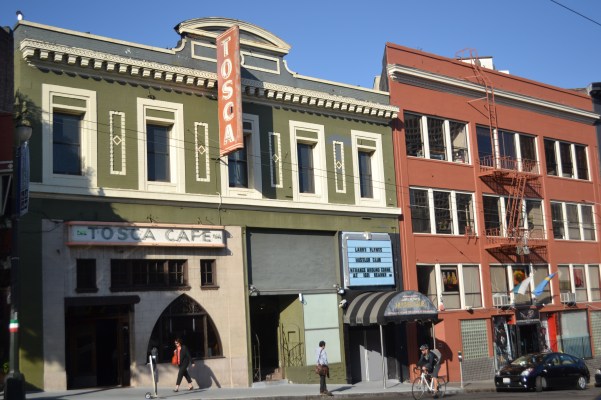
I stayed on Mason at the San Remo Hotel, a pretty, Italianate Victorian with marble sinks, iron bedsteads and old wooden bureaux in the rooms. There were no televisions, duvets or phones, little of the modern world beyond a Wi-Fi connection. It was as if nothing had changed since it opened in 1906, since the two World Wars, since Kerouac slouched round the neighbourhood, seabag on shoulder, bottle in hand, looking for a bed, a sofa, a floor for the night.
DSC_0321

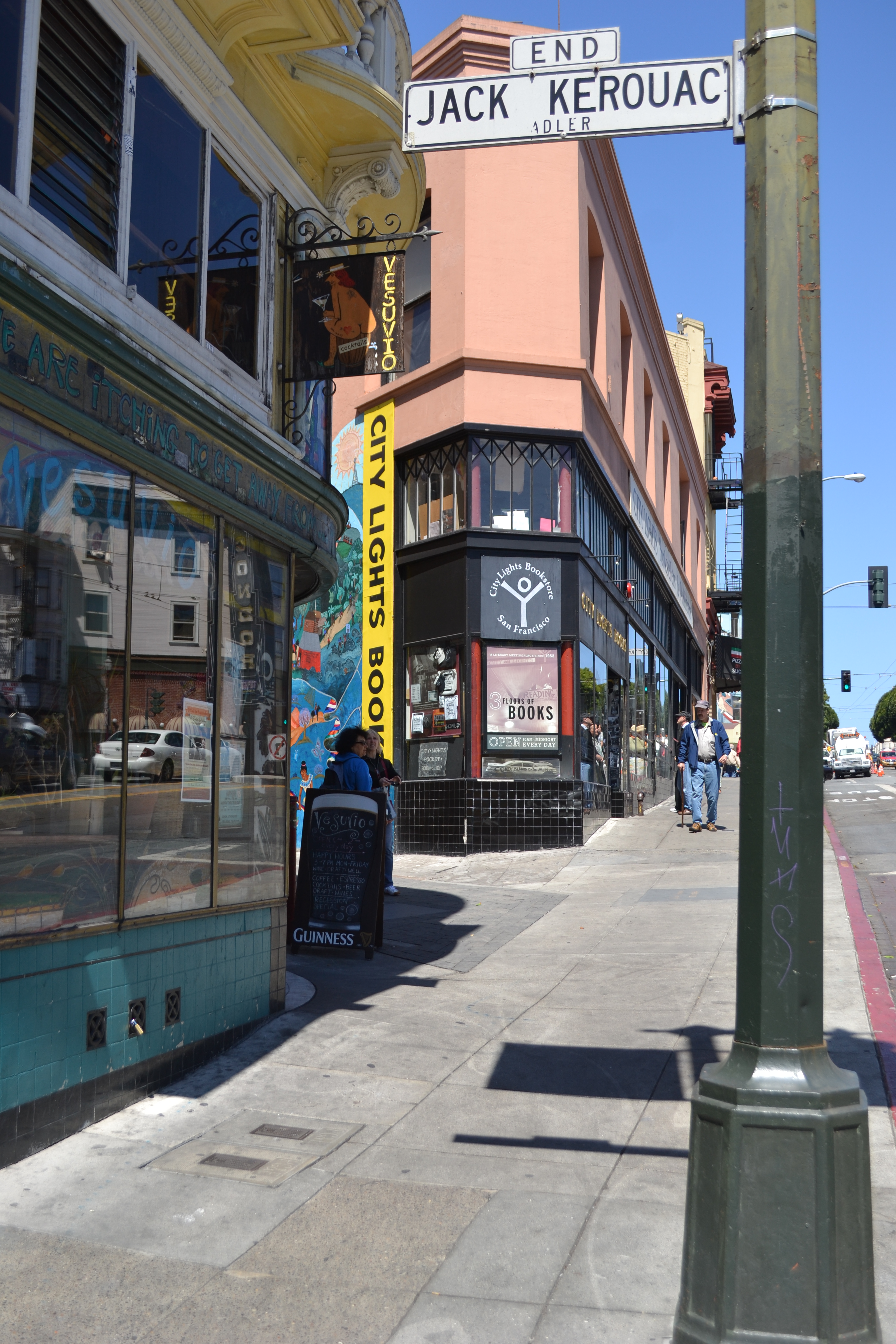
I had just started reading his novel, Big Sur, which opens with ‘Dulouz’ (Keroauc) stumbling drunk into City Lights bookstore to see the owner, his friend ‘Monsanto’ (Lawrence Ferlinghetti), and as I walked down Columbus and glanced in the window of a cheery old bookshop, I was startled to see the words “City Lights” in shaded gold letters on the glass. I had no idea it was still open.

It has the shabby, shambolic air of all the best bookshops, a relief from the corporate monotony of the chain stores which dominate the market and have all the character of a bank. The icons whose names appear on the spines of the books in the Beat literature section which fills one wall, whose photographs decorate another wall, Kerouac and Cassady, Ginsberg and Corso, Snyder and Ferlinghetti, were drawn to San Francisco in the forties and fifties, when writers could afford to live in North Beach. They called themselves the Beat Generation.

Allen Ginsberg (Carlo Marx in On the Road) and Gregory Corso each lived in apartments down the street on Montgomery. Corso broke into City Lights one drunken early morning and robbed the till. “We just didn’t pay his royalties for a couple of years,” shrugged Ferlinghetti. Neal Cassady (Dean Moriarty) lived – between wanderings and mistresses – with his second wife in nearby Russian Hill.
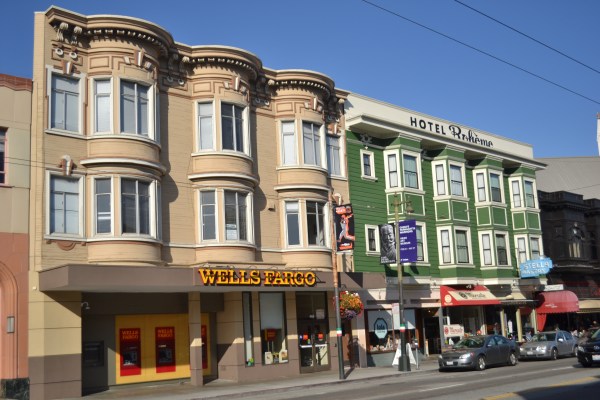
DSC_0311

Kerouac never really lived in his “favourite exciting city of San Francisco,” but frequently ended up there, hitching rides and hopping freights from the East Coast. He spent nights in friends’ spare rooms, or on their sofas, and stayed for a time in the attic of the Cassadys’ “two-storey crooked, rickety wooden cottage in the middle of tenements” which is still standing at 29 Russell Street. Otherwise he booked into Skid Row hotels around Third and Mission and Fourth and Howard South of Market, now developed out of recognition, and the Tenderloin, which is still the sorriest part of town.

I passed through a few times, but always hurriedly and never at night. It makes you despair to see the ruined lives, the lack of hope, the long, desperate queues for soup kitchens, the derelicts in the doorways, the guys selling scraps of pitiful junk reclaimed from bins spread across blankets on the pavement –  another, different, beat generation.

“I ain’t no panhandler,” a man said to me, much as Brits say “I’m not being funny” whenever they are about to be funny. “No!” said his girlfriend, shaking her head in support, as he started to explain that he was from out of town, and his car had been towed, and he had no cash, and his card had been declined, and he was sorry to ask, but he needed to raise $18. I believed none of it, of course, but gave him a couple of dollars for effort.

DSC_0793

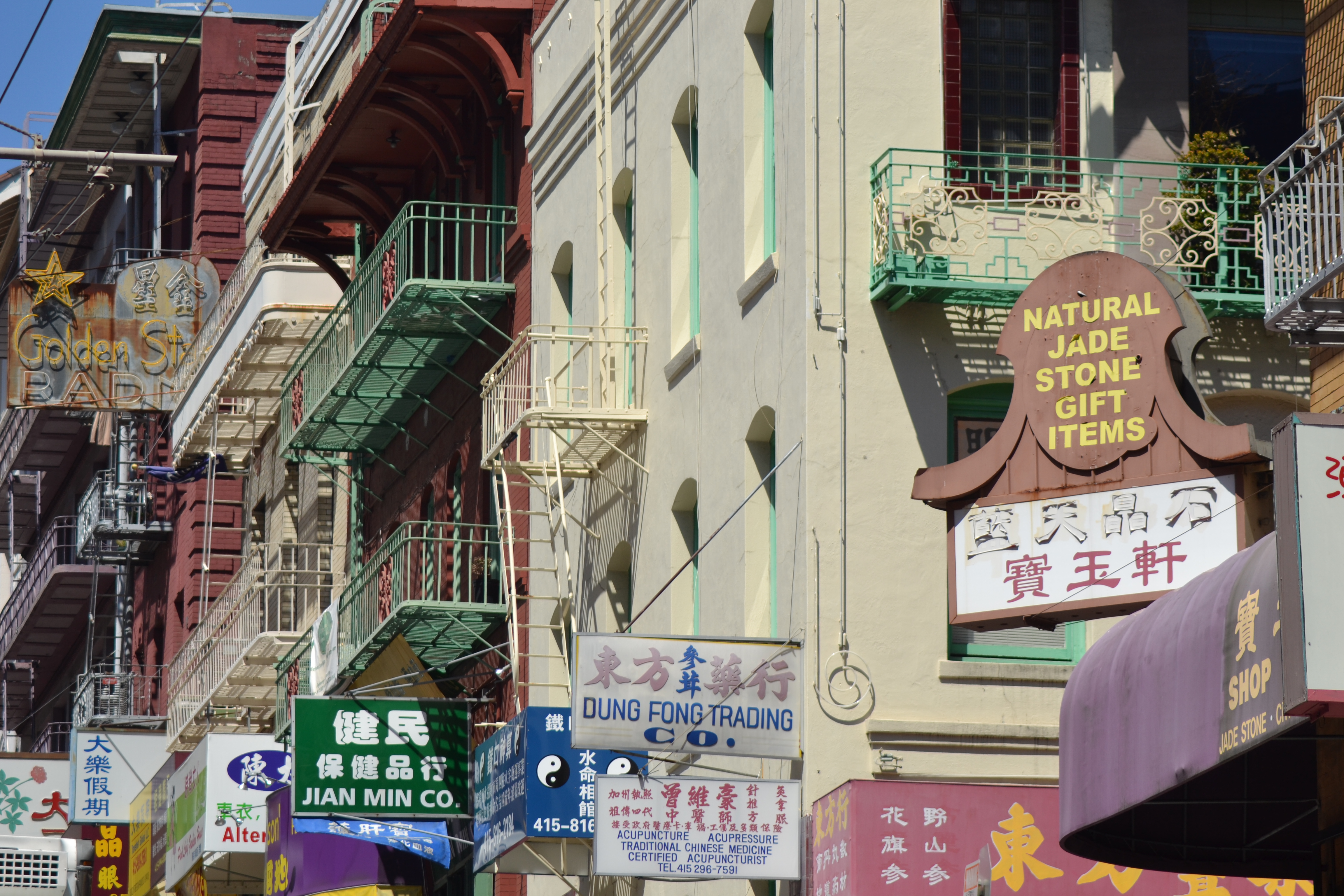
A few blocks north, through the Dragon Gate, is one of the oldest and biggest of the world’s Chinatowns, a teeming, bustling quarter crammed with restaurants, temples, meeting houses, mahjong players, incense, and maneki-neko cats, waving limply as the crowds throng past. The ghosts of the Beat Generation are everywhere. Kerouac wrote in The Dharma Bums of a night at Nam Yuen restaurant at 740 Washington Street, a favourite of Gary Snyder’s:

We all got together…and drove in several cars to Chinatown for a big fabulous dinner off the Chinese menu, with chopsticks, yelling conversation in the middle of the night in one of those free-swinging great Chinese restaurants of San Francisco.

The building is still there with the sign out front, but it is closed, boarded up and graffitied now. Its neighbour, the “marvellous old restaurant” Sun Hung Heung (called Sam Heung in Desolation Angels) is now simply Chinatown Restaurant. Ginsberg preferred the narrow red-brick, green-shuttered Sam Wo along the street at 813, with San Francisco’s most truculent waiter. It closed for good in 2012.

Round the corner, up Chinatown’s steep main street is a dive bar which looks much the same as it did when Kerouac, Snyder and Ginsberg drank there in the fifties: like a cave with a Buddha and red leatherette stools. It is named Li Po, after an eighth century poet with a lifestyle like one of the Beats: a compulsive wanderer, a tough guy who killed men in sword fights, and a committed drinker, who wrote frankly about it in poems like “Waking from drunkenness on a spring day”.

DSC_0791

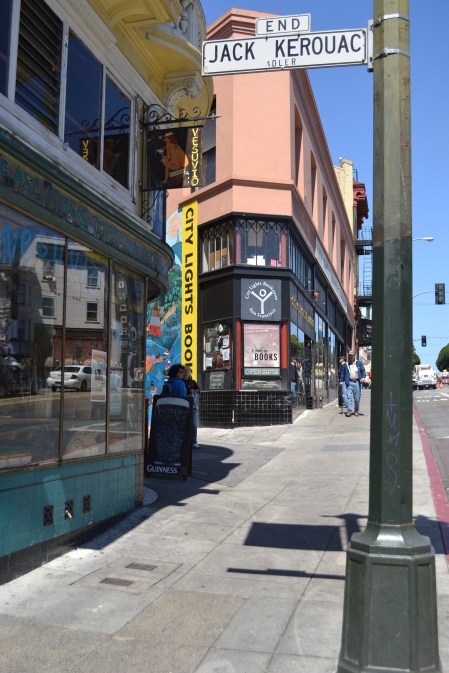
A little further up Grant, midway from Pacific to Broadway, is an alley named in Kerouac’s honour. It leads back onto Columbus, between City Lights and the wonderfully bohemian Vesuvio Café (“the bar on Columbus Street” of Big Sur), which Carolyn Cassady (Camille Moriarty), Neal’s wife and Kerouac’s lover, recalled as:

an arty bar…with colourful cartoon-like paintings….a quiet laid-back little bar where men played chess and guitar, and you could have a drink and  conversion without having to yell over loud so-called music.

It has barely changed – if it has changed at all – in sixty-five years. I expected Neal Cassady to explode through the door, back from the dead, telling three different stories at once. As I read the yellowing newspaper clippings pinned to the wall, a man of late middle age in a silk top hat and a leopard-print jacket rose from his seat and stared, as if I were the one oddly dressed. Perhaps to him I was.
DSC_0797

Caffè Trieste, up the hill on Vallejo, with its dark wood and brass, its old-fashioned juke box and smoke-yellowed ceiling claims to have been the first espresso bar on the West Coast. The Beats were regulars when it opened in 1956 (Ferlinghetti apparently still is) and what you see as you sit and sip your espresso is much as they would have seen it. Francis Ford Coppola is among the star cast of patrons whose black and white photos hang from the wall. He owns the verdigrised Sentinel Building which dominates the corner of Columbus and Kearny and appears in all the brochures. His American Zoetrope studio, based there – in a building which ‘Sal’ and ‘Dean’ and ‘Carlo Marx’ knew well – adapted On the Road for the screen.

The Beat Generation was really just Kerouac, Ginsberg, William Burroughs and their friends. But after the Six Gallery poetry reading of 1955, which Ginsberg and Snyder closed out and Kerouac chronicled in The Dharma Bums, after Ginsberg’s Howl was published the following year and On the Road the year after that, North Beach started to flood with wannabes in sunglasses, berets and turtlenecks, with goatee beards, bongos and half-arsed Buddhist ideas. The media called them “beatniks”.

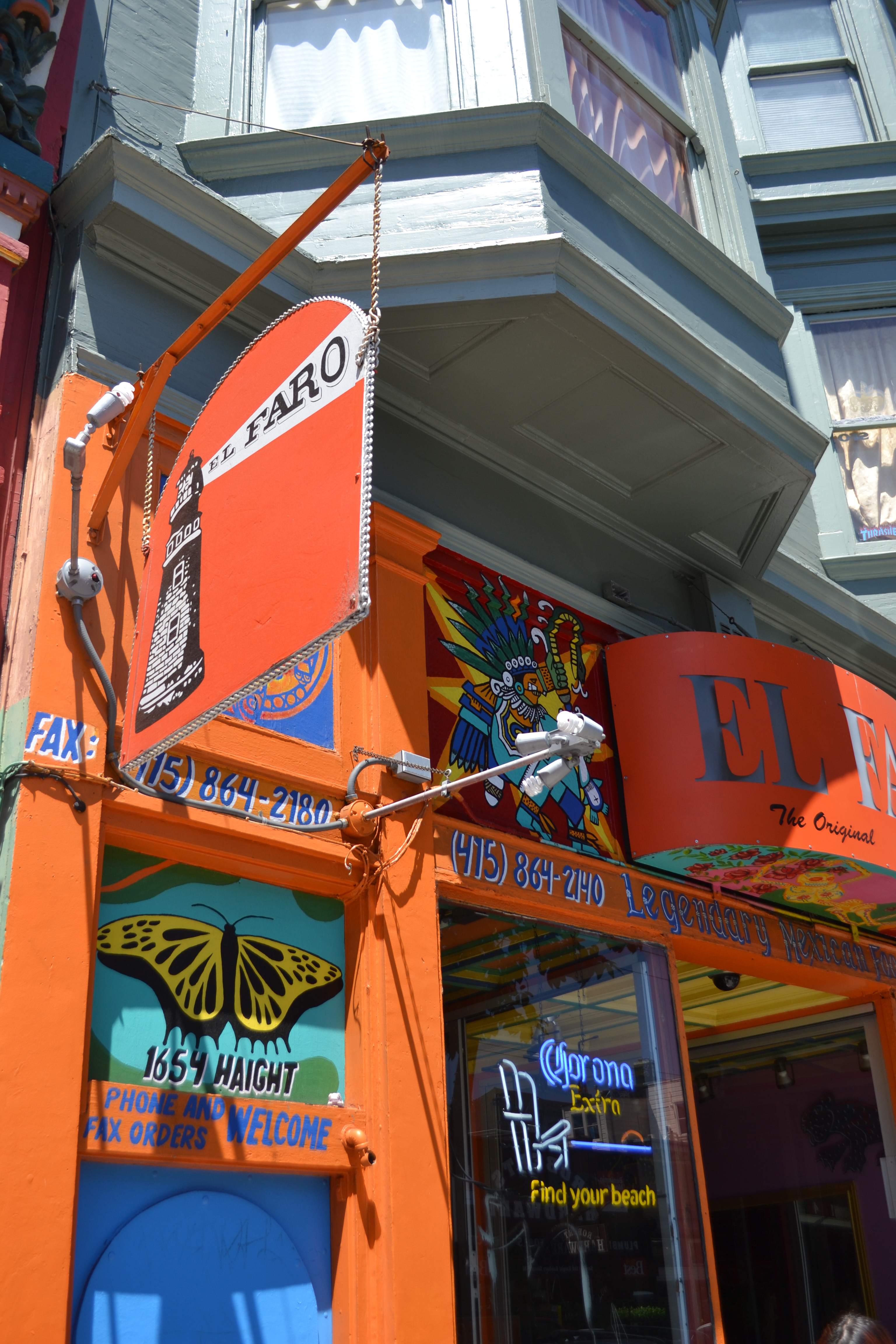
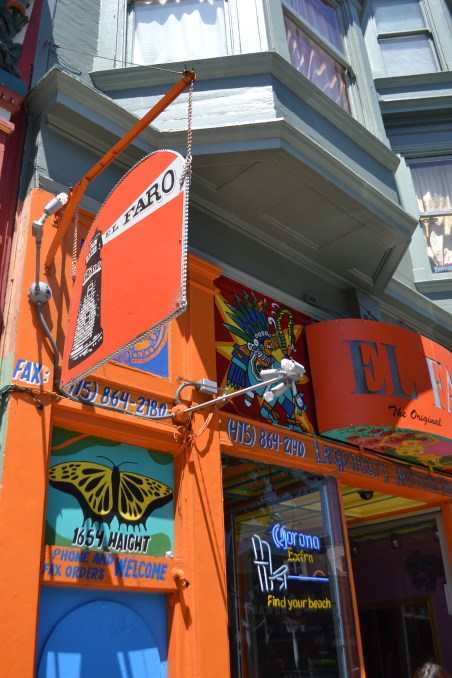
The next generation’s bohemians were priced out of North Beach and settled instead across town in the streets around the junction of Haight and Ashbury, where the media discovered them again and re-branded them “hippies”. The neighbourhood is stuck in the middle-sixties, like some ageing hippie, still high on the acid of half a century ago. Its stores and houses are a hallucination of orange and turquoise, magenta and blue, of peace signs and rainbows and trippy cartoons.
DSC_0436

Tom Wolfe’s Electric Kool-Aid Acid Test is the Haight-Ashbury generation’s On the Road. It follows another hedonistic journey from coast to coast, fifteen years after ‘Sal’ and ‘Dean’s’, when the Beat Generation was middle-aged, and LSD was the favoured drug instead of Benzedrine and booze, and the soundtrack was acid rock, not jazz. But Neal Cassady was still doing the driving; he partied with the hippies as he had with the Beats, bounded from one generation to the next. Ginsberg, too, found a place for himself in the sixties. He became friends with Dylan and Timothy Leary and protested the Vietnam War. But Kerouac slid into a bitter, reactionary middle age; no longer travelling, hardly ever sober. From the joie de vivre of On the Road to the despair of Big Sur, and worse. He died, at 47, just twelve years after his best-known book was published.

But Cassady had been dead 18 months by then, living fast to the very end. A trip to Mexico, a party, a few drinks, a fistful of Seconal tablets, a late-night walk along the railway line. He was found in the morning in a coma from which he never recovered. He was 41.

The only people for me are the mad ones, the ones who are mad to live, mad to talk, mad to be saved, desirous of everything at the same time, the ones who never yawn or say a commonplace thing, but burn, burn, burn like fabulous yellow roman candles exploding like spiders across the stars.

(c) Richard Senior 2014

Cuzco: Shadows of the Incas

“The word that most perfectly describes the city of Cuzco is evocative,” said Che Guevara in The Motorcycle Diaries. “Intangible dust of another era settles on its streets, rising like the disturbed sediment of a muddy lake when you touch its bottom”.

Even Matthew Parris admitted in his often curmudgeonly book, Inca Kola, that it is “worth seeing”.

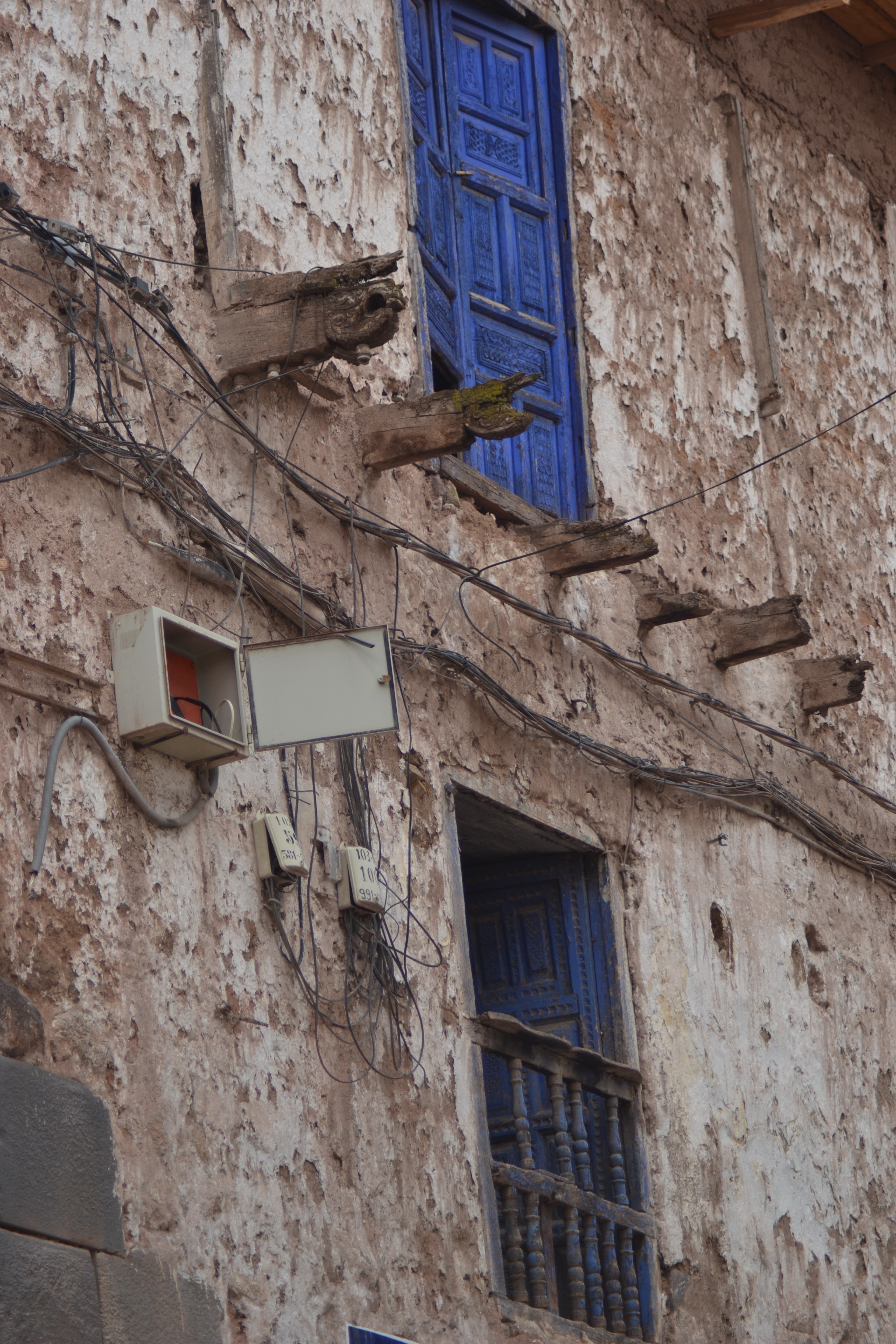
It has the same raffish charm, the same flyblown pomp as the ancient towns of Sicily. Smarter, grander around the Plaza de Armas in the middle of town, tattier, poorer the further away you go from it; but all of central Cuzco has character. Few walls are freshly painted, few have their stucco intact; many are plastered with the tattered remains of several generations of fly poster. But you will want to walk those cobbled streets for hours, for days, forever.

DSC_0302

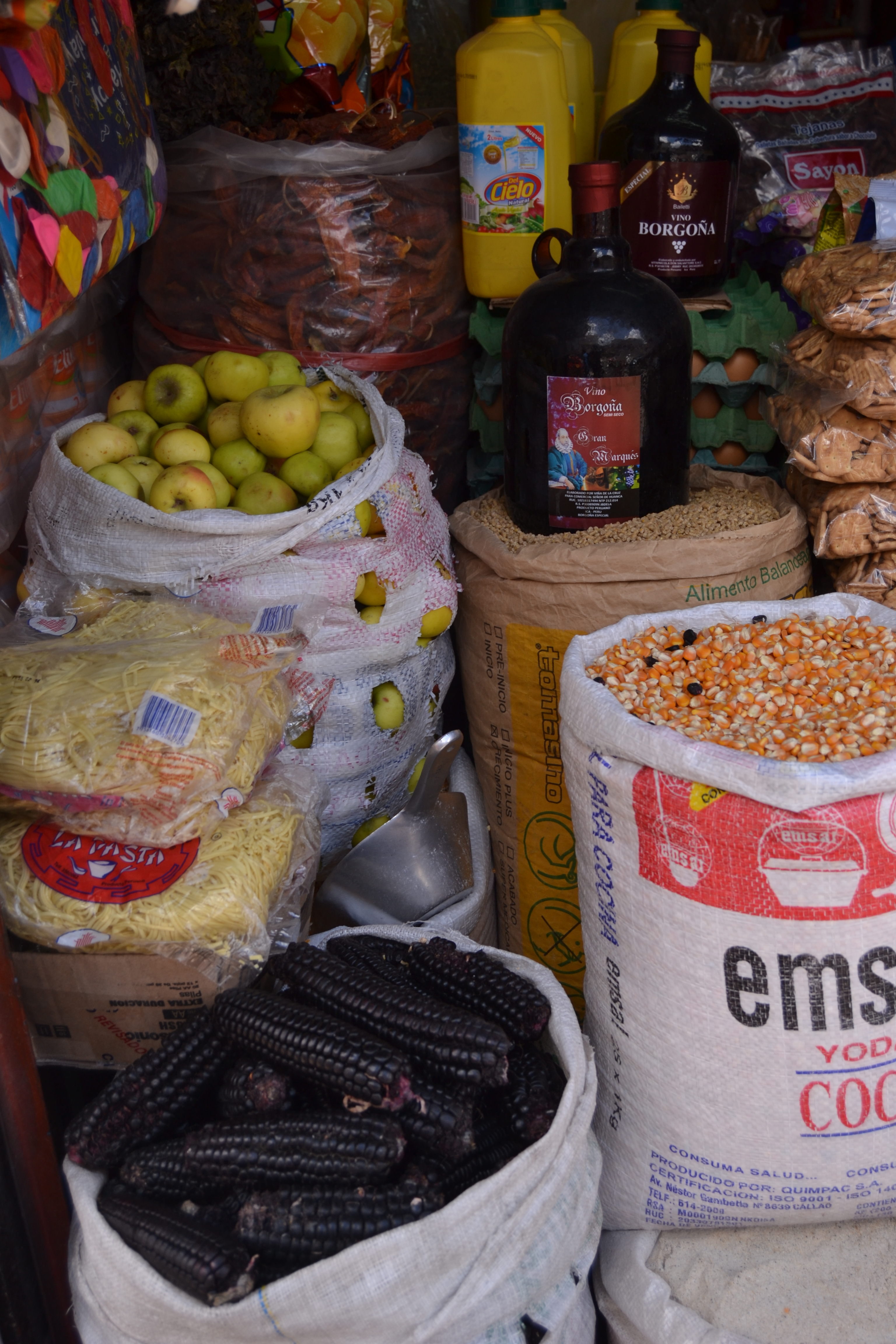
There is a bustle in the streets surrounding Mercado San Pedro, and an indifference to outsiders.  Sacks of beans are piled to the top of doorways, chicken’s feet claw out of windows. The butcher hacks up a carcass to order on a slab right out on the street front. Andean ladies with dirty fingernails squat on corners selling fruit. One has a basket filled with whole roast guinea pigs, a delicacy in Peru. Honking cars burst from every side street and converge in the stalemate of a main road. Mangy dogs quietly thread between them. A policewoman blows a whistle, more in frustration, I think, than in hope of bringing order.

The street food is good and cheap, and every few steps there are ladies grilling sausages and anticuchos*, or else kneeling with a bundle of empanadas.

DSC_0279

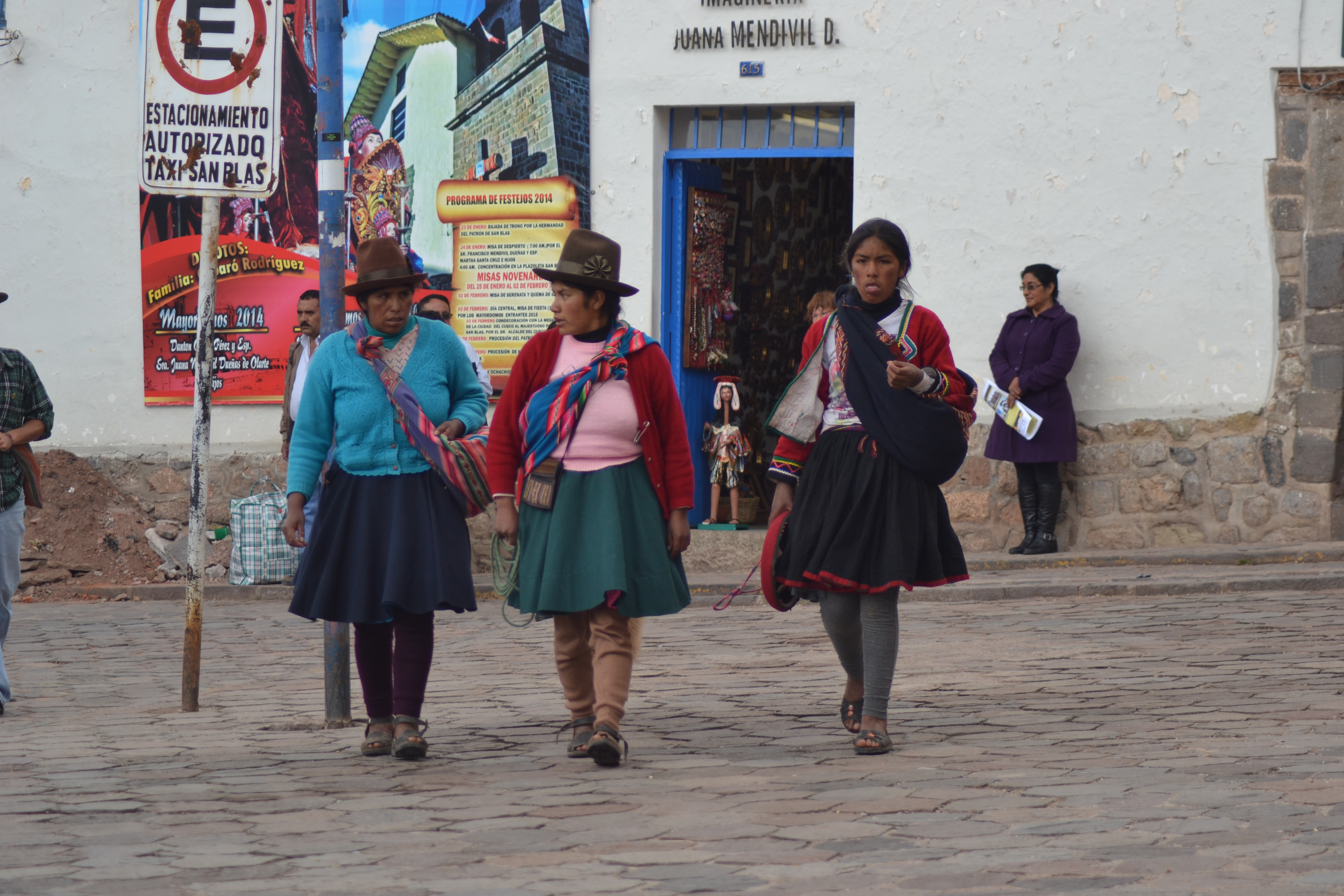
Cuzco was the Inca capital once, and it is an important centre for their modern descendants, the Quechua people. Ladies in fedora-like hats, voluminous skirts and Nora Batty stockings carry their babies in rainbow papooses and walk their llamas on leads. Some are there touting for business – “fotto, amigo, fotto please” – but most keep to themselves, huddle in the shade and chat.

The Spanish built on top of the structures they found, and often you spot the big, interlocking stones of the Incas at the base of colonial buildings. The Andean people adopted Christianity in much the same way, superimposing it onto, incorporating it into their traditional beliefs. While eighty per cent of modern Peruvians declare themselves Catholic, many nonetheless worship Pachamama** much as the Incas did.

DSC_0317

(c) Richard Senior 2014

*marinated beef heart kebabs

**mother earth

The Tyranny of the Bucket List

DSC_0412

My alarm went off at 3.30am. I got dressed and went out and tagged along with the procession of half-asleep travellers crowded into tuk-tuks or furiously pedalling unlit hire bikes through the crepuscular gloom.  At Angkor Wat, the hawkers were patrolling the car park with torches,

“You wan’ coffee-breakfast?”

“Not now, thanks.”

I joined the concert crowd assembling in front of the temple and sat and waited with increasing impatience for an hour or so until the sun struggled over the horizon. Is that it? I thought and went to get coffee-breakfast.

DSC_0324

It occurred to me later that I had seen dozens of landmarks, just as iconic, but had never before felt the need to get up in the middle of the night and watch the sun rise behind them. But it had never before been a Thing You Must Do before You Die.

It is always a must: a sternly-worded injunction, a must try … do not miss … essential … cannot leave without: never a friendly, you could do this if you want. It is like working for a manager proud of being difficult.

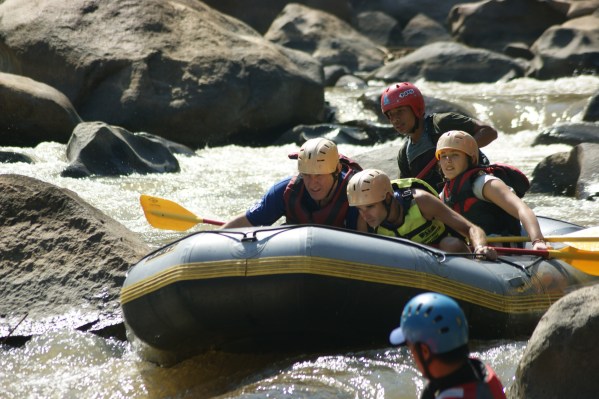
I have been white water rafting, but that was in Thailand which doesn’t seem to count. You have to raft the Lower Zambezi or nothing. I have been to Ibiza several times – I was there for the openings once – but I have never been to a closing party, and that is all the authors of bucket lists recognise. I am not doing very well.

SONY DSC

SONY DSC

I have no chance of getting to all of the 1000 places in Patricia Schultz’s book, especially if I have to find time to read the 1001 books and see the 1001 movies listed in the Quintessence Editions. And I have not even looked at 1001 Foods You Must Taste Before You Before You Die. There are still things outstanding which I should have done before I was 25.

Come to think of it, though, it is hard to see how any one person will ever do all the things which routinely appear on bucket lists. The sort who dream of making a million, meeting the president and having things named after themselves are never going to live out of a van.

Someone putting in the work to get a book published and have an artwork in an exhibition, while becoming fluent in a foreign language, inventing something and running his or her own business, will not have the time to visit every country in the world. He or she will be hard pressed to fit in milking a cow and skinny dipping at midnight.

DSC_0557

In truth, I am not fussed if I never see A Clockwork Orange, and I have wrestled with Finnegans Wake before and been beaten and I am not likely to try again, and while I had the chance to go to the Golden Triangle when I was in Southeast Asia, I decided not to bother.

I have no intention of doing a runner from a fancy restaurant, I am happy to pay for my food; and I certainly do not want to get arrested. I cannot see the point of shouting “the drinks are on me” in a crowded bar, even if (which I don’t) you have pots of money; and I am not sure there is anything to forgive my parents for.

There are, as well, a load of things I have done and want to do which I have never seen on any bucket list but which will stay in my memory long after that early morning at Angkor Wat has faded.

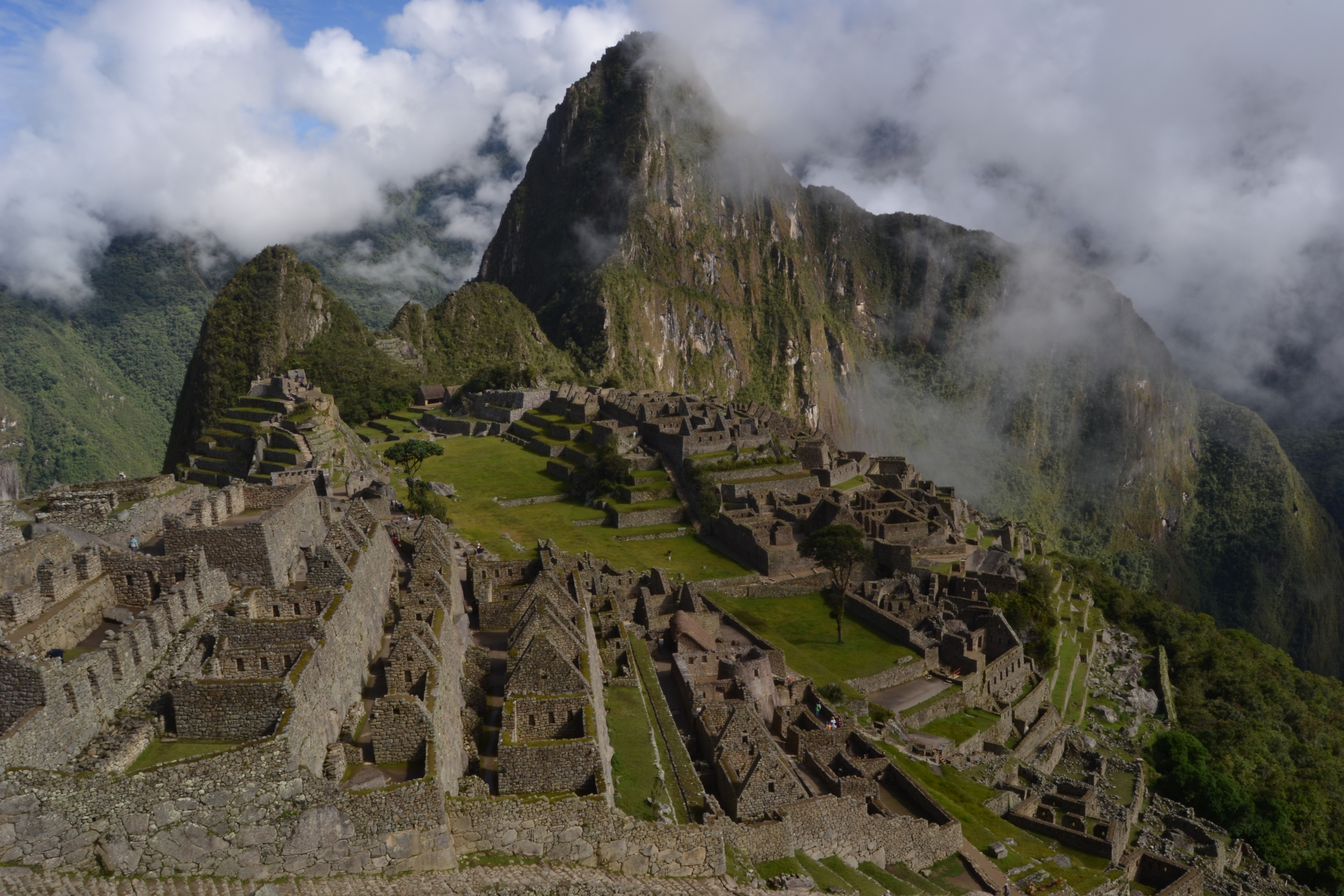
So when I went to Peru and they told me I had to see Machu Picchu at sunrise, I ignored them and spent longer in bed.

(c) Richard Senior 2014
Okavango Alarm Clock

DSC_0996

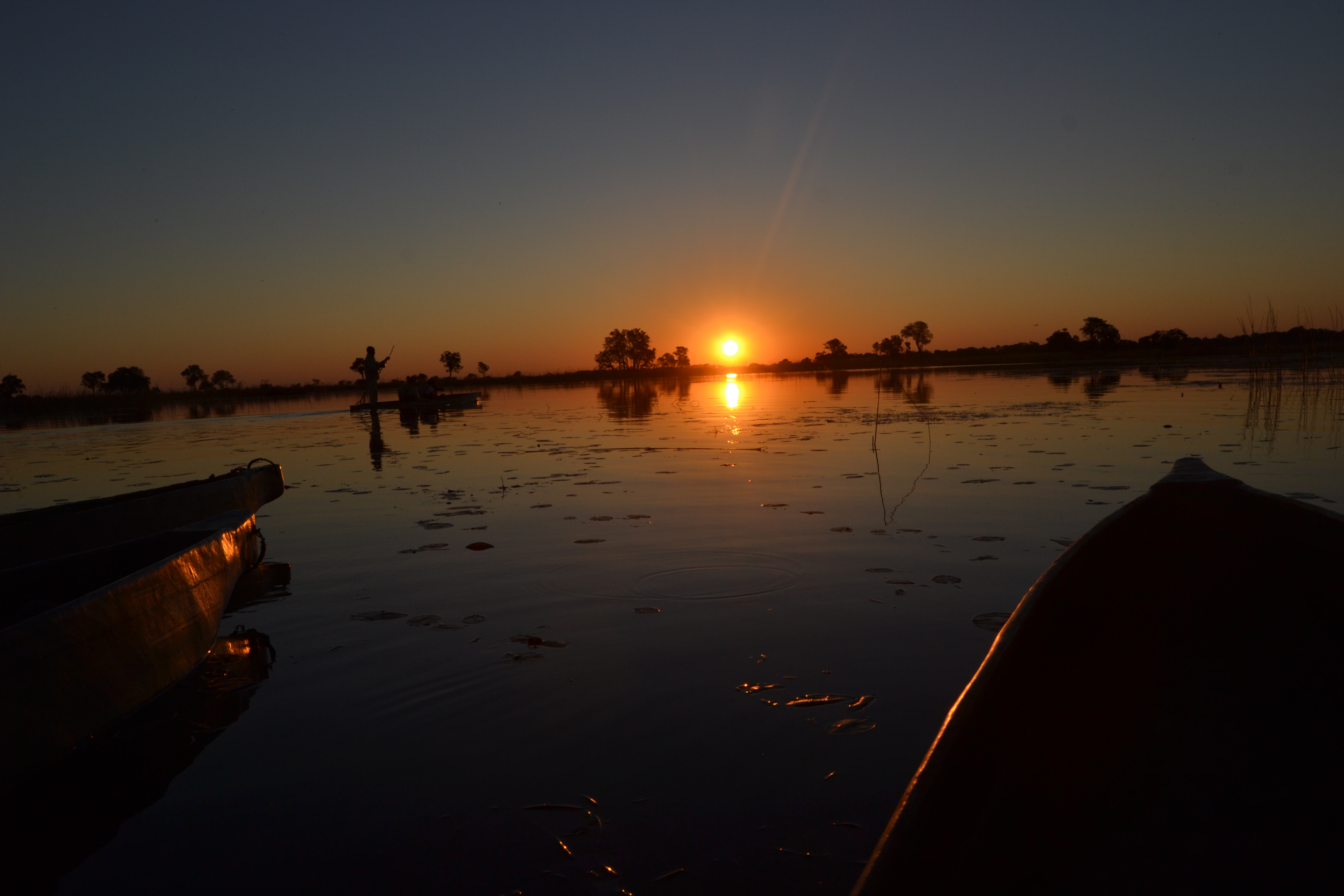
It sounds as if a team of early workmen is taking hammer drills to solid stone when the hippos start to grunt their good mornings and hope you slept wells. The frogs burp and trill in overwhelming numbers; the cicadas chirrup a counterpoint.

An elephant grumbles somewhere beyond the trees. The red-eyed dove introduces itself, as it does every day. “I am…a red-eyed dove,” it sings in its Andean flute voice. “Go away! Go away!” shriek the grumpy grey louries, known to all as go-away birds. The emerald-spotted wood dove quietly sobs, “My mother dead! My father dead! Everybody dead! Dead! Dead! Dead!” “Go away!” snap the louries. “Drink lager! Drink lager! Drink lager!” chant the hard-partying Cape turtle doves, for whom it is always six o’ clock somewhere. “Good Lord deliver us,” mutters the disapproving fiery-necked nightjar.

(c) Richard Senior 2014
“It is the Journey that Matters in the End…” as Hemingway DIDN’T Say

DSC_0345

It is good to have an end to journey towards; but it is the journey that matters, in the end,” wrote Ursula K Le Guin in her novel, The Left Hand of Darkness, although the internet tends to credit it to Hemingway.

The idea is baffling to regular fortnight a year vacationers, for whom journeys mean getting up early, battling across town, standing in line, getting half undressed, being scanned and frisked, having bits of their hand luggage confiscated, being bullied by cabin staff, sitting for hours between an old lady who thinks out loud and a fat man who snores very loudly, and watching the drinks trolley creep up the aisle to the row before theirs, then shoot back up the other end of the plane and behind the curtain for the rest of the flight, then bowing to pressure from the crowd to stand up the second the plane has come to a stop, even though they know that the doors will not open for ages; then standing in line again and again and again until they have stamps in their passports, cases in their hands and taxis to take them to hotels.

If this is what matters, might as well stay at home.

But on a longer trip, when you are dotting about from place to place, by train, by bus, by car by bike, what you see as you travel between the big sights will lodge in your mind as firmly as the sights themselves. You can get as much from the journey as you can from the end.

When I think of Cambodia, I think of the bus ride to Phnom Penh from Siem Reap, through rural villages of wooden houses balanced on stilts, of hayricks, pitchforks and ox carts, of broods of chicks jogging after hens. In the bank of memories from Vietnam are the journeys on overnight trains, waking and looking out of the window at villagers kneeling in conical hats to harvest the rice in the half-light of the early morning. I remember long road trips in South America through epic landscapes of mountains and plains which stretched for ever, and the occasional Andean herdsman tending llamas an hour from the smallest town.

In New Zealand it was the journeys I enjoyed the most. There is not much to Picton and little more to Nelson but the Inter City bus took a glorious route between them, through the Marlborough wine region where the vines had turned and flooded the fields with an ocean of yellow on either side of the single track road, where the mountains were stacked three deep: green then grey then blue. The Tranz Alpine Express train threaded its way from coast to coast, from the ruins of Christchurch to the thrift stores of Greymouth with me gazing up at endless mountains, and into the depths of a gorge at a fast-flowing river, and out across the expanse of a pine forest with splashes of yellow and brown among the deep dark green.

I rarely plan a trip in detail, sometimes hardly at all. But I always know where I am going to end up. I need that to give it some kind of structure, and to focus on when things go wrong and half of me wants to jack it all in and go home. There is always an end, and it is always a destination; but there is always a whole lot more to the trip. There are all the intermediate ends, the UNESCO sites, the bucket list staples, the Must Sees, the Wonders of the World and – more mundanely – the towns where the ferries dock, the cities where the buses stop; the stations at the ends of the lines. And there are the landscapes and townships and villages I pass through as I travel between them.

It is good to have an end to journey towards; but, yes, it is the journey that matters in the end.

(c) Richard Senior 2014