Cappuccino with the Cats in Korea

IMG_3141

The girls at the cat café spoke no English but by pointing and miming got me to understand that I had to take my shoes off at the door and sanitise my hands.

A haughty Persian lay on the counter resting its eyes; a silver tabby stood behind it, inspecting the accounts. In the middle of the room there was an activity centre lined with soft carpet for the cats to climb on, sharpen their claws against or curl up asleep in. Next to it there was a rug for them to roll about on and cardboard boxes to play in and toy mice and things on strings for customers to dangle in front of them.

IMG_3138

Modern life is too often too busy, too cramped for pets, and cat cafes are a compromise. There are rabbit cafes as well. Maybe you would love a cat of your own but your apartment is too small, or your lease stipulates against animals, or you spend all day and half the night at the office and all your free time out of town; so you can go to the cat café, buy a drink and stroke their cats instead. They started in Taiwan, became hugely popular in Japan – where there are now owl cafes and goat cafes – and spread across Asia to the West. This one was in Busan, in the south-eastern corner of Korea.

I first heard about them sometime last year when one opened in Shoreditch and thought they were a lovely idea but worried that the cats might be exploited, or at least not get enough quiet time to themselves. But, at this café, there were places for them to go where the customers couldn’t, and the customers left them alone when they wanted to sleep or were not in the mood to be stroked. They looked healthy and happy and properly fed, neither scrawny like feral cats nor fat from over-indulgence.

rsz_img_3143

I am good with cats; they like me. I can usually persuade the toughest of toms to come and say hello. I have had them climb on my shoulders all over the world, and purr and poddle and roll on their backs to have their tummies tickled. But these Korean cats were indifferent to me, until the girl handed me a packet of fish-flavoured treats and I instantly became the most popular guy there. The little white kitten which had, until then, just wanted to curl up and sleep on the activity centre now tried to badger me into letting it eat the whole packet. But while I was feeding the kitten – far less than it wanted – a tabby climbed up my leg and meowed and gave me its best wide-eyed, heart-melting look, so I fed it as well, and then a black and white cat strolled over and muscled out the tabby.

IMG_3144

Once I had fed them all, and they grudgingly accepted that I was telling the truth when I said there were no more treats, they sat on my table or on the sofa beside me and were happy to have their paws and noses stroked. It seemed as if we were friends for life. But, being cats, they would of course have abandoned me without thought if another customer had opened a packet of fish-flavoured treats.

© Richard Senior 2015

Osaka’s Brave New World

DSC_0064

It was early morning. A drunk old woman puffed on a cigar and shouted at nobody. Men with straggly beards and beaten up clothes were curled up asleep on the pavement. One cuddled an empty bottle of shōchū.

The adult cinema, the blowfish restaurants and the cheap clothes stores were yet to open. They might have closed for good. But the lanterns were already – or still – illuminated at the casual kushikatsu places, selling deep-fried things on skewers. Forlorn-faced maneki neko cats waved limply to customers who did not come. Lights pulsated on the facades of the pachinko parlours; the music inside was amped-up to festival volume.

Shinsekai, it says on the signs: New World. Half was modelled on Paris, half on Coney island. What could go wrong? It was meant to show the world how forward-looking Osaka was when it was laid out in the early twentieth century and everything Western was fashionable. There was even a version of the Eiffel Tower. They called it Tsūtenkaku: the tower reaching to heaven. An ‘aerial tramway’ connected it to a Luna Park. There were Billiken statues copied from the United States. They are supposed to bring good luck.

IMG_2700 fs

But the amusement park closed in 1925. Tsūtenkaku was torn down in the War, although another was built in the Fifties. The New World grew old. There was no longer anything fashionable about it. If it suggested Paris, it was the Paris of the shabby streets around the Gare du Nord.

The entire area is squashed with small, cheap eating houses,” says the Japan National Tourist Organisation with what is presumably meant as positive spin. Shinsekai became the seediest quarter of Osaka. It was – by reputation – the most dangerous place in Japan. That is all relative, though. If Shinsekai were in London or New York, wealthy professionals would happily live there, and walk home late at night.

Everyone has heard the stories about salarymen who were made redundant in the slump of the 1990’s but kept on dressing up in their suits every morning and taking an early train to jobs they no longer had. To admit to their families and friends that they were out of work would have been too great a loss of face. Some, instead, moved to Shinsekai, where they could live in penurious anonymity. The rough sleepers with the straggly beards might well be the ambitious middle managers of twenty years ago.

It is, indeed, a New World.

© Richard Senior

Thank You for Flying with the Bangkok Helicopter

rsz_dsc_0008

It was evening rush hour in Bangkok. The offices emptied of workers and they swarmed on the transport hubs. Motorcycle taxi drivers sat in a line on their bikes at the ends of the sois. Meter cabs worked the main streets. The queues for the buses at the Victory Monument were as long and unruly as they are in London when the Tube drivers strike and there are dozens of applicants for every place on each bus.

I didn’t know which bus to catch to get back to Banglamphu, so I shuttled between stops, and forced my way to the front of each queue in the hope of finding a route map or someone who could tell me where to go; but there was never a route map and no one told me where to go, or at least not in a good way.

I waited to see if the crowds would thin out, but they swelled instead and I gave up on the idea of catching a bus and walked to the main road and flagged down a taxi. “Khao San Road?” I said, and he abruptly drove off by way of reply. The next two ignored me and drove past, and several after that already had fares, so I gave up on the idea of taking a taxi, as well.

That left what is known locally as the Bangkok helicopter: the fastest, most dangerous way to get across town. I approached a knot of drivers and interrupted their sniggering conversation and asked the one who had a spare helmet clipped to his bike if he could take me to Khao San Road. He quoted an inflated price and I tried to haggle but it was a waste of time so I agreed and got on the bike.

I asked for the helmet but he waved a dismissive arm and roared off while I tried to insist. It is illegal in Bangkok to ride without a helmet and I would have been the one to be fined if we were stopped; farangs are easy targets and assumed to be good for the money. I had more immediate anxieties, though, than the risk of being handed a fixed penalty.

I held onto my hat and bag with one hand and gripped the handle with the other. I have no idea what speed we were doing on the expressway, and nor had the driver because the speedo was broken; but it was comfortably above the speed limit. Everyone busts the speed limit in Bangkok if their cars or bikes or trucks will go fast enough. It is so widely ignored the police barely try to enforce it.

The driver kept up the speed as the streets became narrower and busier, ducking through traffic, overtaking a bus, undertaking a truck, carving up a taxi, mounting pavements, weaving to the front of queues at the lights and setting off shortly before they changed, ignoring the horn concerto which the other drivers performed. It seemed to me to be more of an adrenalin sport than a mode of transport. All it would take is a car to swap lanes without warning, a passenger to fling open a door at the lights, a pedestrian to step out between buses.

But locals, as ever, seem relaxed. It is, for them, just a convenient way to get to the office, or school. You see kids of ten or eleven on the back of motorbike taxis, and office girls side-saddle, using the time to finish their make-up. Only the cost would deter them from using the Bangkok helicopter: not the danger.

© Richard Senior 2015

If You Meet a Lion, Just Pretend Nothing Happened

rsz_dsc_0364 (1)

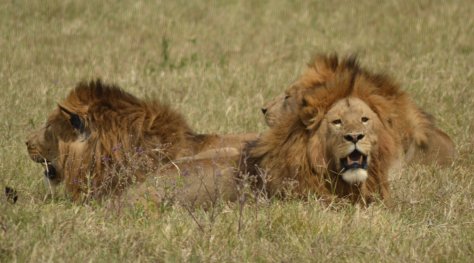
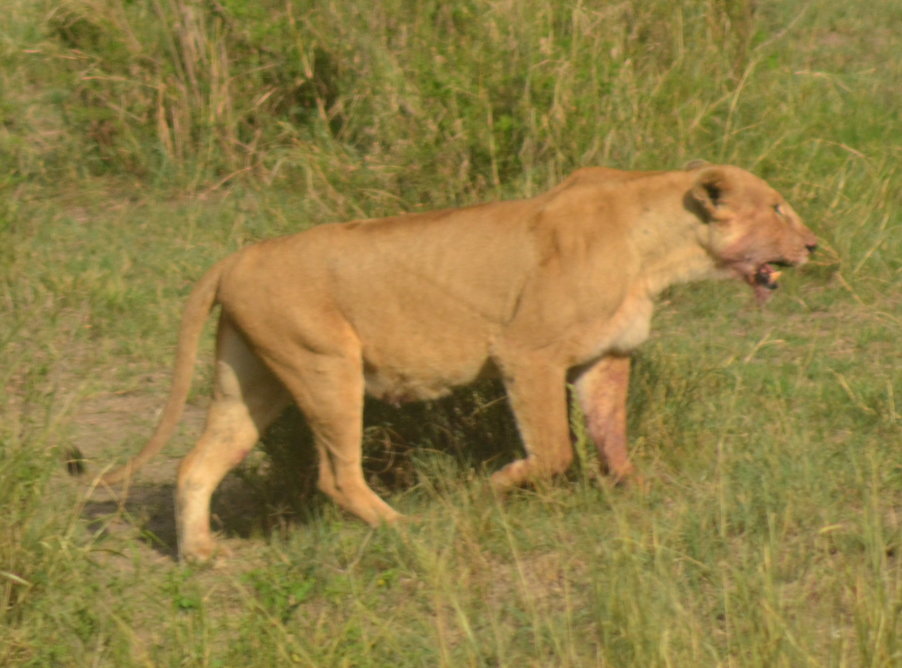
If you meet a lion on your way to the toilet block,” I was told, “whatever you do, don’t run. Only food runs. And don’t turn your back on it either. Walk slowly, back to your tent, zip it up and pretend nothing happened. Just remember that you’re not their main source of food. And make sure you have your torch with you at all times.”

“Yeah, I wouldn’t want to face a lion without it,” I said.

The Serengeti is just south of the Equator and the nearest town is hours away, and when the sun sets it just drops from the sky and the darkness is suddenly total. The piercing whistle of ten thousand cicadas stole the silence, and birds sporadically cackled and whooped as I zipped up the tent and turned in for the night.

There was nothing to stop the animals coming into the campsite, no fence, no hedge, no one ready with a tranquiliser gun, just in case. Two separate herds of elephants had wandered through that afternoon and trumpeted, stamped and flapped their ears if anyone went too close with a camera. Buffalo and wildebeest grazed around the edges. Baboons were all over the place.

Something woke me up in the middle of the night and I made the long, lonely walk to the toilet block, surrounded by the buzzing cicadas. A glow worm would have been disappointed with the light my wind-up torch gave out. The oinking grunts of the wildebeest were close at hand but they were out of sight. They sounded to be inches away. If they were nearby then, surely, so were their predators. There might have been a lion a foot from me. Remember that you’re not their main source of food. Not their main source!

Don’t run…don’t turn your back on it…walk slowly back to your tent. It is easy enough to say; but if the yellow eyes of a 400lb lion had blazed at me through the night, I would undoubtedly have turned and run, in any direction but the right one.

rsz_2dsc_0607

Baboons began barking. It is a horrible, heart-rending sound: a sound of terror, a sound of unbearable pain. Or so it seems, at least, when you hear it when out, alone, in the sinister East African night. “If the baboons are barking,” I recalled someone saying, “it means that leopards are close”. So leopards were out there somewhere, as well. The cicadas hissed, the wildebeest grunted, the baboons barked, a bird trilled, but still I saw nothing. I would not have seen anything, even if something was there. With my useless torch, I would have fallen over a leopard before I saw it.

The cicadas hissed, the wildebeest grunted, the baboons barked and something howled. Hyena? Jackal? I didn’t know what it was but quickened my step until I was all but jogging and reached the toilet block and shut the door and flicked on the light and met an enormous spider.

I got back to the tent and fell into an uneasy sleep, until I was jerked awake again by the gurgling roar of a territorial lion. I would, I supposed, get used to all this in time.

© Richard Senior 2015

Winning Entry: Wanderlust Magazine Travel Writing Competition

Wanderlust

“A Flight I’ll Never Forget (no more than 700 words)”

Down Under (and Back Over Again)

I had been thrown round the sky by an aerobatic pilot before. But it was in an aggressively capable modern aircraft, built for that sort of thing. I had been strapped down firmly with a seven-point harness and had a canopy slammed and locked into place above me. And I was twenty, then, and had no fear.

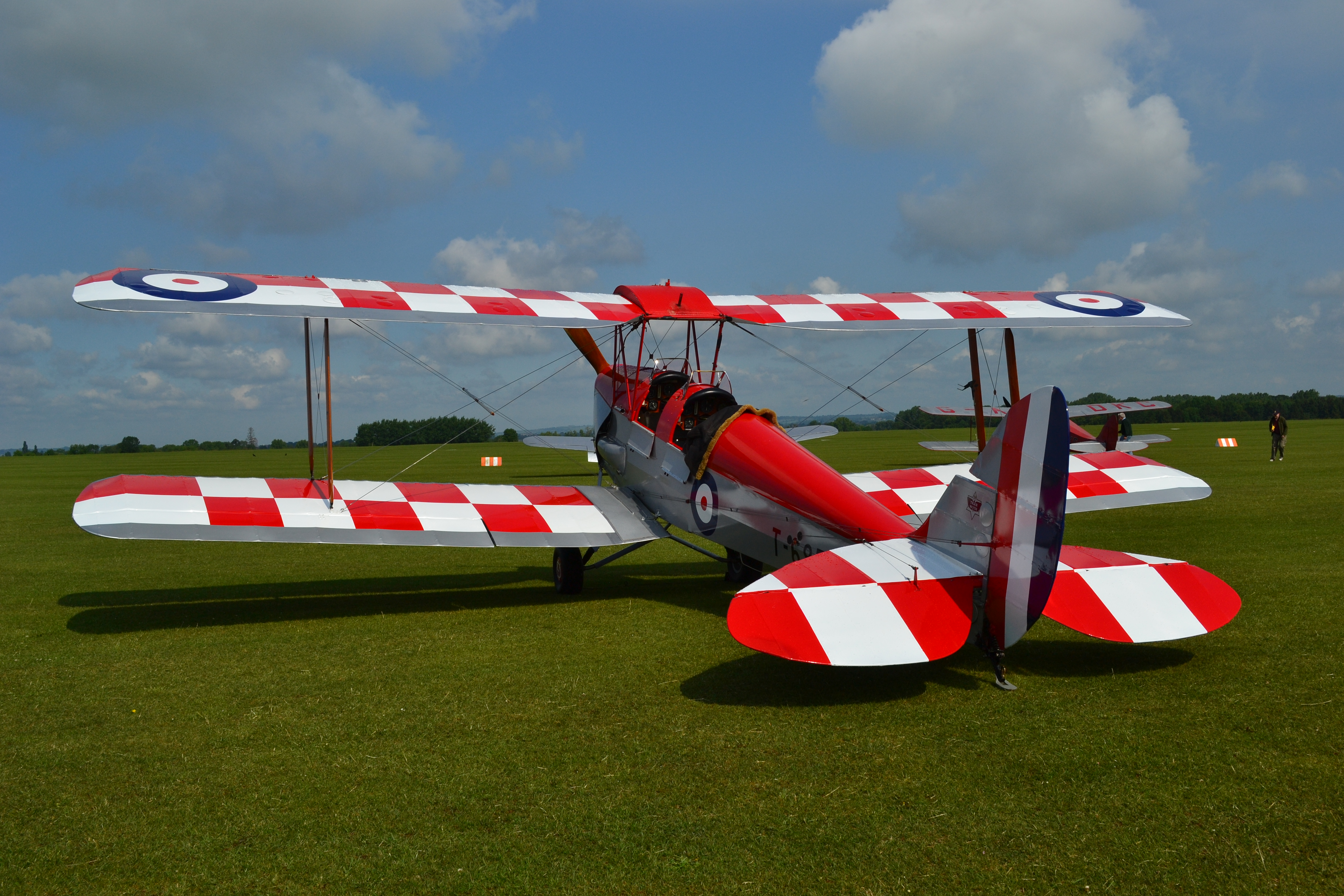
This time, I was in a Tiger Moth: a flimsy-looking, open-cockpit biplane built of fabric and wood in the Second World War to a design from the early thirties. I had nothing but a pair of straps, much like the ones on my backpack, to stop me from falling to my death. “If you fall out they can blame me,” said the pilot as he strapped me in. I was not too reassured.

The septuagenarian engine coughed hard, spat out a gobful of smoke and settled into a throbbing rhythm. We chugged across the field, then turned and accelerated along the runway. The Tiger Moth limbered into the air, like an elderly man mounting a stile, and climbed at a leisurely pace as we pottered out towards the bay. There was a wonderful view from 3,000ft over the marina at the boats at anchor and out towards the Barrier Reef.

DSC_0591

In straight and level flight, it is easy to imagine yourself back in the days of boaters and blazers and croquet on the country house lawn. But we were not there for civilised flying.

“Okay here we go
,” said the pilot over the radio, chopped the throttle and pulled the stick right back. The Tiger Moth reared up to the vertical, stood on its tail and stalled. It fell sideways with a bang, as if a wing had come off, and spun. All my senses screamed that I was going to die. I gripped the edge of the cockpit, as if that would somehow save me.

The sky, the ocean, the marina, the reef whirled round me in the confusion of a tumble down stairs as the pilot dived to build up airspeed and unstall the wings and then pulled straight up into a perfect loop. Over the top, upside down; my headphone lead flapping about in the air; the wind howling through the rigging, the sun flashing off the glass in the windshield. I looked up at the ocean and down at the sky; and we tipped right over, back round to where we had started. Then, straightaway, sideways into a barrel roll – boats sailing upside down in the sky – under and over, and the world righted once again.

Terror to elation and back again. Rolling, looping, spinning. East to west inverted, west to east right side up. The engine snarling, then abruptly cut. Just the whistling of the wind in the wires. Sky and ocean switching places again and again, until I was no longer sure which was right.

But no one can hear you scream from up there.

(c) Richard Senior

Keeping it Capsule

Capsules

An alley led through to the cheaper restaurants, a few hostess bars and the capsule hotel I was looking for.

I took my shoes off at the door and put them in a locker. There was a sign with a tattooed man crossed out. It technically meant what it said: that you were not allowed in if you had tattoos, but what it really meant was that you were not allowed in if you were a gangster. The yakuza famously have full-body tattoos.

I filled out a form at the desk and paid, and they handed me a pair of pyjamas, a towel and a plastic wristband with a locker key folded inside. It looked like something the courts would impose on you for a minor criminal offence.

Capsule hotels are aimed at salarymen who have got too drunk at corporate events to find their way home, or would not be let in by their wives if they did. But they are used, much like hostels, by anyone who wants a cheap place to sleep in the city. The other guests were all Japanese, and sober; but it was still a bit early.

There was a vending machine in the lobby with everything a guest might need in the morning: toothbrush and toothpaste, shaving kit, clean underwear and headache tablets. The inside of the lift was papered with flyers for food – to soak up the drink – coffee – to sober you up – laundry – in case you had made a mess down the front of your suit – and massages – in case you could not make it to the hostess bars round the corner.

Capsule interior

On the upper floors, there were beer vending machines and rows of desks with power sockets and partitions, so that sozzled salarymen could set up their laptops and bash out emails they might suddenly remember in the morning, with a stab of panic, as they open their eyes experimentally and start to work out where, why and how.

I changed into the pyjamas, which were made of brown corduroy and reminded me of the jacket my middle school art teacher wore, and shut my clothes and daybag up in the locker. The backpack had to stay out in the corridor.

There were sinks and toilets on that floor and a communal bath in the basement. It was the usual Japanese set up, with sit-down showers around the wall where you scrubbed yourself up before soaking in the hot tub. There were sauna rooms, too, and because it was all-male they had televisions inside screening football, instead of that soothing music which is supposed to evoke temples and beaches.

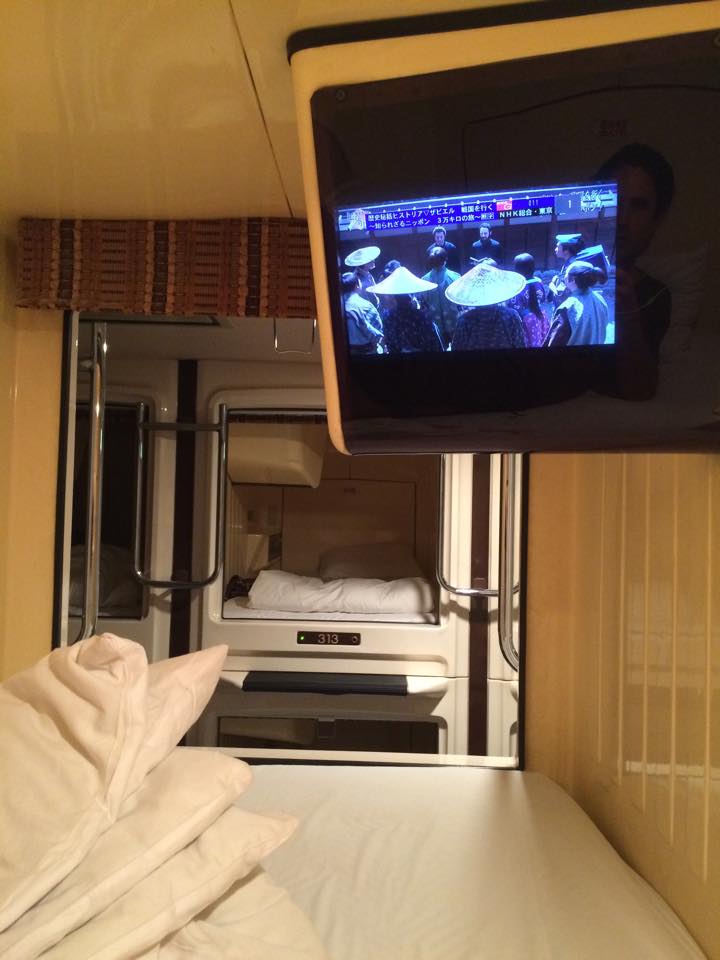
The capsules were arranged like train station lockers, stacked two-high in parallel rows with a walkway of perhaps two metres wide between them. Some of the guests had left their screens open and, with the rows of feet, it was hard not to think of a morgue. There were rubberised steps and a chrome grab handle to get to the upper capsules. It was like climbing onto the back of a truck. I would not like to try it if I were in no state to get myself home.

The capsule was much nicer than I had imagined, though. It was more cosy than claustrophobic. There was enough room to sit up and read, and a decent light to read by; and there was a television, in case I wanted to watch people being loud and hysterical in a language I did not understand. It was quiet enough with the screen pulled at the end and the sliding door shut on the communal area; but I wore earplugs anyway. Some of the drunker guests who arrived in the early hours made enough noise to wake me up as they tumbled in, but I slept at least as well as I ever do in hostels.

© Richard Senior 2015

Byron Bay: If You Can’t Surf or Skate, Do a Handstand

DSC_0205

No one in Byron Bay seems to do what parents call a proper job.

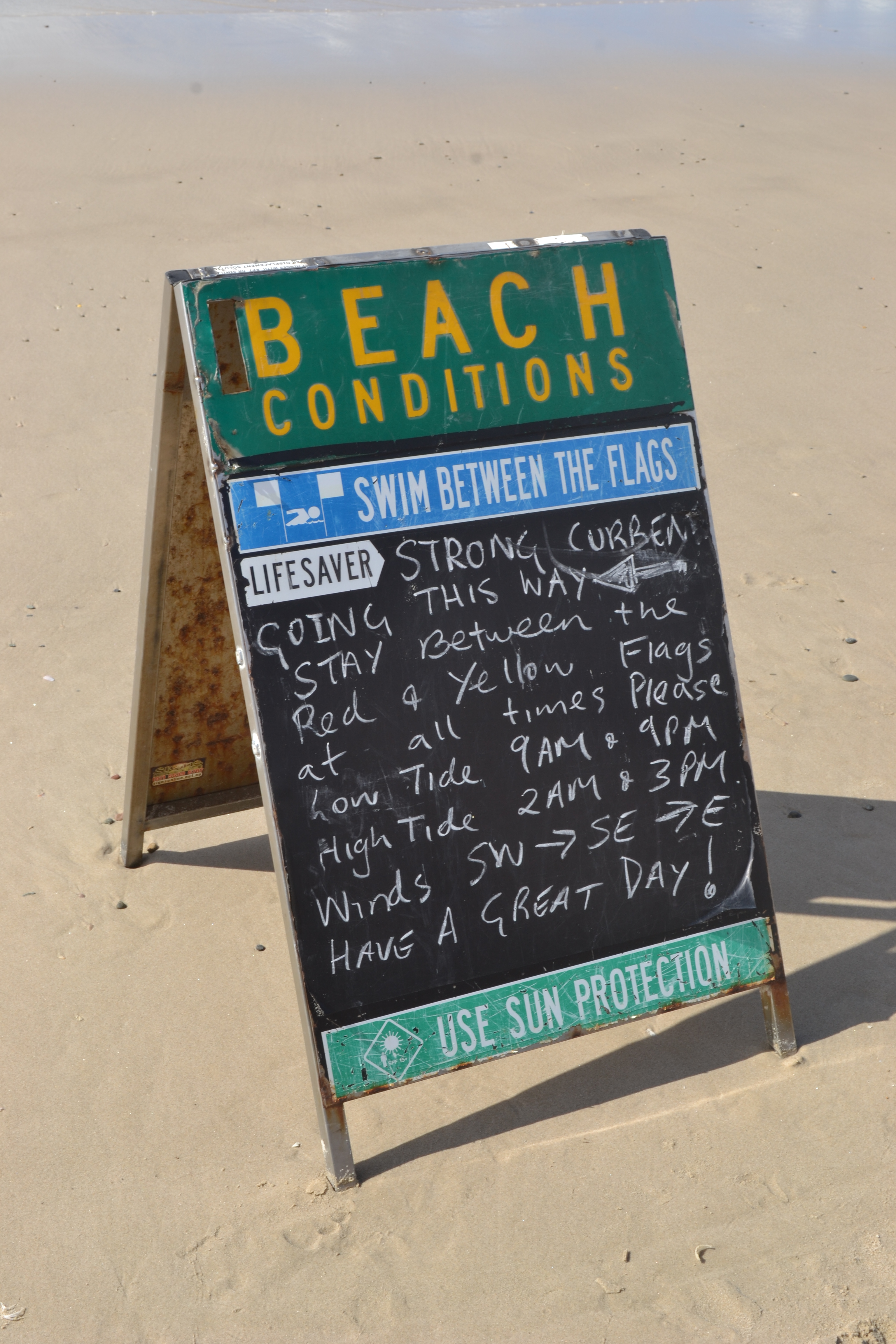
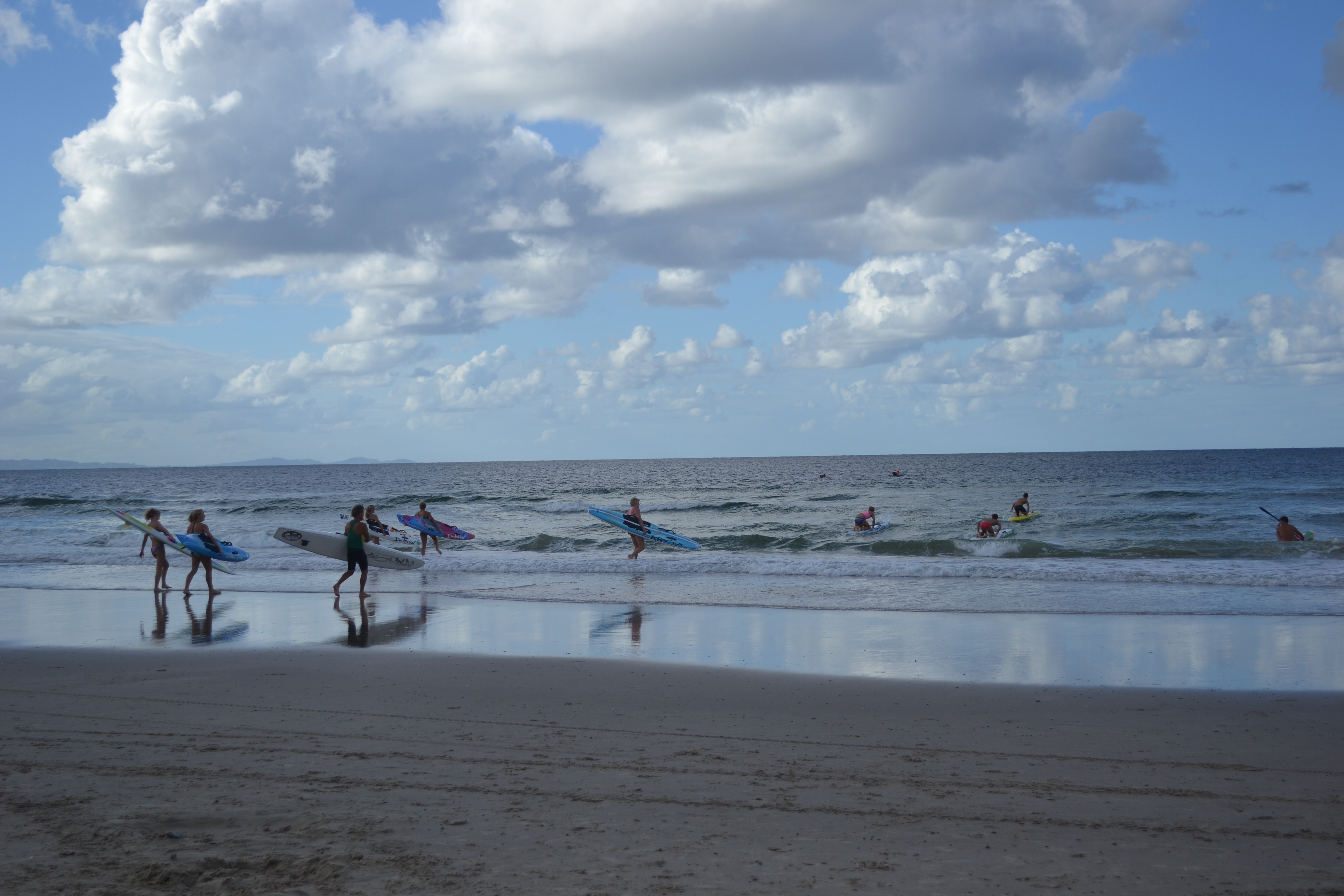
They run craft shops and galleries, surf shops and skate shops. They play Spanish guitars on street corners for dollars. They make and sell funky jewellery. Or they sit on the rocks and sketch. In their spare time, they surf. Everyone surfs. Old men, surf. Teenage girls, surf. Little kids surf.

You are never more than six feet from a surfboard. They are on sale and for hire in the shops. Strapped to the top of Volkswagen campers, slung in the back of vans, poking through the hole where the window used to be in an old Holden estate. Laid out in rows on the beach.

I watched the surfers riding the swell and gliding right onto Main Beach, or else falling headlong into the waves, then getting right up and trying again. It has got to be the coolest of sports.

But if the surfers are cool, the lifeguards are cooler, strutting about the beach, looking as if they have been carved out of marble. Those who are neither surfers nor lifeguards find their own way to be cool. One spent a day on the beach doing handstand after handstand. Another stood facing the sunbathers, juggling four balls without pause for a morning. He was not after spare change: just showing off.

DSC_0208

One evening I saw a guy on a mountain bike pop a wheelie and sustain it all the way down Jonson Street. A unicyclist passed him, going the other way. Guys in their twenties and thirties skate barefoot round town on old-fashioned downhill boards. I saw one the other side of 45 skating down Marvell Street. Even he looked cool.

Jonson Street, Marvell Street, Tennyson Street, Burns Street: it was all, apparently, a misunderstanding. Captain Cook sycophantically named Cape Byron after Vice Admiral The Hon. John Byron, whose grandson, George, would become a famous Romantic poet to help him pick up girls. But a clerk in Sydney assumed it was that Byron, and named the streets of the town after all the poets he had heard of.

I am not a surfer and I have not skated since I was 15, and I have never learned to ride a unicycle; so I went sea kayaking instead.

I paddled hard through the waves the surfers are there for, let them lift me up and carry me over and slap me back down at the other side; then again and again, until I was through and into smoother water. I spotted a pair of dolphins out to the left, leaping joyously out of the ocean: a wonderful sight. They slipped under the water and disappeared and I paddled on round the easternmost point of Australia.

The sun was hot, the sky was clear and it was hard to think of a more perfect morning.

© Richard Senior 2015

Graduating from Uyuni

DSC_0025

The bus driver stopped twice on the way to Uyuni: once to dump some old tyres at the side of the road, and once for a toilet break at a remote house with an outside loo. It was not at all obvious that the owners had said that he could. The women from the bus formed a long line to use the one toilet. The men, of course, pissed where they felt like.

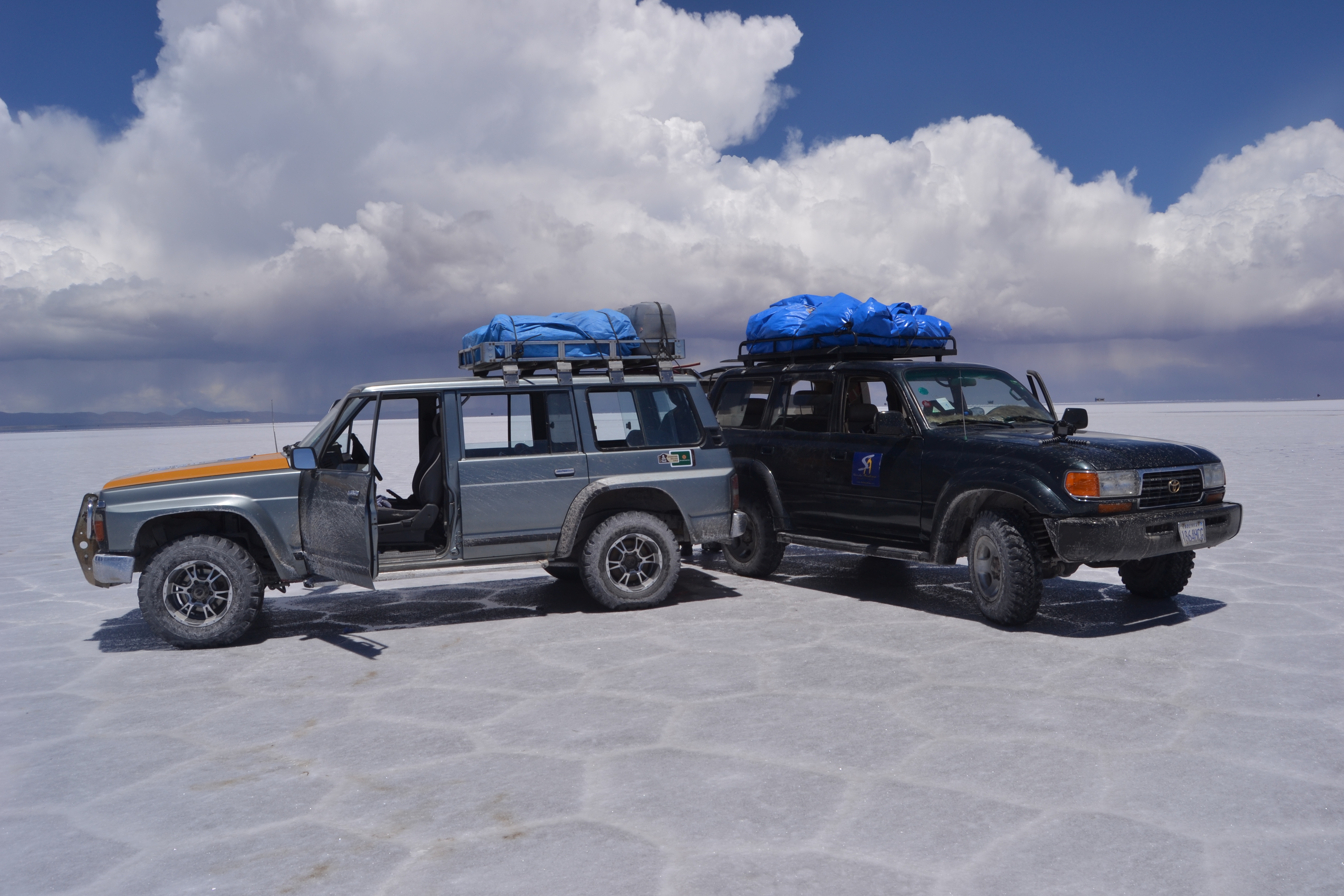
Uyuni is a small town with a frontier feel and the temporary look of a film set. The wind howls down the broad streets, whipping up dust, and you expect, when it clears, to see Eastwood, Van Cleef and Wallach among the filthy jeeps and kids on old BMX’s. It is a staging post for the famous salt flats. Every parking space is claimed by an overland truck with the logo of an ‘adventure travel’ company on the side, or a Land Cruiser belonging to one of the local outfits. Buses arrive as incessantly as planes into Heathrow, disgorging travellers, who struggle down the street under backpacks. Everyone ends up in Minuteman Revolutionary Pizza. It has a happy, hostel-like buzz, but the food is not at all revolutionary. I had spaghetti with ‘pesto’ which came from a jar, as I ought to have realised it would.

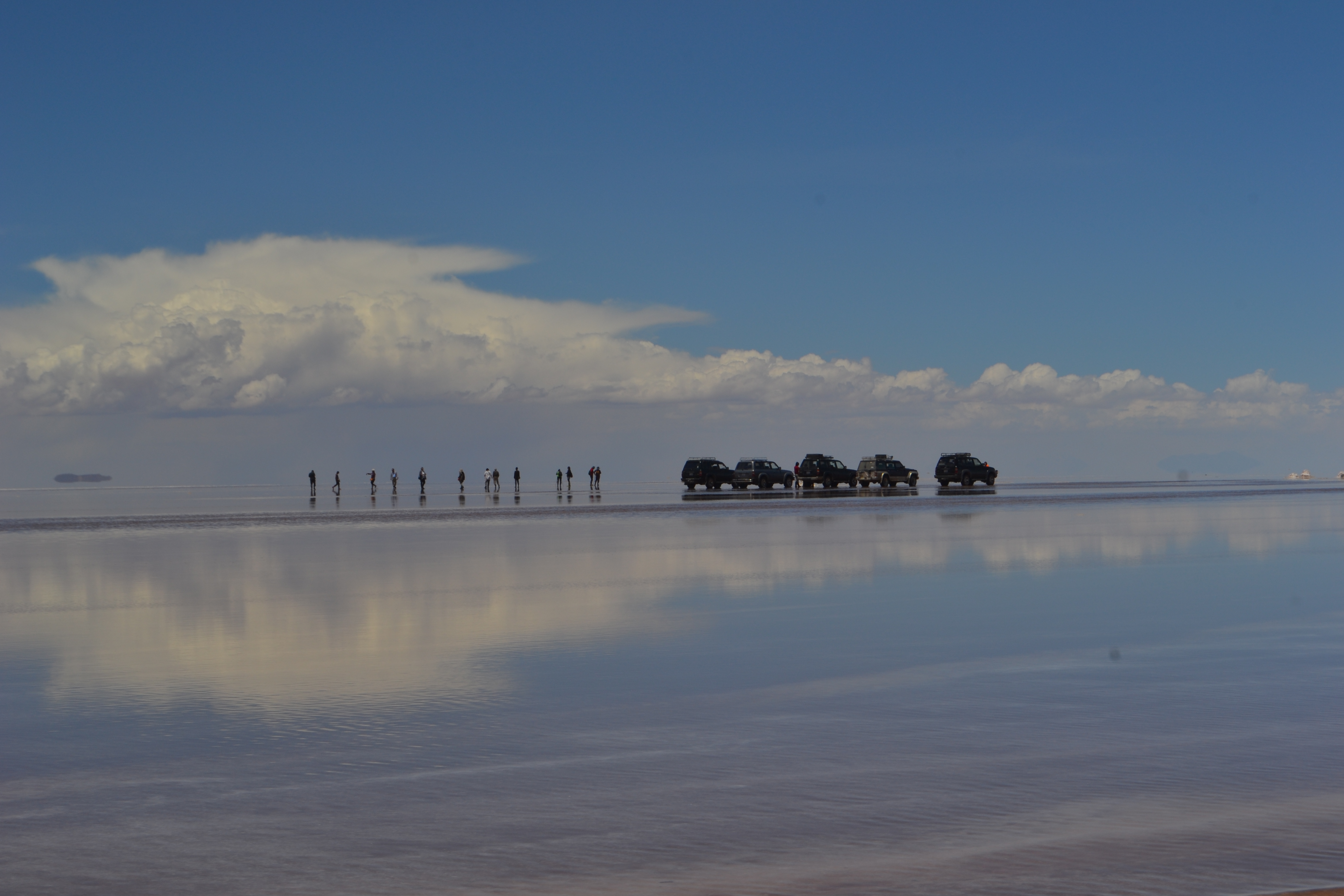
The Uyuni salt flats, the world’s largest, extend over 12,000 sq km, roughly the area of the Falklands; NASA uses them to calibrate satellites. The outer edges were still under water from the rains of a few days before, and through some alchemy I would not understand if a scientist patiently explained it, the salt, the sun, the water and sky came together to create a perfect reflection.

DSC_0987

The view from the jeep was a view as if from a plane: clouds above, clouds below, and clouds to infinity each side. Without a mountain or another jeep as a reference point, there was no way of telling where the salt flat ended and the sky began.

What used to be the Paris-Dakar Rally before fundamentalists forced it out of Africa had roared through the salt flats a few weeks before and Juanito drove as if training for next year’s event; he had the stickers on the flanks of his jeep already. Further into the flats, the salt was dry and cracked into pentagonal shapes. The sky was a searing, intense blue, the salt flat dazzling white. Flamingos occasionally scrawled a pink line between them.

The conditions induce psychedelic effects. I watched a column of jeeps roll along the horizon and distort into weird, trippy shapes; the bodies compressed, the wheels stretched like elastic, until the jeeps had morphed into a camel train. All sense of perspective goes: someone standing ten feet away looks beyond walking distance. A camera is as easily fooled as your eye, and we spent a giggly hour taking novelty pictures of the sort which appear in the brochures. I held a tiny person in the palm of my hand, then a giant dangled me from his fingertips, a group of us stood in a bowl, resigned to being eaten by a hundred foot man, then a big cartoon dinosaur chased us all away.

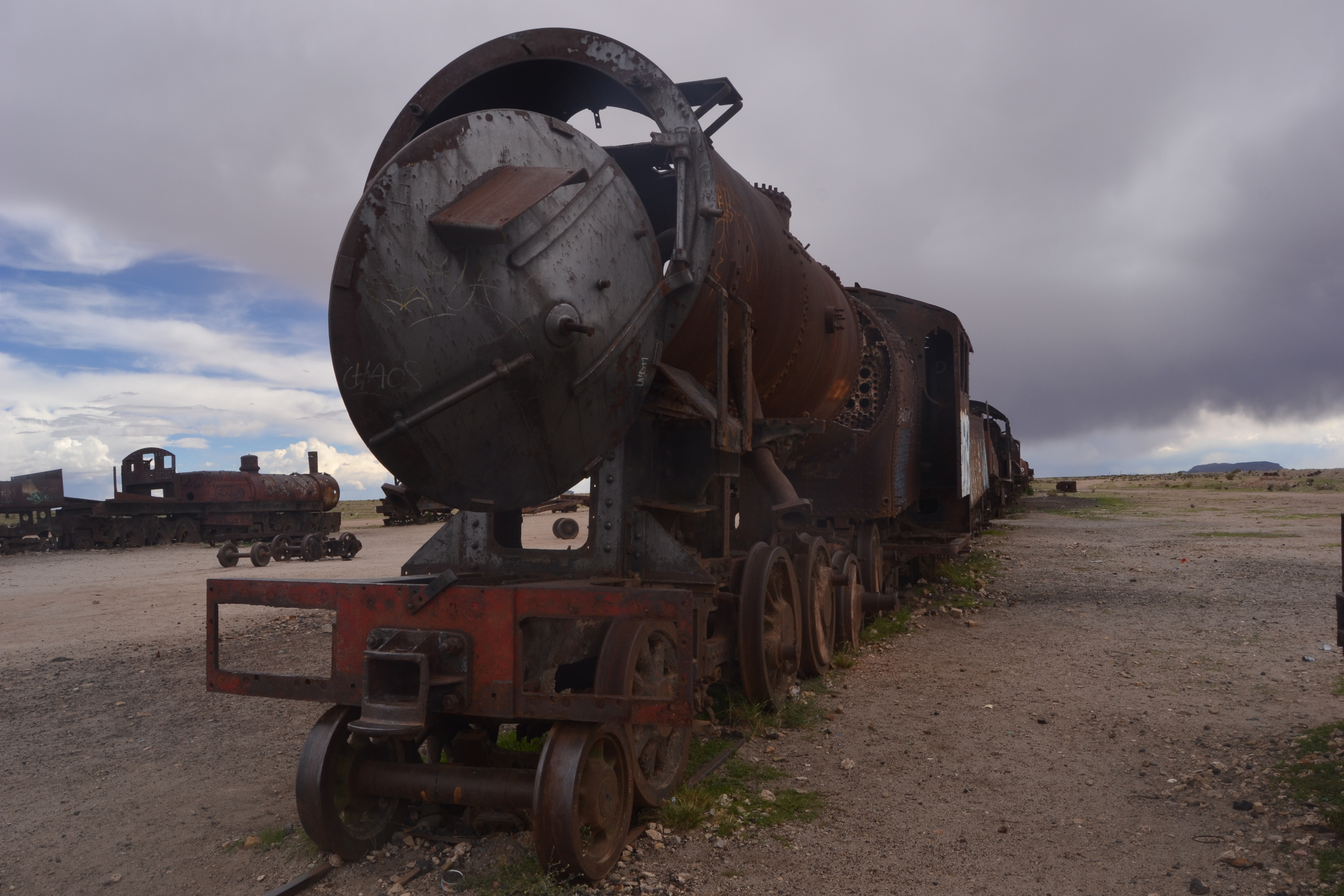
Near the edge of the salt flats, there are two long rows of rusting steam trains, sunk into the ground to their axles. They call it El Cementerio de Trenes. The trains were apparently abandoned there when the mines they worked closed in the 1940’s, but someone has gone to the trouble to arrange them artistically in parallel lines and hang children’s swings from a few. Others have gone to the trouble to steal anything worth a few Bolivianos.

DSC_0032

We turned south and drove on until late afternoon, then stopped for the night in a one street town with a cluster of houses, a shop and a backpacker hostel. The room smelled like laundry left in the machine for a very long time and the bed felt like concrete. It was concrete. But I slept better there than I often do at home. Perhaps I should build a bed out of concrete; and, when my neighbour asks me what I am doing with the cement mixer, I can tell him I am making the bed.

© Richard Senior 2015

Gangneung: Sun, Sea and Spy Submarines

rsz_dsc_0261

It was a magnificent coastline. The rocks extended out into the sea, an abstract beauty above the surface, a dark shadow beneath. The water was turquoise near the shore, fading to deep blue further out. There were stripes of white sand at the foot of the cliffs.

Yet no one sat on the beach. No one paddled in the sea. No one clambered over the rocks. They might have been shot if they had.

A sturdy fence surmounted by razor wire stretched along the coast. The waves broke onto tank traps. There were watchtowers every few hundred yards, manned by camouflaged soldiers with heavy machine guns and rifles.

fence-3367298_1920

I missed the stop for Unification Park and got off at the next one and set off walking down the coast road, along the security fence. There was nothing to stop me, but it felt like I ought not to be there. It was as if I were walking through a war zone. There was no one else on foot.

It was a hot morning and pleasant to walk and silent except for the droning of insects and the occasional car on the road, and there was a glorious view through the fence. But I could not help but be anxious.  I wondered how I would explain myself to an excitable soldier with whom I had no words in common.

I had laboriously copied 통일공원 – Unification Park – on a sheet of paper to show to the bus driver (he had nodded, then shot past the stop); but I saw the scope for a terrible misunderstanding if I reached for my pocket when challenged by men with guns, so I took out my sheet of paper and clutched it as I walked down the road. I wished that I had not brought my daypack.

shutterstock_1229880634

I tensed whenever I walked towards and past a watchtower, and deliberately did not look up at the soldiers, but there was never a shout, or – worse – the click of a safety catch. A troop carrier seemed to slow as it passed me and I thought that it was going to stop, but it was just that the driver was struggling with the hill.

Then a company of fully-armed combat troops with rifles, packs and steel helmets marched up the road towards me. I held my breath as they came close but they marched past, an inch away, as if I were not there at all. It was a routine patrol.

There is good reason for the strong-armed security. One night in 1996, North Korean commandos landed on the shore nearby. When the submarine came to collect them after their spying mission, it snarled up on rocks and stuck fast. The captain burned his papers and tried to destroy sensitive equipment, although it would probably have been of more interest to museums than military intelligence.

DSC_0253

He and ten others were later found shot dead, presumed, by some, to have been executed for negligence. The other fifteen tried to sneak back to the North on foot. They stole food, stabbed three civilians, strangled a soldier and stopped at a ski resort to play video games; but after a frantic seven-week manhunt, all but one had been killed or captured. No one knows where the other one went.

The submarine is on walk-through display at Unification Park. It is claustrophobic enough when you squeeze through it alone with all the hatches open: unthinkable to spend days at a time locked inside it with twenty-five others struggling for space between the engines and bulkhead, the pipes, the gauges, the valves, and the periscope tube. It has had a fresh coat of paint on the outside, but there are still the scorch marks and melted radios in the cabin, and a smell of oil and diesel.

Nearby, there is an old American destroyer which went into service a few weeks too late for the War in the Pacific but got its chance to fire at North Vietnam twenty years later, before it was sold to South Korea. It is claimed as the only warship displayed on land anywhere in the world. I doubt that, somehow; but I cannot immediately think of another, and the point is too trivial to research.

© Richard Senior 2015

Watchtower image via Shutterstock

Fence image via Pixabay

To Set Foot on a Foreign Land

Red_Phone_Box

The whole object of travel,” wrote Chesterton in The Riddle of the Ivy, “is not to set foot on foreign land; it is at last to set foot on one’s own country as a foreign land”.

The parochialism of the British newspapers seemed laughable after six months away. They wrote as if the nation’s power and influence were unchanged since 1860, as if it were in a Cold War with the European Union, whose member states were all virtually communist, and as if the entire population of every country outside the OECD were determined to come to Britain to claim Job Seeker’s Allowance, and would if the borders were not kept on a war footing. I had forgotten all that.

I had forgotten, too, that everything here always seems to be broken. The toilet at the airport did not flush; no water came out of the taps, no air came out of the hand dryers. The trains were delayed, as they usually are; several were cancelled, as ever. Every third or fourth shop on the high street had a fading To Let sign in the window. Some big names had gone bust while I had been away. Pawnbrokers were back, although they were not called that anymore.

I got cash from an ATM and stared at it for a moment, nonplussed. Sterling looked like something from a museum: so big, so thick, so conservative in design. No one else’s currency is like that.

It was a five hour journey on four trains to get up north to see my family. Six months earlier, I would never have contemplated it straight after an overnight flight. But it no longer seemed such a big undertaking. In Australia, in New Zealand, in the States, I had routinely spent seven or eight hours on a bus, sometimes day after day. My sense of scale had changed.

For a time, I saw home as a tourist sees it. I noticed the black cabs and red buses; the unarmed policemen; the bluebell woods and the drizzly skies; the thatched cottages and cricket greens; and, less happily, the casual destruction of century-old buildings to make way for disposable office blocks.

The gratuitous thank yous and sorrys seemed quaint now; and it was alarming to see – underneath the civility – a constantly simmering aggression. There is the baffling hostility from shopkeepers who need your custom to stay in business, the tuts and muttered insults in the supermarket aisle if your trolley crosses somebody’s path, the furious faces of the commuting crowd, the people who leap from their cars at the lights and scream obscenities at some other driver, and the virtual certainty of seeing a serious fight if you go out for the evening.

What was wrong with everyone, I wondered. Where was their sense of proportion? Why did they let themselves get so angry over so little? How could someone end up in intensive care because he, or the other guy, spilled a drink?

Seemingly I had set foot on a foreign land.

© Richard Senior 2015

Image: “Red Phone Box” By Dunpharlain (Own work) [CC BY-SA 4.0 (http://creativecommons.org/licenses/by-sa/4.0)%5D, via Wikimedia Commons