Climbing Sydney Harbour Bridge

DSC_0751

For generations, Sydneysiders tumbled out of the pub, looked up at the Harbour Bridge and felt compelled to climb it, in the way that others are compelled to make a hat of a traffic cone. They used to be able to scale the gate, negotiate the spikes at the top, then go up the steps to the arch.

The legendary climber, Bryden Allen, did it the hard way. He squeezed into one of hangers from which the deck is suspended, climbed 200 feet up the inside (“rather like caving…great fun”), roping onto struts, until he got to the lower chord of the arch, where – in his estimation – the “real climbing” began. He had to stretch backwards to reach the lower lip, grip on rivet heads, let his feet fly out into space and force himself up onto the ledge with his arms, and once there, repeat the move on the upper lip six feet above him. “From there the climb [was] easy,” he reckoned.

A decade later, the French high-wire artist, Philip Petit, climbed the bridge one night, strung wires between the pylons and walked across them in the early morning in full view of the rush-hour traffic. The police were good-humoured about it, even when Petit continued performing by relieving one of his watch and tie; but they arrested him anyway and the court fined him $200.

By 2011, when the former soldier, Michael Fox, climbed the bridge to protest the custody laws, the fine had gone up to $3,000 and there was talk of three months in jail, but the judge might have seen the irony of a custodial sentence and left it at a fine.

DSC_0036

The bridge is now watched by CCTV and patrolled by security guards and, in this jittery age, it is too easy to imagine a drunken prank being misread as a terrorist incident and some poor student being shot down from the arch by snipers.

But anyone with $228 (£140, US$170) to spare can now climb the bridge quite legally. Prince Harry’s done it, Oprah’s done it, and Usain Bolt, Katy Perry and Matt Damon. So have I.

The breathalyser seemed an unnecessary precaution at half-past ten in the morning, but the whole thing is organised like a commando assault.

Once the Climb Leader was satisfied that nobody was drunk, she handed us each a pair of overalls in BridgeClimb’s corporate colours and sternly warned us not to take anything out onto the bridge: not a camera, not a phone, not even a handkerchief. It seemed, again, a bit over the top, but then I suppose a dropped handkerchief could do plenty of harm if it draped itself over a motorcyclist’s visor.
DSC_0002

We were allowed sunglasses, provided they were secured with a cord round the neck like your Grandma’s reading glasses; and there was an optional clip-on BridgeClimb cap for anyone who wanted to look more of a dick than they already did in the overalls.

Then, once we had gone through a metal detector to check that we had done as we were told, there was a training session to make sure we were familiar with steps and ladders – just in case we had reached adult life without using them. We were kitted out with harnesses and one-way radios and, as often in Australia, more or less forced to apply sun cream.

We went out in single file behind the Climb Leader, clipped into the lifeline and followed her up a series of service ladders, as the cars and the bikes and the trucks thundered past, through manholes, under stanchions, watching elbows and heads, until we came out on the top of the arch. Helicopters constantly buzzed the bridge, as if this really were the military exercise it felt like.

It was thrilling, in its way, but it is not really an adrenalin activity. There is no sense of danger. A clumsy person could probably twist an angle or even break a leg, but a clumsy person could break a leg walking to the shops. It is hard to see how someone could fall off the bridge by accident.

BRIDGE CLIMB

It is worth remembering that none of the 1,400 men who worked on the bridge between 1924 and 1932 used any protection at all, and only two of them fell off. They only had rivet heads as footholds, too: now there are steps welded into the arch. It is, in truth, more of a walk than a climb.

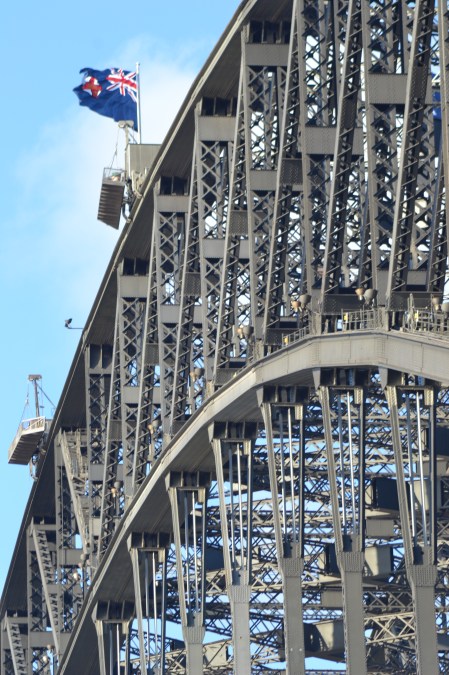
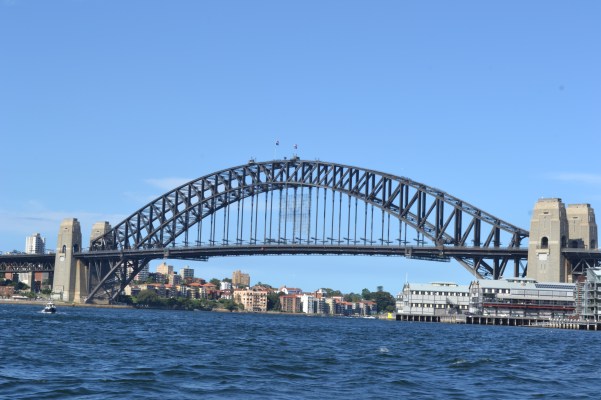
Nonetheless, it is quite something to see the business end of the bridge close up. You get a much better sense of its scale than you ever can from ground level. The Climb Leader told us that it was 440 feet above the harbour at its highest point, although to be annoyingly pedantic it is actually 440 feet above mean sea level. She also said that it was the longest single-arch bridge in the world, and apart from five others, it is.

The view silenced everyone: right across the harbour, over the Opera House, the Botanic Gardens, the Rocks, Circular Quay and the financial district beyond it, out east over Bondi Beach, north over Luna Park and Manly, and west towards the Blue Mountains. It is worth your $228.

We crossed over to the western side of the arch and walked back towards the south pylon, down the ladders and inside. I had lost all sense of time while I was out on the bridge. It felt like half an hour, perhaps an hour, had gone by but in fact it was three and a half.

© Richard Senior 2016
Alms and the Monks: Luang Prabang

DSC_0463

The gong sounds at 5am and the monks rise and gather in the prayer hall and chant. As the sun comes up, they leave the temple and walk, barefoot, with alms bowls hanging from shoulder straps towards Sisavangvong Road.

Each of the city’s thirty-three temples disgorges its monks and novices and they converge on the main street and join the long line –a few hundred strong – of bright orange robes, shaved heads and alms bowls.

DSC_0367

The locals, and often Western travellers, kneel along the side of the road to await the procession, shoes slipped off respectfully. As each monk passes, he slides the lid from his alms bowl, wordlessly and without expression. A woman, making sure to keep her head below the monk’s as tradition demands, tosses in a ball of sticky rice and he slides the lid back on. The city is silent except for the padding of bare feet on the pavement and the scraping of the lids on the bowls.

Luang Prabang, with its fairytale name, is embraced by the mountains of northern Laos, and scored across by the broad Mekong River and the sinuous Nam Khan. It is the fourth largest city in Laos but that translates to the scale of a small town in Europe with half a dozen major streets and a population below 50,000.

DSC_0496

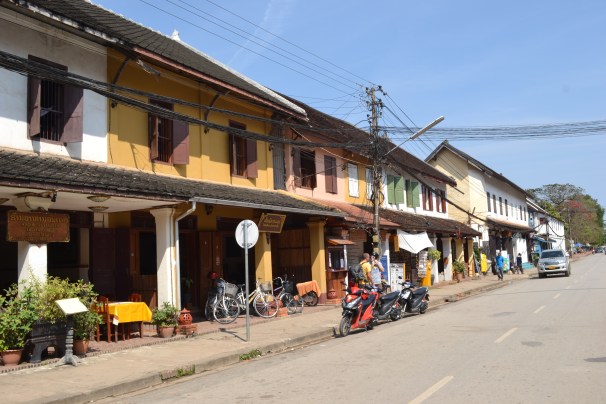
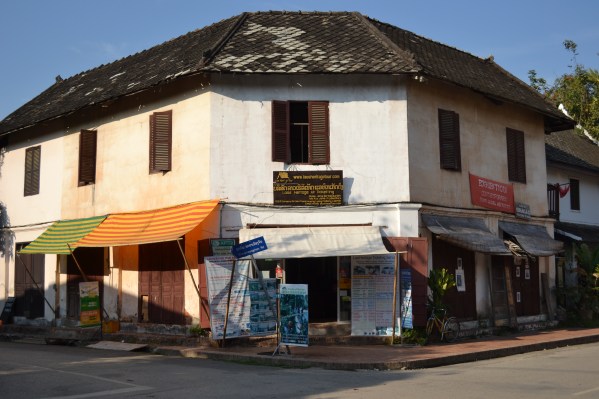
It is compact enough to see in a day, but absorbing enough to be worth staying for several. It is calmer even than Vientiane, but not so soporific. The main roads are lined with colonial buildings with porticos, balconies and shutters; the side streets with traditional wooden houses. Bougainvillea bushes explode over walls, palm trees stoop towards roofs.

The monks glide in and out of view. The smell of incense wafts from the temples. The gongs sound, the monks chant. There is a gentle thudding of drums, a clash of cymbals, a howling of lutes and plinky-plunk of xylophones.

DSC_0470

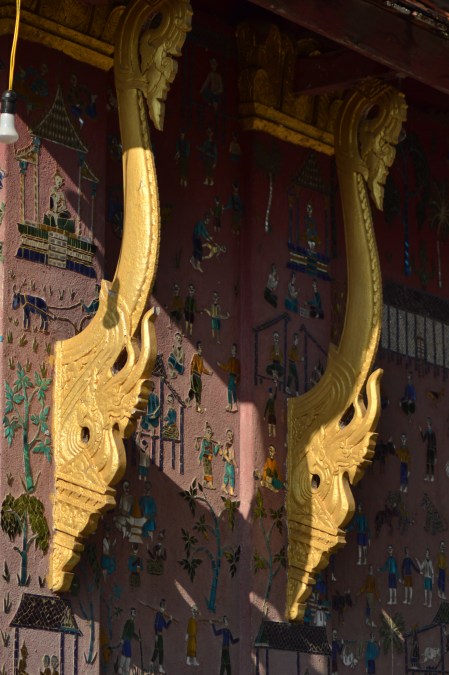
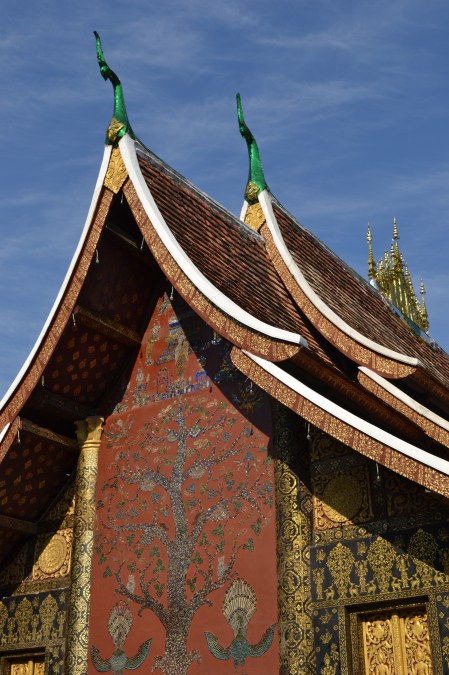
The swooping roofs of the temples are stacked three-deep and topped by horn-like finials formed into the shape of nagas*; the facades are gilded and intricately carved, and there are glass mosaics telling epic stories of birth and death, work and play, town and jungle, hunters and fishermen, elephants and tigers.

Luang Prabang is an established stop on the Banana Pancake Trail, and increasingly on the mainstream tourist trail, as well. But the Western interlopers have not taken over in the way that they have in Vang Vieng.

DSC_0580

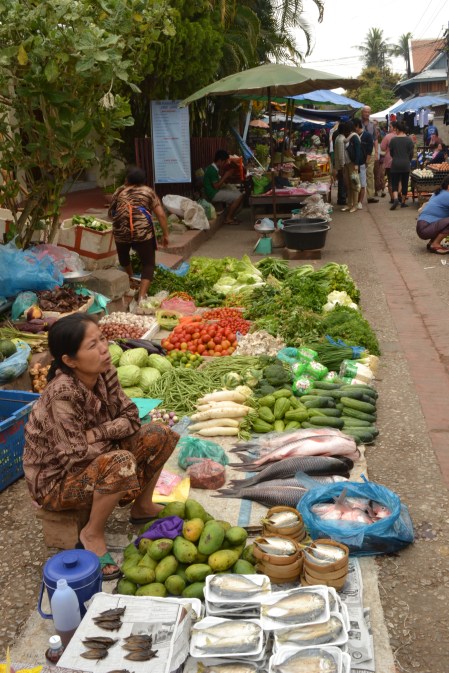
There are agents all along on the main street, offering mahout training, bike tours and transport across the border to Thailand. But just a few steps away, there are buffalo sausages drying on racks, chickens scratching in the trash and street markets which make no concessions to tourists with raw fish laid out, right next to vegetables, on sheets on the road, smaller fish twitching in bowls of water and blood running down the street from the meat stall where every bit of the pig but the squeak is piled up for sale.

It is noticeable, though, that quite a few businesses are run by falang** as if they arrived, years ago, with a backpack and the idea of staying two or three nights but could never quite bring themselves to leave. It is that sort of place.

© Richard Senior 2016

*River serpent

**Loosely “Westerner(s)”. Cf. Thai farang and Khmer barang.

En El Hospital

DSC_0848

In Argentina I was bitten by mosquitoes. Then I was bitten by bed bugs. I had lost count of the bites by the time I got the ferry to Uruguay – and, there, I was bitten by sandflies, or something as small and pugnacious. Dozens of them died in the DEET on my legs; dozens more got through and bit me. Horrible things.

One bite smarted as if I had been stung by a wasp. I ignored it until late in the evening when it blew up like a balloon and turned yellow.  I slapped a big plaster on it until morning, then went to the pharmacist for antihistamines and more plasters. I showed her the bite.

“¿Do you have médico?” she asked

“Medico?” I guessed she was talking about some kind of insurance scheme until I dredged up a memory from my desultory attempts to learn Spanish. “Oh! Have I seen a doctor? No, I haven’t.”

“Deberίas: you eshould. Pienso que might be espider.”

“A spider?”

“Sί, espider.”

Where do I go?”

El hospital. La próxima block.”

There were a dozen or more clinics crammed into two cross streets, each covering a separate discipline but my Spanish was too hopeless to work out which was which, and they all, in any case, had the sleek corporate look of institutions who specialise in sending big bills to insurers.

But there was a grubbier building with “Emergencias” on the sign above the door and no smart reception with blonde wood floors and expensively bland art on the walls. It was the familiar chaos of an A&E unit with coughing, sneezing, crying children, hobbling adults and ice packs clamped over painful bits.

¿Sί?” said a guy in a white coat, and I explained – in English – why I was there.

No espeak espanish,” he said with a smirk and seemed to think it was a clever line, because he sniggered and repeated it to several other people. Nobody laughed except him.

Someone else pointed to a sliding window in the far wall and I went over and spoke to the guy inside and he had no English either but called over a girl who spoke Spanglish like the pharmacist and took me through to the accounts department.

No espeak espanish,” the sniggering man called out to the girl as we passed, but she ignored him. I imagine that happens to him a lot.

You need for to pay,” they told me in accounts.

How much?” I asked, but they didn’t want to talk about figures until they had swiped my card and then, when they found out what card I had, didn’t want to talk to me at all. They sent me over the road.

No aquί,” they said across the road.

¿Hablas Inglés?” I asked, but they didn’t. Nada. No una sola palabra. Lo siento.

But where should I go, then? ¿Donde?

“Fuera de la clínica, a la izquierda, ir a la vuelta de la esquina, traverser la calle, y hay un edificio blanco con un rótulo de «emergencias»*.”

I gathered from the gestures and the occasional word I understood that she was directing me back to the hospital from which I had come.

“Erm, I think that’s where I’ve just been and they sent me over to you?”

“Fuera de la clínica,” she repeated with a sigh, louder and a little more slowly, although it was still just a blur of sound to me,“a la izquierda, ir a la vuelta de la esquina, traverser la calle, y hay un edificio blanco con un rótulo de «emergencias».”

Oh bollocks to it, I thought, and went out to enjoy my day.

But my mind always looped round to spider bites. What kind of spider? Why did the pharmacist think I needed to see a doctor straight away? In the end, I had to go back to the hostel and get onto Google.

It seemed clear enough: if you were bitten by the sort of spider toxic enough to leave a blister like that – and assuming it didn’t kill you outright – you either had to be rushed straight to intensive care, or there was not much a doctor could do for you, except prescribe things which you could buy over the counter, anyway.

But the blister got bigger overnight and I read some more about spider bites and found horror stories – admittedly in sources like The Daily Mail – about people who had been bitten and left the blisters to take their course and ended up with agonising ulcers, gangrene, and worse.

I was due to go back to Argentina, up to the far north and then down to Patagonia, but I would not, now, be able to do the trekking and climbing I had planned. I thought that the bite would more likely than not turn out to be nothing to worry about; but if there were any real risk of getting the symptoms I had read about, I wanted to be at home, not in a backpacker hostel, still less in a hospital where hardly anyone spoke English.

So I went back to BA and got the next plane but one to London.

© Richard Senior 2016
*I’m sure this is terrible Spanish. It’s the gist, of course, not the actual words.

Slow Boat to Amsterdam: a Sailing Diary

DSC_0543 - Copy

In the summer of 2012, I worked a passage from Stavanger to Amsterdam on the Dutch tall ship, Wylde Swan. I kept this diary, of sorts, with the idea of writing it up into a feature, which never happened: 

Thursday, 30th August

Arrive in Stavanger in the late afternoon. Blustery day. Call up the number and they come to collect me in the tender and take me out to the ship, which is moored off a small island. Dutch skipper, German mate, Danish engineer, German cook.

The Swan was originally a steamship, built in 1920, on a German flag. It was a herring boat, built for speed. A Dutch outfit bought the hulk in the Noughties and refitted it as a two-mast topsail schooner – biggest in the world, apparently.

More of the crew arrive in the evening, two Dutch, one British (but born in the Netherlands).

DSC_0774

Friday, 31st August

Bright and sunny in the morning. Not sailing until evening so get the tender into Stavanger, look round, take photos, get lunch.

Back to the ship. Three more crew aboard, one German, two Dutch.

Sail around 5pm.

I’m on the 1pm-8pm and 1am-6am watch, so I’m on straight away. Weigh anchor. Slip out of harbour. Stop alongside another ship for the last crew member (Norwegian) to jump aboard. Get a couple of stay sails up. South, south, south…

Can’t sleep. Read until midnight. Shaken awake at 12.30. Back to work.

DSC_0757

Saturday, 1st September

Still heading south. Up on the roof at 4am sweating a sail down, gathering and tying. Trimming and tidying; hauling ropes and cranking winches.

Sailing ships are incredibly noisy things: banging and clanking, creaking and groaning. The wind howls across the deck, slapping hard against the sails. It means I can shout and swear when I repeatedly make a mess of coiling a sheet, and nobody hears me.

The sun is coming up and I want to stay and watch it, but I want to sleep more. It comes easily this time.

Ship pitching heavily when my next watch starts at 1pm. A few of the crew are seasick. But it’s a dull watch. Not much to do. A couple of sails up, a tack, but mostly pootling along on the motor. Cloudy and cold but no rain.

I stare out to sea for hours. It sounds dull but it’s more peaceful than anything I can remember. No rushing, no deadlines, no shouty emails.

DSC_0741

Sunday, 2nd September 

The work always seems to be in the early morning watch. Strong wind across the deck. Ship heeled right over. Deck soaked. Hard to stay upright. A few involuntary sit-downs. Stretch the safety net across the leeward side so no one goes overboard. Stay sails back up. Exhausting first two hours then quiet after that. Quiet and cold.

Only me and the watch leader still standing. Everyone else on the watch is seasick. I can understand it. The ship rolls and pitches and suddenly the horizon rears up at a 30 degree angle. But thankfully I don’t get seasick.

We reach Danish waters around midnight, down the coastline, past the oilfields. Rigs lit up like Harrods at Christmas. The computer shows tankers all around us but none is in sight. The watch leader shows me how to fill in the log and I do it next time.

Still cloudy at lunchtime. The last watch put up the jibs and top sail. It looks more like a tall ship should now. No mainsail though. It takes 10 men to raise it. They call it “the Bastard“.

Two thirds of the way down the Danish coast by 2pm, heading for Germany. I belatedly hoist down the courtesy Norwegian flag. We forgot about it until now. Don’t suppose it matters.

There was talk of being in Amsterdam tonight but the skipper thinks lunchtime tomorrow at best. We take it for granted now that we can be anywhere in Europe in two hours, and anywhere in the world within the day (more or less). Everyone travelled like this until a couple of generations ago. It used to take a couple of months, I think, to get to Australia.

Another quiet afternoon. Ship porpoising gently. Cruising at around 6 knots. A cruise ship going north is about the only thing I see for an hour. Not even any gulls here. The mate has resorted to cleaning the ship. Must be bored.

And then it starts drizzling.

Slight change of course to break the monotony. Re-trim. Swing on the grinder. Make a mess of coiling the sheet again. How hard can it be for fuck’s sake?

DSC_0738

Monday, 3rd September

The 1-6 watch is hard. Just as you start to get properly to sleep, some bastard wakes you up and makes you crawl from your bunk and put waterproofs on.

We are in Dutch waters now, I think. Tracking 190 degrees. Cruising at 7 knots. Busy waters here. Tankers all along the horizon.

A quiet watch. Some trimming of sails, nothing too exciting. Music and tomfoolery on the quarter deck.

Dutch coast in sight at 10 30. Sun out too. The last watch has pulled the sails down. Just motoring all the way now: into Ijmuiden, through the locks and down the canal to Amsterdam. Due in early afternoon

Sunbathing on the half deck until my watch starts; sunbathing a while longer as well. Nothing much to do.

On the outskirts of Amsterdam we monkey out on the nets round the bowsprit and pack the sail. Six of us wrestle with the bloody thing to wrap it into a sausage, get it onto the bowsprit and tie a daisy chain round it. People on the bank whip out phones to photograph us and that feels good.

We arrive around 3pm, throw fenders over the side and moor up. Climb the rigging – like something out of a movie – to lower and tie up the topsails.

 Grab my bag, say goodbyes and wander towards Dam Square.

© Richard Senior 2016
Cycling the Shimanami Kaidō

image1 (9)

I set off too late from Hiroshima, then got the wrong train, and it was going on for lunchtime when I reached Onomichi. But I decided to skip lunch because I wanted to cycle at least some of the Shimanami Kaidō between the eight islands, from Honshu to Shikoku, across the suspension bridges over the Inland Sea.

I have since read about travellers planning and training for the ride for weeks and basing their trips to Japan around it, but I am too spontaneous, too chaotic for anything like that. I had found out about the Shimanami Kaidō by chance a day or two before when looking for something else in the guidebook.

It is a 70km (43 mile) route, end to end, and my guidebook reckoned it would take somewhere around eight hours to ride, which to me seemed too pessimistic. I reckoned four or five.

IMG_2979

The rent-a-bike point was hidden in a car park but I found it eventually and chose a cheap ‘mountain bike’ over a selection of old ladies’ shopping bikes. I revised my estimate to five or six hours when I saw it, dropped my daybag into the basket and rattled along the waterfront to the ferry across the Onomichi-suido Channel. I had picked up a map of the route but it was, in any case, marked with blue and white lines on the road. It would be hard to get lost.

If I wanted my deposit back, I would have to return the bike to Onomichi before 6pm, but the deposit was only ¥1000, or £5.89. (The hire cost was half that, which made it a cheap afternoon’s entertainment.) I saw when I skim-read the back of the map that I could drop off the bike at the end, or at points along the way, and take a bus back; and that was all I needed to know, for the moment.

The bike was too low-geared to go anywhere fast, but the route was flat – or at least so it seemed after the merciless hills of northern England – and the sun was hot and it was a perfect day for cycling. The route took me through a slice of Japan which you rarely see as a tourist, neither the sleepy towns of old wooden houses, nor the bustling cities of neon-lit skyscrapers, just workaday hamlets with a few houses and shops, a filling station, then nothing until a big-hammer factory, and nothing again for the next ten minutes.

IMG_2969 edit

I tracked diagonally across Mukaishima Island and came out at the waterfront and followed its contours round towards the Innoshima suspension bridge. The blue and white lines led under the bridge and round a corner and then twisted back on themselves up a steep hill which spiralled to the cycle lane of the bridge suspended beneath the roadway.

Two hours in, I had worked across Innoshima Island and traversed the Ikushi Bridge, with orchids lining the approach road and big barges trundling underneath and the sun glinting off the water. I was on the fourth island of eight and seemed to be making good time.

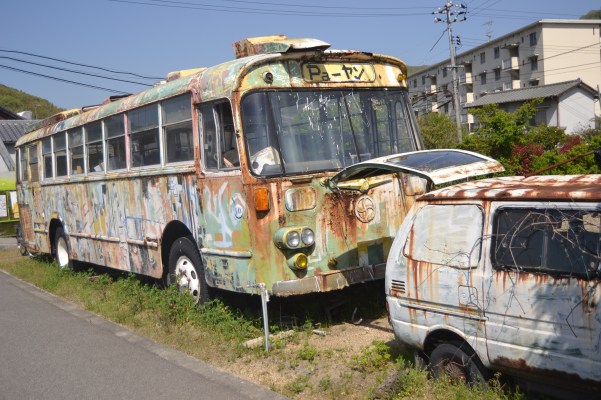
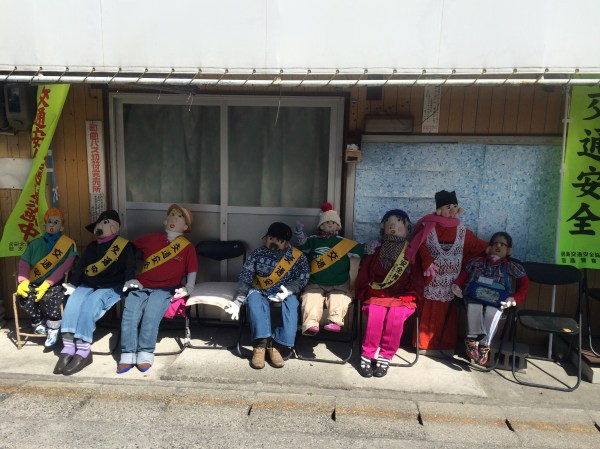
There is apparently a temple worth seeing on Ikuchijima Island but I was too focussed to detour to it, and in any case I had been to Nikkō, Nara and Kyoto already on that trip and would not feel cheated if I never saw another temple. There were, as well, a few curiosities at the side of the road: an old bus in faded psychedelic paint in the style of Ken Kesey’s Furthur and a group of life-size dummies seated in a row as if they were waiting for a bus.

DSC_0837

It took me somewhere around an hour to get to the next bridge, 36 kilometres from Onomichi, a little over half way to Imabari. I had, it seemed, been wildly optimistic to think that I could finish the route in four hours but about right with the more conservative six. I was not sure why the guidebook thought you needed eight, but then the map said eight to ten and I have since read that some travellers spread the ride over a couple of days.

I could still, just about, have turned the bike round and headed back to Honshu before the rent-a-bike terminal closed, but I was enjoying myself too much for that. The other terminals, I saw when I read the back of the map properly, closed at 5pm. There was an outside chance that I could get all the way to Imabari on the edge of Shikoku and find the terminal in time, but it was no more than an outside chance.

There were three other terminals along the way, so there was no need to give up just yet. It was a lovely ride along the waterfront on Omishima Island and across the arched bridge to Hakatajima, where I caught up with a group of serious cyclists with sprayed-on lycra and bikes made from carbon fibre and fresh air and passed a couple of them; but there was too much face to be lost in being overtaken by a tourist in street clothes on a pig-iron mountain bike, so they clunked down a gear and streaked past me.

IMG_2976

I decided as I snaked through the national park to the west of Hakatajima Island to drop off the bike at the next terminal, just before the Hakata-Oshima suspension bridge, the last but one before Imabari. I only had 20km left to ride to the end of the route, and plenty of energy, but by then it was clearly too late to get there before 5pm.

I imagined the bus interchange to be a big building with helpful things like timetables and an information desk, but it was actually just a turning circle with a few wooden shelters. There was no one else around. In a few of the shelters, there were photocopied sheets with bus times on them but the destinations – naturally – were only in Japanese. The last bus going anywhere seemed to be at half-past five.

At somewhere around twenty-past, a bus pulled in but the driver denied that he was going to Onomichi.

IMG_2975

Of course I had no contingency plan and I thought I would be lucky even to find an English-speaker within reasonable walking distance, let alone a hotel or a taxi firm. If it came to it, I supposed I would just have to walk back to Honshu.

But then, at something to six, the bus turned up.

© Richard Senior 2016
Eating up Vietnam #5: Hanoi

Copy of DSC_0077

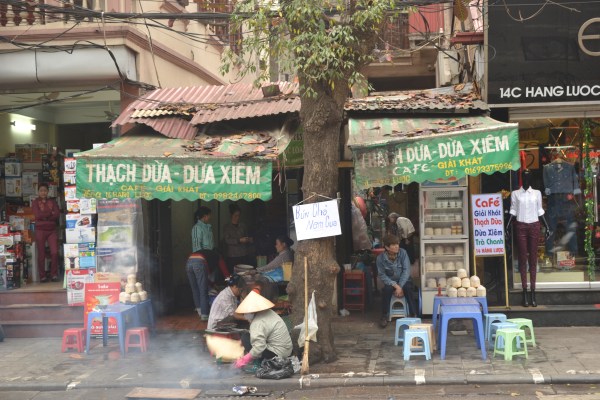
I felt self-conscious as I sat on the plastic stool on the pavement at the side of a busy intersection in the Old Town of Hanoi. I was the only Westerner and, although I am nobody’s idea of tall, seemed an ungainly mess of knees and elbows on that tiny stool, like an embarrassing father squeezing himself into a pedal car. The other customers, hunched over their bowls, took no notice.

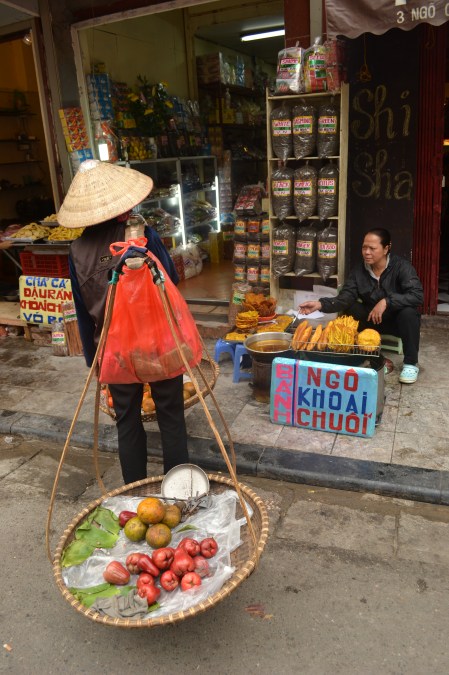
I had watched the vendor set up. She humped everything across town on a yoke on her shoulder, the big pot with the broth and the meatballs, the containers with rice vermicelli, spring onions and coriander, the bowls and the stools, which she laid out in a semi-circle, and a hand-drawn sign to tell passing customers that she was selling bún mọc.

She spoke no English and my Vietnamese had still not got beyond xin chào (hello), so I just pointed and she raised an index finger to confirm that I wanted one bowl. I nodded and she scooped a handful of noodles into the bowl, chopped a few stalks of coriander and sprinkled them over the noodles, then ladled in the pork broth and meatballs fashioned from minced pork and chopped shi-take mushrooms. She took up the cleaver again and clicked off a few slices of spring onion tops, scattered them over the top and handed the bowl to me.

Wherever I walked in the old town, I smelled pork grilling over charcoal at the little shops selling bún chả, Hanoi’s most iconic dish. The vendors marinate pork mince and belly pork overnight with fish sauce, soy sauce, honey, garlic, shallots and spring onion, then form the mince into patties like miniature burgers and cut the belly into strips and char-grill both. They blend fish sauce, sugar and vinegar with pork broth, heat it up and add the meat, then serve it to you with rice noodles and an abundance of greens. As often in Vietnam, you assemble it yourself at the table.

DSC_0164

Hanoi’s food vendors tend to do one thing and do it well. The restaurants along Chả Cá Street only do chả cá, nothing else. Chả Cá La Vong is the best known; so well-known that restaurants all over Hanoi have appropriated its name. It has been there for generations, making the same dish dozens of times every day.

I was expecting a menu, but I am not sure why when it was chả cá or eat somewhere else. Instead the waiter came with a sauté pan, sizzling with chunks of turmeric-coated fish, which he balanced on a fondue burner, then brought a bowl of rice noodles, a generous plate of herbs, and a ramekin of dipping sauce made with lime juice and chilli.

I was supposed to take over the cooking myself at that point but was not sure what to do, so the waiter, spotting my confusion, took a handful of herbs and dropped them in with the fish, and then when they had wilted, switched off the burner and left me to work out that the fish and the herbs went in the bowl with the noodles.

The chả cá was great, but then everything I had eaten in Vietnam had been great, from south to north, from Saigon to Hanoi and everywhere I had stopped in between; from smart restaurants to street food carts, from summer rolls wrapped in bus station cafes to lobster grilled on the beach. It seemed impossible to eat badly in Vietnam.

© Richard Senior 2016
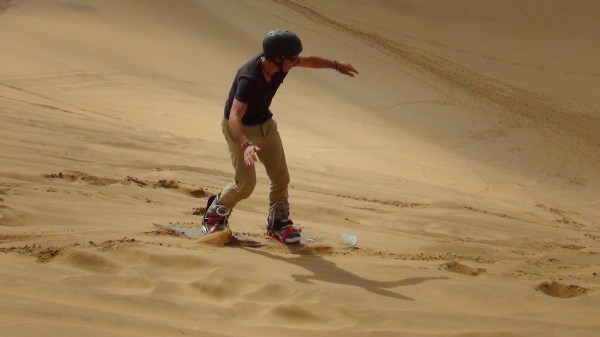
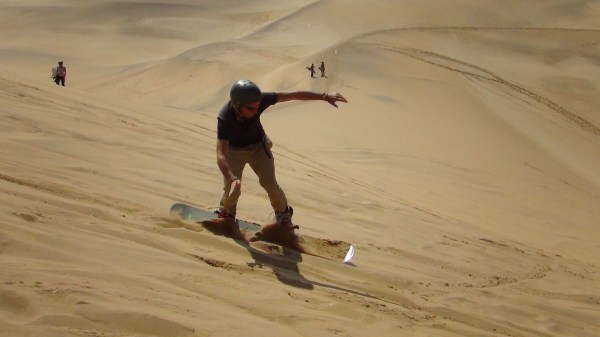
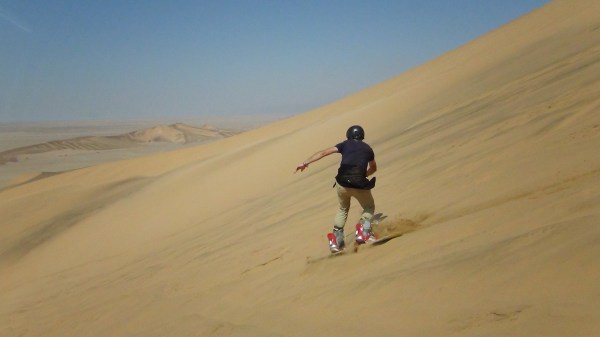
65km/h on a Sandboard

(120)

Swakopmund, Namibia. A mind-bending, hallucinatory place: an authentic slice of small-town Germany deep in Southern Africa. Cutesy, pastel-coloured Jugendstil buildings. Signs on store fronts in Gothic script, all umlauts and harsh consonants. A Lutherian church; a bierhaus selling good lager and sturdy plates of sausage and sauerkraut.

Leave town early in the morning in an old Volkswagen minibus. The sandboards strapped to the roof; a mangy dog standing on my knees so it can look out the window, wobbling as it tries to keep its balance.

Arrive at the dunes. Take down a sandboard, change into snowboard boots; trudge up the long curving track to the top. Grab a cloth, dip it in wax and smear it over the bottom of the sandboard. Find a place to sit at the edge of the slope.

(76)

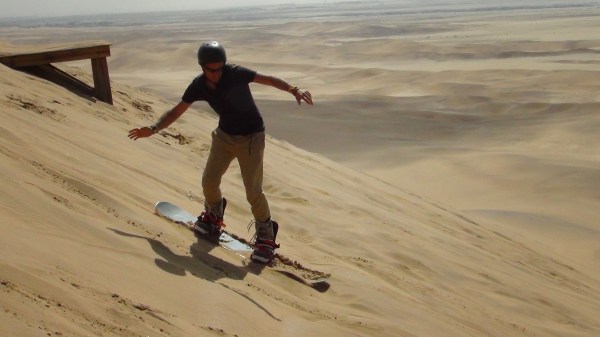
Third in line. The first guy struggles to stay on his feet, falls over a few times, wobbles, squats and touches the ground, as if reassuring himself it is there. The second is an experienced snowboarder and streaks down the dune at speed, slaloming round imaginary poles to show off.

My go then. Follow the instructions: turn my back to the slope, do a backwards roll. Straight away scudding diagonally across the dune, balancing better than expected.

Picking up speed. Halfway down. Much faster now; faster than feels comfortable on a first attempt. Shift my weight to my toes to slow the board; but it digs in and stops dead and the kinetic energy flings me forward onto the sand and rolls me like a barrel with the board still clipped to my boots.

(121)

Unclip from the board, spit out the sand, empty it from each of my pockets in turn, wipe the thick off my arms, then plod back up to the top of the dune.

You looked like a helicopter trying to take off sideways,” someone says.

I get further down the slope on my second run then come off again, but not as spectacularly. Land head-first. Glad of the pisspot helmet. But it rattles my brain nonetheless. On the third run – or it might have been the fourth – I glide all the way to the bottom and feel good. The snowboarder, by then, is doing jumps.

(222)

Move to a different slope, and a different, brutally straightforward, style of sandboarding. Take a big sheet of plywood, lay face-down on it, lift my feet, grab the corners and curl them up, then just hang on as the board careens down the slope. There is no slowing, or stopping, or steering, as there is with a proper sandboard: just staying on or coming off. It feels stupidly fast – I will find out how fast – and totally out of control, which I suppose it is, except I could bail if an unexpected springbok suddenly heaves into view.

Whisk past the guy at the bottom with the speed camera, heading for the run-off slope. Somehow hit it at the wrong angle, bury the board in the sand, fly a few metres then bury myself. Spit out the sand, shake it from my hair, rub it from my t-shirt, empty my pockets again.

65k,” the guy with the camera says.

© Richard Senior 2016
Journeys through the Rain

DSC_0639

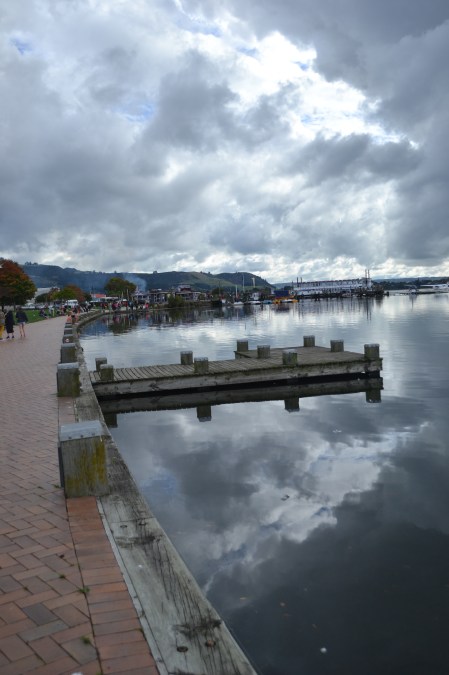
The rain had followed me all the way down the North Island. It didn’t rain all day, all every day, but it did rain every day, and some days it rained all day. Then I got to Wellington and it stopped, and stayed stopped as I took the ferry across to Picton and buses on to Nelson and then to Christchurch.

But it was raining again as the TranzAlpine Express pulled out of the station. I wondered whether its promise of “the trip of a lifetime” was meant to apply in all weathers, but I had not read it literally in any case.  It depends on the rest of your lifetime, I guess.

The train spent the morning threading its way through an operatic landscape from east coast to west, from Christchurch to Greymouth, and the rain spoiled none of it: not the illimitable mountains, not the great swathes of forest with splashes of yellow and brown in amongst the dark green of the pines, not the fathomless gorges, not the fast-flowing rivers way down below. I would not think to call it a trip of a lifetime, but it was a nice way to spend a morning in New Zealand.

It was drizzling in Greymouth, which suited it. The girl on the desk cheerfully admitted that hardly anyone stayed there anymore. There was a For Sale sign outside the hostel. A German couple were the only other guests. “I love NZ but not Greymouth” someone had written on the wood of a bunk in the dorm room I had to myself.

DSC_0893

It stayed fine, for a change, the next morning, as the InterCity bus chugged down the coast road and stopped off in the little town of Hokitika for a lunch break.

It stopped outside the National Kiwi Centre, which in the happily small-town way of New Zealand is a modest clapboard building, next door to Jeff Evans Plumbing. They had New Zealand eels, which they told me were anything from 85 to 100 years old and a tuatara, which they called ‘the oldest living dinosaur,’ as well as the kiwis, which I never managed to pick out of the simulated darkness.

The rain started to slap against the windows as the bus continued south to Franz Josef, where I had a hostel booked. It felt like a ski resort with its log cabins, chalets and homely wood smoke. The air was mountain fresh.

There was an anonymous poem from the nineteenth century framed on the wall of the hostel. It was simply called The Rain:

It rained and rained and rained.

The average fall was well maintained 

And when the tracks were simple bogs 

It started raining cats and dogs. 


After a drought of half an hour 

We had a most refreshing shower 

And then most curious thing of all 

A gentle rain began to fall. 


Next day but one was fairly dry 

Save for one deluge from the sky 

Which wetted the party to the skin 

And then at last the rain set in.  

Franz Josef Glacier was hidden behind cloud, so there was nothing much to do but go to the Glacier Hot Pools. There are three pools in the middle of a rainforest with glacial water heated to 36, 38 and 40 degrees. It is open air, but with a canopy to keep out the rain.

I only had time, in the morning, to see the glacier from the bottom of the mountain, but it was still impressive from there: a bluey-white torrent of water, eight miles long, stopped and frozen, filling a crevice in the mountain like expanding foam.

I got back on the bus, then, for the last time, for a final dash south to Queenstown. It was an eight-and-a-half-hour run, but I had got used to spending all day on a bus by then.

DSC_0928

Needless to say, it was raining. But if it blurred the sky into a miserable smudge, it at least made the waterfalls dramatic. The driver stopped, briefly, to let us get out and scramble through the forest to go look at one.

The road twisted inland, past Mount Cook, and wound tightly round the mountains – sharp right, sharp right, sharp right, sharp left – and the driver kept the speed up, taking a racing line in the big old bus when he could see far enough in front.

In the late afternoon, we shot over the Shotover River and pulled into a car park in Queenstown.

© Richard Senior 2016
Casablanca’s Forgotten Colonial Heritage

DSC_0745 edit

Just as the muezzin began the call to prayer, a man lurched into the middle of the boulevard, swayed like a palm in the wind, then tottered diagonally at speed to the pavement and collapsed at the feet of another man sitting outside with a café noir. He pretended not to notice.

Casablanca is not Morocco,” said the novelist, Paul Bowles, in 1966, “it is a foreign enclave, an alien nail piercing Morocco’s flank”. It is different, for sure, from the rest of Morocco, but it is as much Morocco as Marrakesh, and as interesting in its way. It is just not the Morocco the tourists expect.

There is an ancient Medina, but it is not much to look at and the tourists hurry away disappointed and urge others not to go. They miss the point, though. Casa is not about souks and snake charmers, carpet shops and donkey trains: it is about the ville nouvelle.

DSC_0750 edit

The French meant the new town to be a shop window for the Second Empire. General d’Amade let slip the scale of their ambition in 1928 when he wrote that, “by the end of the century, French North Africa will be the United States of today, with Casablanca stepping into the shoes of New York”. Of course, that was not quite how it worked out.

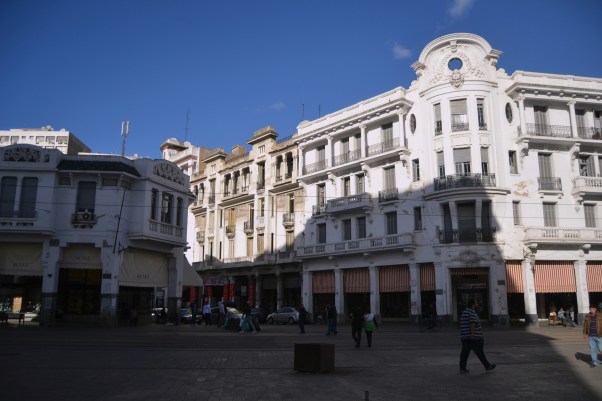
Planners and architects, frustrated by the conservatism of the authorities in France, flocked to Casablanca where they were free to do more or less what they liked. They schemed grand boulevards, lined with palm trees, connecting to monumental squares. They imported Art Nouveau and Art Deco and blended in classical Moroccan touches to create a Néo-Mauresque style of their own.

Jean Vidal’s short film, Salut Casa, shows what Casablanca had become by 1952: a beautiful, bustling city with spotless streets and gleaming white facades, and honking cars, dozens of bicycles and the occasional camel, and pavement cafes, grand arcades and luxury shops.

DSC_0760

The streets are not spotless anymore; the facades no longer gleam.

Boulevard de la Gare was the grandest of the grand boulevards in colonial times, stretching proudly from Casa Voyageurs station to the old Medina with upmarket shops beneath its porticos and marble-floored arcades leading through to adjacent boulevards. The luxury shops are long gone from what is now called Boulevard Mohammad V.

At the station end of the street, the rusting shutters look as if they were rattled down decades ago; the signs are from a bygone age. One shop has been gutted behind the grille and filled up with 10, 15, goodness-knows-how-many years of Coke cans, cigarette packets, fast food containers and rubble, all coated with a thick layer of grime. Ruined men lounge in doorways and rummage in bins. Kids kick a scuffed football between the walls of an alley.

DSC_0777

But to fixate on how much the ville nouvelle has declined is to see the glass half-empty. The point is how much has survived.

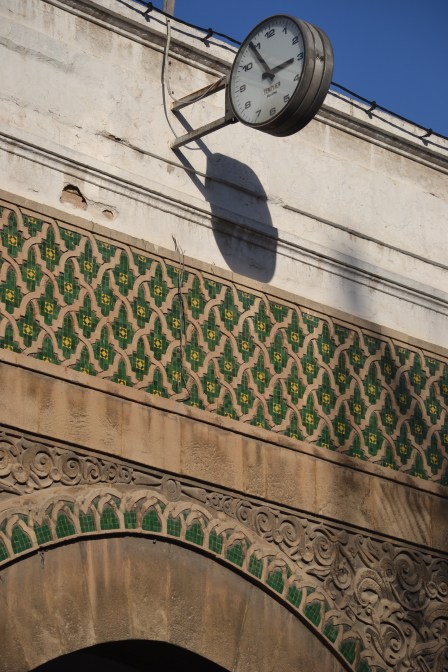
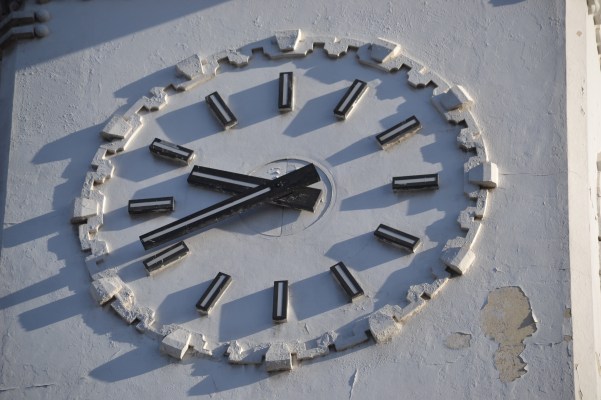
Casa Voyageurs’ clock tower can still be seen way down the boulevard, just as the planners intended in 1923. It is always half past two, twenty to six or a little before quarter to ten, depending which clock face you check. The monumental buildings which the camera panned across in Salut Casa are by and large still standing.

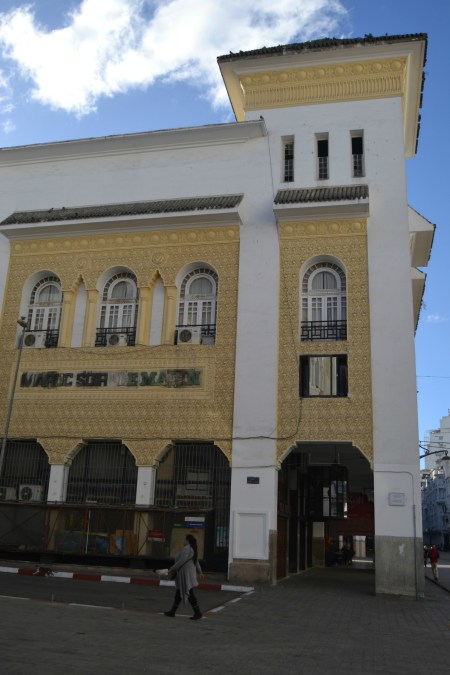
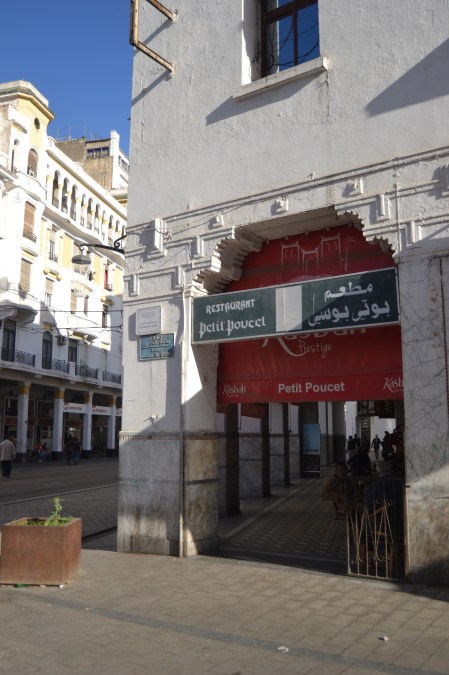
Restaurant Petit Poucet is much as it was under the French Protectorate, with the original bar which Albert Camus, Antoine Saint-Exupéry and Édith Piaf have all leant against.  At the end of the block is the Maroc Soir and Le Matin newspaper offices. A few letters have dropped off the facade, so Le Matin is now just  e Ma  n, but it is a nice example of Casablancan Néo-Mauresque, as is the Central Market across the road with its keyhole-shaped arch and green zillij tiles.

DSC_0753

Avenue Hassan II still has dazzling white Art Deco buildings, the town hall, the law courts and the Main Post Office from 1918 with its columns and arches and a frontage of zillij tiles in emerald green, royal blue and gold

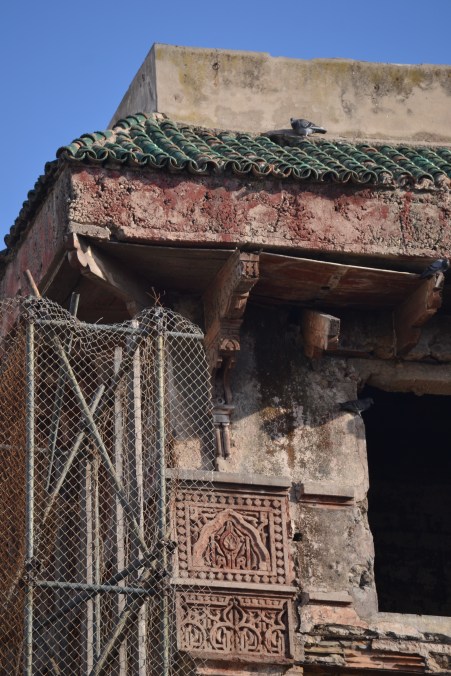
You could lose a day wandering the streets in the scalene triangle between the Medina, Parc de la League Arabe (the French called it Parc Lyautey) and the Central Market, remembering to look up to see curving balconies, zillij tiles, ornate brise-soleil, entrance gates worked into the shape of peacocks and bouquets of flowers, ghost signs from the days of the Protectorate, and the huge stone crown topping La Princière salon de thé.

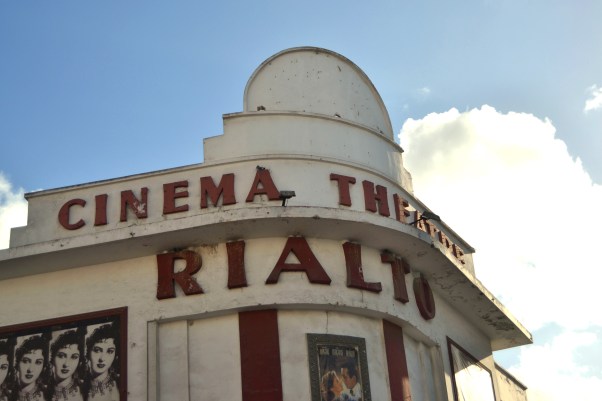
There is a hint of a renaissance in downtown Casa. The Art Deco Cinéma Rialto and half a dozen period hotels have been beautifully restored inside and out. The new tramway has thinned out the cars whose exhausts had been filthying the grand old buildings since colonial times.

DSC_0748 edit

But there is a tension between those who want to preserve the heritage and those who have to pay for its upkeep. The old Hotel Lincoln is emblematic.

It was the first landmark building on Boulevard de la Gare, a masterpiece of Néo-Mauresque. But it lost its lustre after the French left in 1956 and the owner has, reportedly, wanted to tear it down for decades so that he can build an office block. Campaigners persuaded the authorities to list it as a historic monument, and since then it has been left to rot.

The roof caved in a long time ago; one floor collapsed in 1989 and killed two people, another section fell down in 2004, killing a homeless guy who was sheltering inside, another in 2009, and yet another in 2015. Only the crumbling walls of the central section survive…for now*.

DSC_0730

Casa’s future is hard to predict. It could become an African Valencia with its Art Nouveau and Art Deco facades rejuvenated, or it could be another Coventry: a city which once had buildings worth seeing.

© Richard Senior 2016
*2020 UPDATE: The facade of Hotel Lincoln is now being preserved and rebuilt as part of a new 5 star hotel project by a French consortium

Eating up Vietnam #4: Huế


Copy of DSC_0079e

Mr Cu is an excellent photographer. The walls of his restaurant, the Mandarin Café, are crammed with his shots of the people and places of Vietnam. He is a sociable chap, speaks good English, and makes a point of chatting to his customers. He gives them all a postcard of one of his photographs.

I stayed next door, in the cheekily-named Google Hotel, and stumbled into the Mandarin Café each morning for coffee and a bowl of the city’s famous noodle soup, bún bò Huế.  It is made with beef shank and pigs’ trotters simmered with lemongrass, onion and shrimp paste, then flavoured with fish sauce, sugar and a wallop of chilli powder, poured over round noodles and sprinkled with herbs.

Huế was Vietnam’s imperial capital, until the last emperor abdicated at the end of the Second World War, and there are restaurants across town offering elaborate, expensive, banquets of dishes which they claim were traditionally served to the imperial family, all arranged into the shape of peacocks, elephants and such like. It is impressive enough, but not really what I was there for. The street food interested me a whole lot more.

On the banks of the Perfume River, in the shadow of Eiffel’s Trường Tiền Bridge, there is a bustling night market with food carts and picnic tables crowding the pavements. The grills smoke, the prawns sizzle, the vendors shout, the customers jostle, and the aromas fill the air. I ate banh khoai – happy pancakes – as I nosed round the stalls.

The batter is made with rice flour, a good pinch of turmeric, which turns it yellow, and sugar and carbonated water which help it to crisp up on the hotplate. It is stuffed, then, with prawns, pork belly, beansprouts, spring onion and shredded carrot and folded like an omelette.

DSC_0038

I happened upon a restaurant, the next day, a few blocks from the river, which looked run-down enough to be good and ordered nem lui, ground pork and pork skin mixed with garlic, sugar and fish sauce, shaped into sausages, skewered with lemon grass and grilled over charcoal.

It came with a pile of rice papers, lettuce leaves, herbs and cucumber slices and a deceptively complex dipping sauce made with hoisin and fish sauces, chopped pork liver, toasted peanuts and peanut butter. The idea is to force the meat off the skewer with your chopsticks, roll it and some of the leaves and vegetables in the rice paper, then dip it in the sauce.

I got so engrossed in poking about in the ruins of the imperial citadel that I forgot all about having lunch, but bánh bèo from a roadside stall kept me going until evening. These delicate steamed rice cakes are topped with a mixture of chopped prawns and crumbled dried shrimp, pork crackling and sliced spring onions and dressed with nuoc mam sauce, made with rice vinegar, fish sauce and sliced chillies.

Dinner, then, was cơm hến: a bowl of rice topped with tiny clams, sliced spring onion, julienned apple, crispy pillows of fried pig skin and a handful of herbs, served with a jug of clam broth to add to taste.

I had eaten well in Huế but could not help thinking, as I continued north, that I had only tried a small sample of its regional dishes. Never mind. There was Hanoi still to come.

© Richard Senior 2016