A Morning in Hanoi’s Old Quarter

DSC_0077

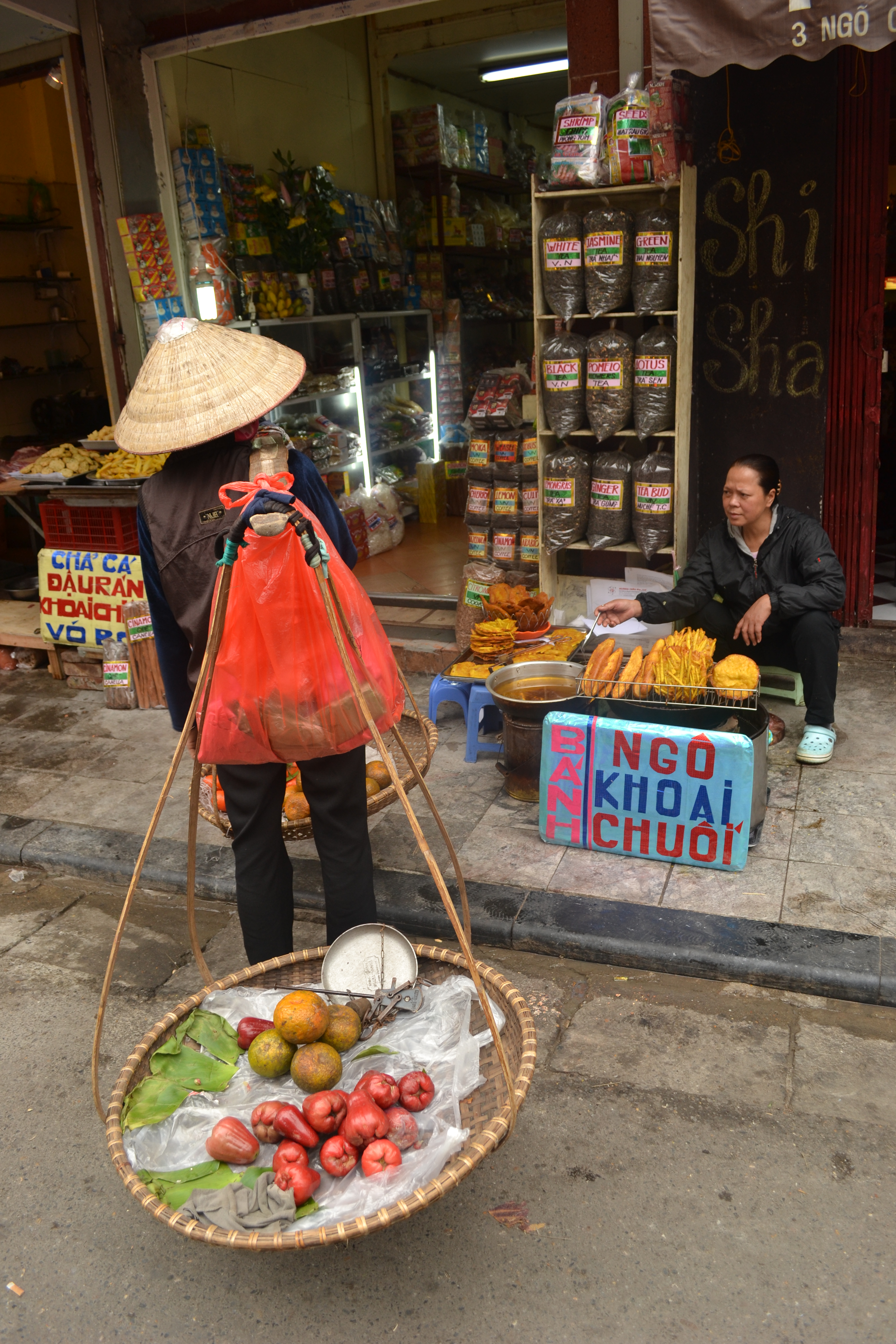
Scooters wail through the tangle of alleys, weaving round ladies in conical hats with yokes balanced over their shoulders and old pushbikes half-buried under baskets of fruit and slowly perambulating cyclos. The sound reverberates off the walls of the decaying colonial buildings with their sagging awnings and missing windows and roofs bodged up with corrugated iron.

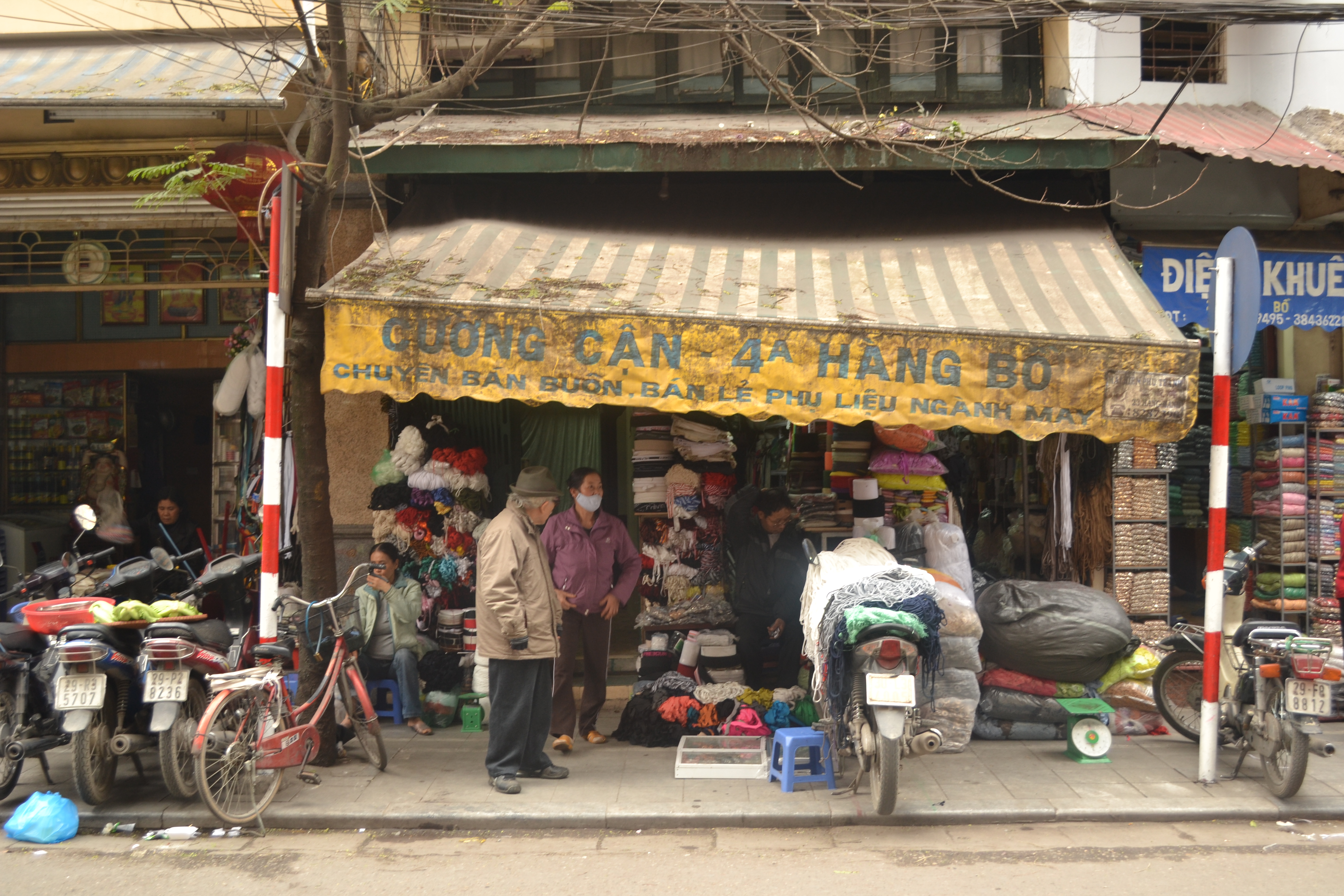
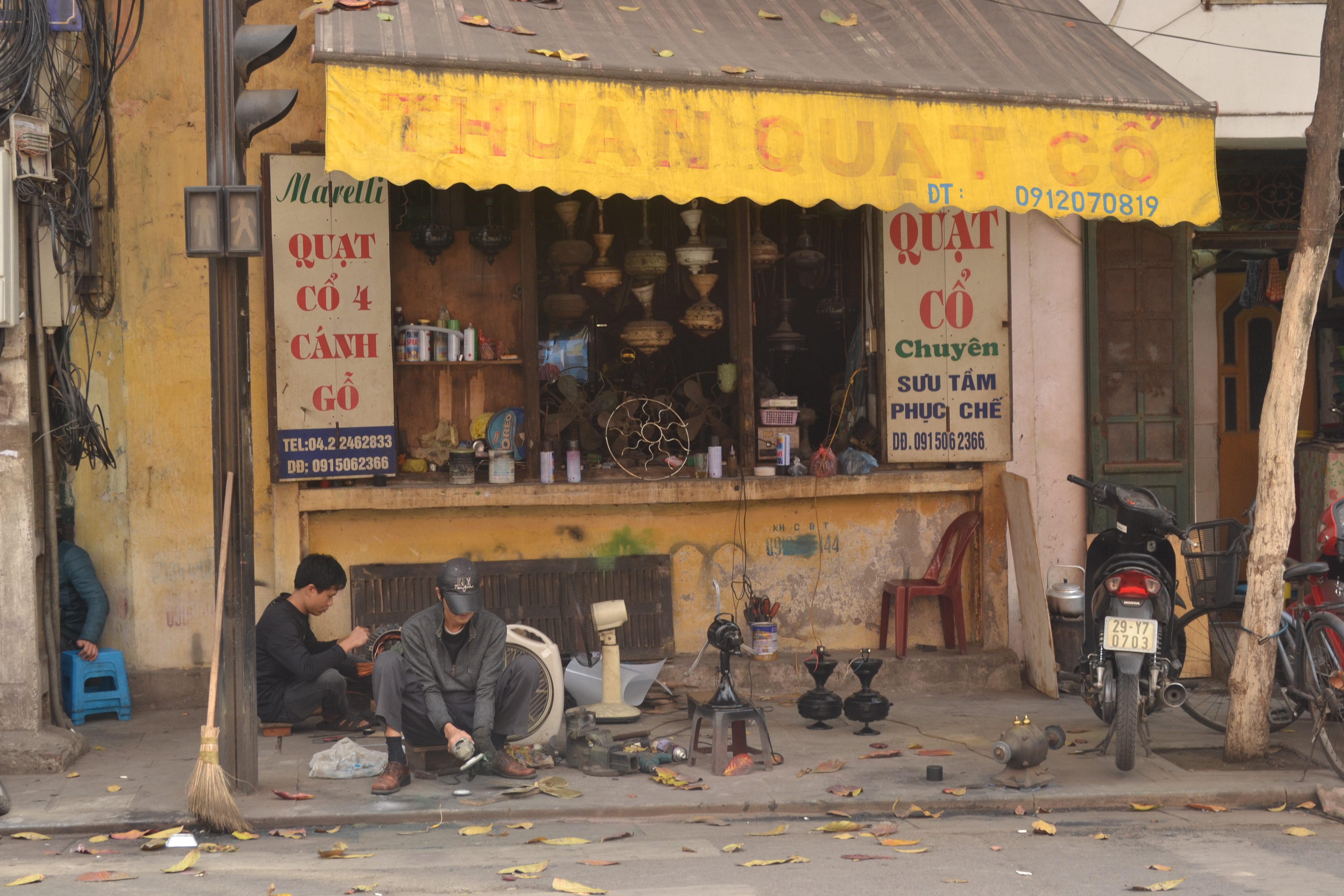
Traders spill out of their shops and fill the pavements with mannequins, fridges, anvils and circular saws. Women sit cross-legged, shaving pigs’ trotters and scaling fish with cleavers; men kneel over sheets of stainless steel, hammering, grinding, welding, drilling, and fashion them into boxes and bins. Street food vendors arrange tight circles of miniature stools on any available corner. There is nowhere to walk but in the road with the scooters.
DSC_0093

One shop sells nothing but heaters. Next door sells nothing but fans. Three doors further on sells lightbulbs. Two doors beyond that sells adaptors and leads. You go to one side of the road when your scooter needs tyres, to the other when it needs a new seat. And if it needs a new mirror as well, then you nip across town to the French Quarter. There are two streets on which every shop sells metal boxes, one street reserved for flowers and one for bamboo poles. Padlocks and door handles have half a street each, as have cooking salt and caged birds. Shoes get a crossroads of their own, but trainers, flip-flops and football boots have to share with army surplus. Musical instruments are lumped together with antiques, on the hunch, perhaps, that people who play instruments are likely to collect antiques.
DSC_0406

Chả Cá Street is named for the single dish which the restaurants along it sell. The best known is Chả Cá La Vong, so well known that restaurants all over town have ripped off its name. It is a poky little place with a rickety staircase leading up to a room with the look and atmosphere of a rowdy works canteen. Though it is in all the guidebooks and on every food blog, most of the other customers are shirt and tie locals. There is no menu, because chả cá really is all they do. They don’t see the need – as a restaurant would at home – for novelty chả cás or alternatives for people who go to a chả cá restaurant but don’t really care for chả cá.

The waiters bring the chả cá in relays. First, a sizzling fondue pot filled with turmeric-stained fish. Then, as that hisses and crackles in the middle of your table, a bowl of rice noodles. Then a ramekin of dipping sauce, a plate of crushed peanuts and a handful of herbs, which the waiter dunks in with the fish to wilt, and leaves you to assemble it when the fish and the herbs are done.

(c) Richard Senior 2014
The Washing Machine Delivery Man of Huế

DSC_0751

An old man wobbled across the Perfume River on a scooter held together with duct tape and rust. He had a washing machine strapped to his pillion seat and a toolbox balanced on his knee.

A month or so earlier, I had seen a family of three on one scooter – no helmets – on the motorway heading out of Bangkok. Then I saw a family of four, husband, wife and two kids; and I thought that was as many as could squeeze on a scooter, until I crossed into Cambodia and saw five.

The scooters in Phnom Penh scuttle in random directions, like a colony of evicted ants. They make crossing the road an adrenalin sport as they streak past you, too close, performing the horn concerto.

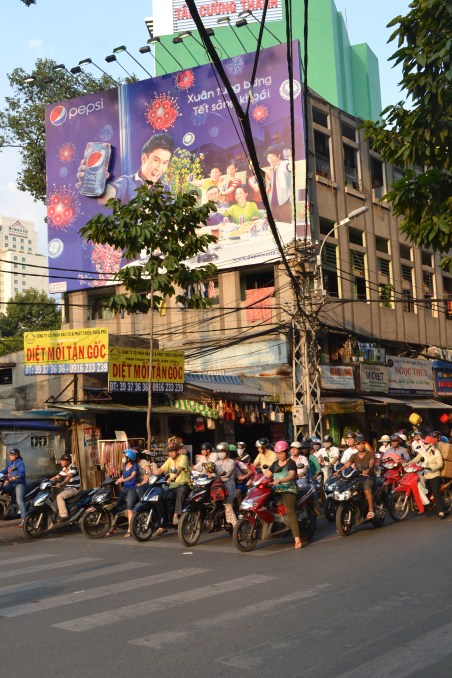
But Cambodia is Switzerland compared with Vietnam. “Seven million people in Saigon,” a guy told me, “and four million scooter”. They swarm like a nightmare of wasps, a cacophony of tiny horns beeping, enough two-stroke motors revving together to outroar a Hell’s Angels convention. They stop for no one, for nothing.

I stood at the lights and wanted to cross but could not see how. Red and green were all the same to the scooters. Then a little old lady in a conical hat with more than her body weight slung from a yoke on her shoulders stepped into the traffic and tottered across while the scooters flowed round her as a river flows round a rock. That is how.

Motorbike taxi drivers lined the side streets touting for business. “Motta bi’, motta bi’” one shouted to me as he jabbed excitedly at his motta bi’. “I know, mate,” I said “I’ve seen one before”. “Marry wanner?” he offered, but I declined that as well. “Lady massage?” That too.

As I made my way up Vietnam, through Laos and back into Thailand, I saw scooters half-buried under bouquets of flowers, and piled up with boxes or water cooler bottles, and a pillion passenger with his arms at full stretch to steady a car bonnet on his lap, and office girls sidesaddle on motorbike taxisapplying their lipstick as they threaded through traffic, and tiny kids blasting down dusty lanes, and the washing machine delivery man crossing the bridge in Huế. 

(c) Richard Senior 2014

Classic travel scams #2: You Didn’t Pay for Last Night

DSC_0358

You didn’t pay for last night,” said the guy on the desk at the guest house in Vang Vieng.

Yes I did.”

“No.”

But I found the receipt screwed up in the bottom of my bag and that was the end of that.

I might have assumed that it was all a mistake if he had not then said exactly the same to the Israeli backpackers who went to the desk after me. They didn’t have a receipt and had a minibus waiting outside, so they had to pay again.

You didn’t pay for last night,” said the lady in the guest house in Luang Prabang a few days after that, and we both knew that I didn’t have a receipt because she had been on the desk all the time. I argued the toss but ended up paying again, and spent the rest of the day in a filthy mood because I ought to have known better by then.

(c) Richard Senior 2014

Escaping Patong

DSC_0115 (2)

I was tired of the babel of English, Russian, German and French, never Thai; of the fat farangs; of the burgers and Heineken; of the parasols laid out in uniform rows.  

So I walked away from the resort and over the hill, about as far as I could get in flip-flops, and stopped at a beach which was smaller and tattier than Ao Patong. It was dotted with stones and bits of dropped litter and things which had washed from the sea. There were no deck chairs or jet skis, and no hawkers came round with sunglasses, watches, ice cream or beer.  I was the only farang there.

I sat and I watched as the tide crept further up the beach and the sun began to fall and it drew a line across the sea and lit the wet sand at the margin. I watched the fishermen set off in their long-tail boats with old car engines spinning long propeller shafts dipped in the sea. The vendors up the hill were grilling fish and the smell drifted down towards me.

A pick-up arrived with a group of Thais in the back, students I think. They jumped out and scampered across the beach and jumped in the sea fully clothed. They were as happy as children, squealing and shouting in the waves, and splashing each other, until the driver beeped his horn and they scampered back and left.

The sun had slipped further by then, backlighting the clouds and silhouetting the fishing boats and the mountains behind them. I could see across to Ao Patong, where the deckchairs were still laid out in neat rows, and the jetskis still chased across the water, and a parasailer floated a few hundred feet above a powerboat tearing round the bay. It was too far away, though, for the English and Russian and German and French voices to reach me, too far away to pick out the hawkers selling sunglasses, watches, ice cream and beer.

I stayed until the last of the sun leaked from the sky and I could barely make out the mountains and boats in the distance. Then I made my way up to the street food stalls and bought fish and rice and a Singha beer and ate at a table with locals.

(c) Richard Senior 2014